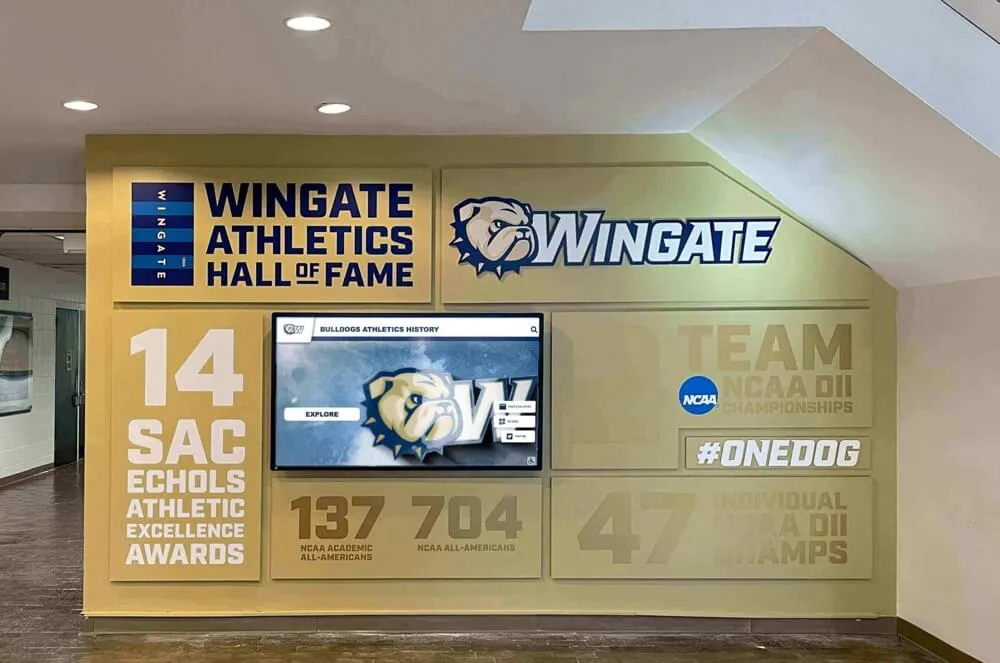
Establishing a hall of fame program represents one of the most meaningful ways schools celebrate achievement and preserve institutional legacy. Yet many administrators struggle with fundamental questions: What criteria should govern inductions? How do we ensure fairness and consistency? Who makes selection decisions? And once inductees are chosen, how can we present their achievements in ways that inspire current students while honoring past accomplishments?
These questions matter because hall of fame programs shape institutional culture, influence alumni engagement, and define how communities remember excellence. A well-designed selection process builds credibility and trust, while thoughtful presentation through digital displays ensures recognition reaches broad audiences and remains relevant for decades.
This guide explores both dimensions of successful hall of fame programs—the selection criteria and processes that identify worthy inductees, and the digital display technologies that bring their stories to life for current and future generations.
Understanding Hall of Fame Selection Criteria
Hall of fame induction criteria vary widely across institutions, but successful programs share common principles that balance achievement recognition with program sustainability and community engagement.
Categories of Achievement
Most comprehensive hall of fame programs recognize multiple achievement categories rather than limiting recognition to a single dimension:
Athletic Excellence
Athletic achievement remains the foundation of most school halls of fame, typically requiring performance that distinguished individuals or teams at conference, state, or national levels. Common athletic criteria include:
- All-state, all-conference, or all-American selections
- State or national championship participation
- School records that demonstrate sustained excellence
- Professional or collegiate athletic success after graduation
- Coaching achievements that elevated programs
- Contributions to athletic program development
Schools commonly require athletes to have graduated at least five to ten years before becoming eligible, allowing achievements to be evaluated in historical context and ensuring recognition reflects lasting impact rather than recent popularity.
Academic Achievement
Academic halls of fame recognize scholarly excellence and intellectual contributions, often including:
- Valedictorian or salutatorian honors
- National Merit Scholar recognition
- Academic All-American status
- Scholarship recipients of prestigious national awards
- Advanced research contributions or publications
- Distinguished professional careers in academic fields
Many schools find that academic recognition programs strengthen institutional identity beyond athletics, demonstrating commitment to comprehensive excellence.
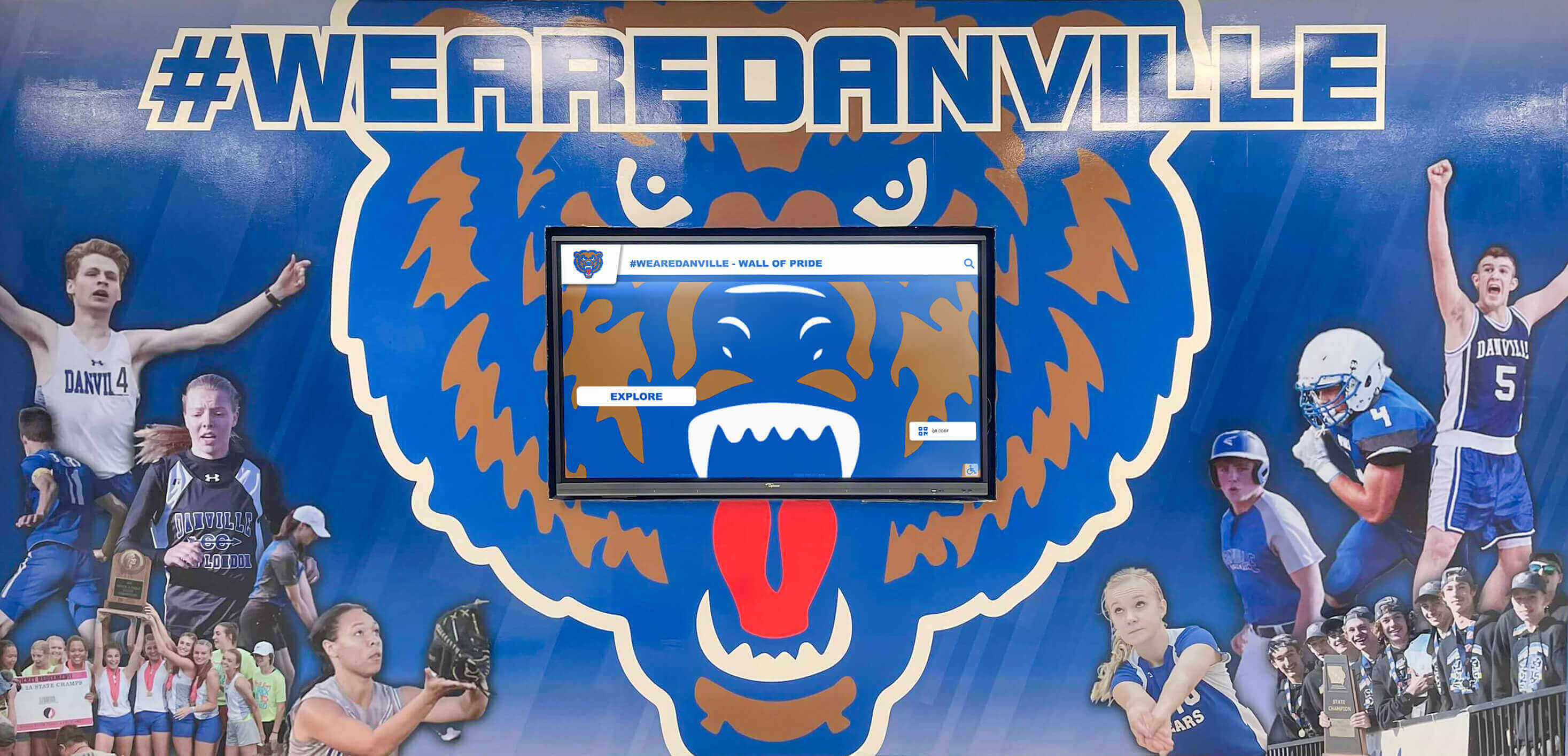
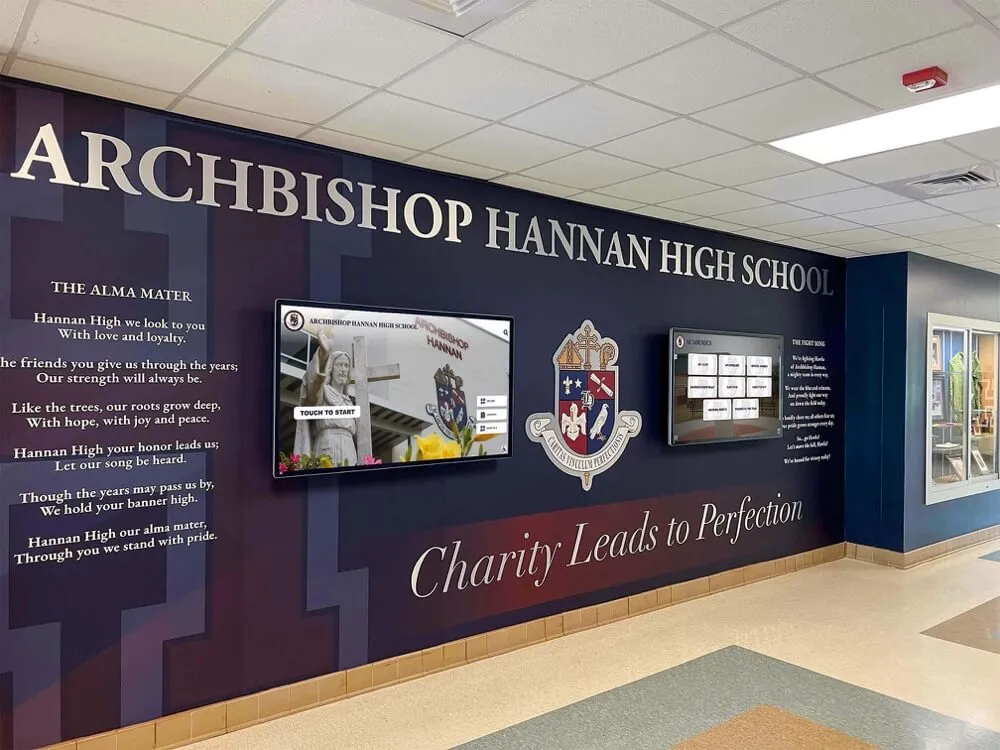
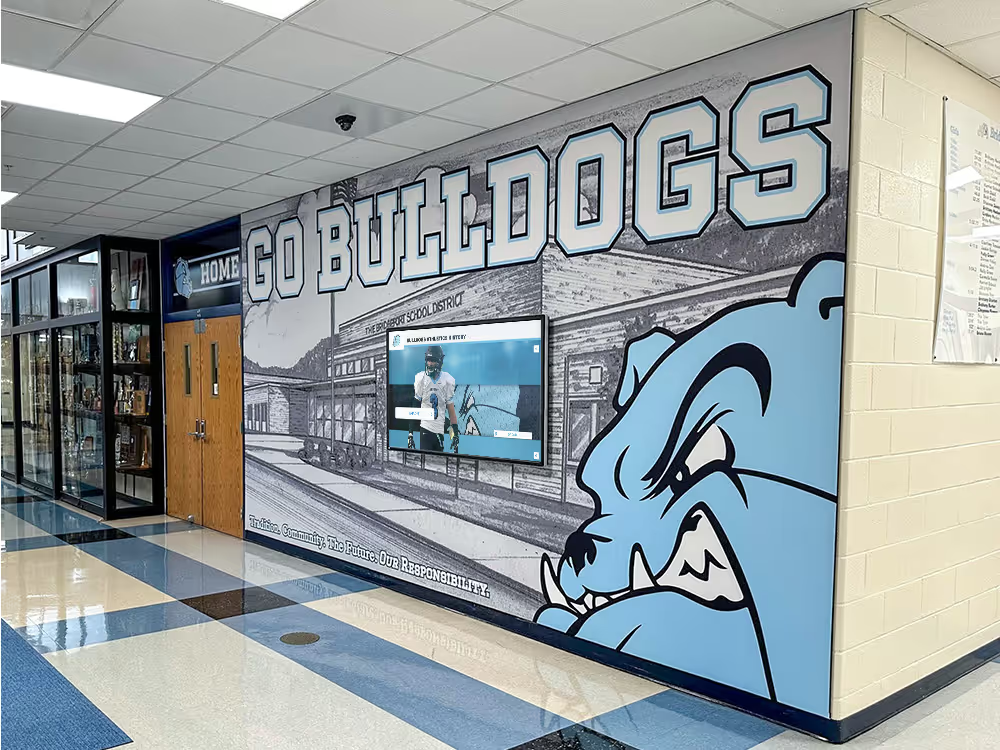
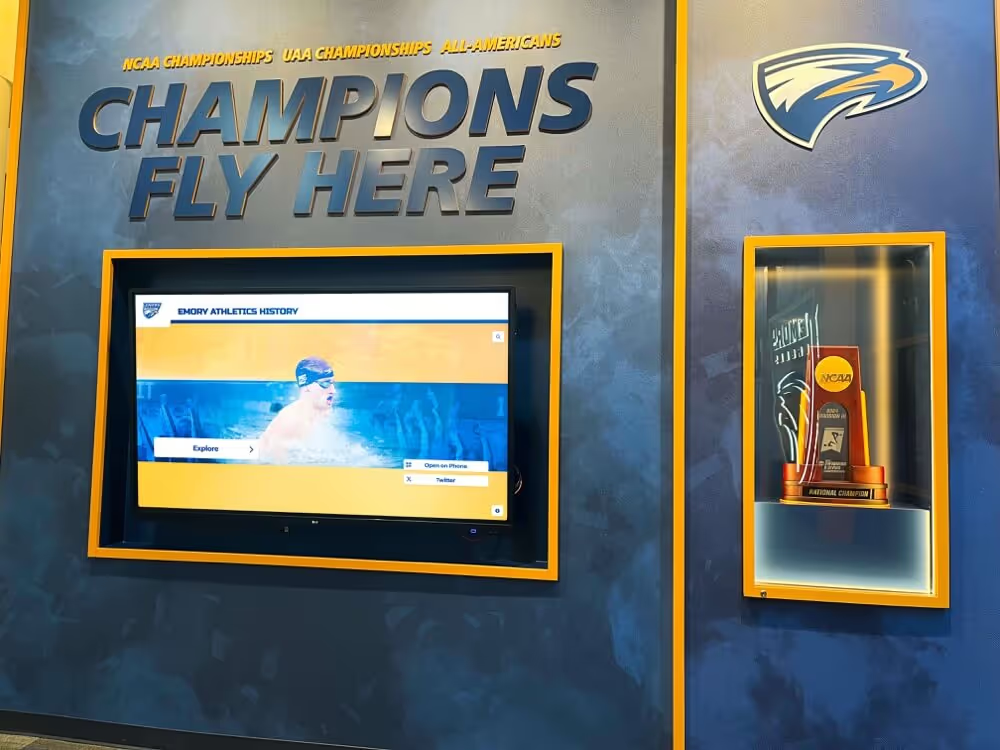
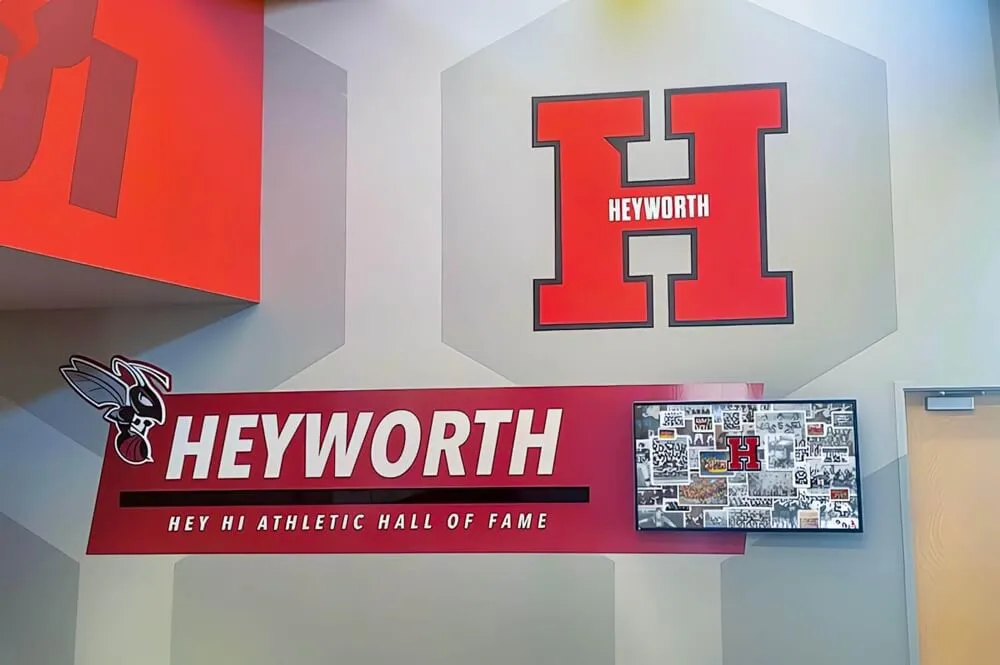
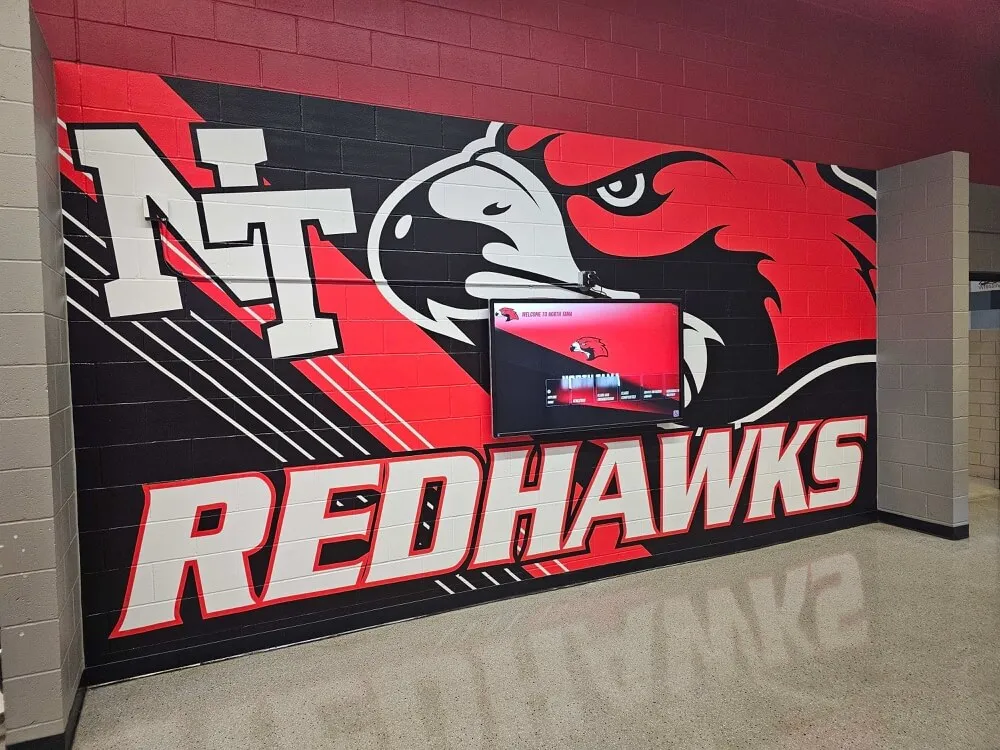
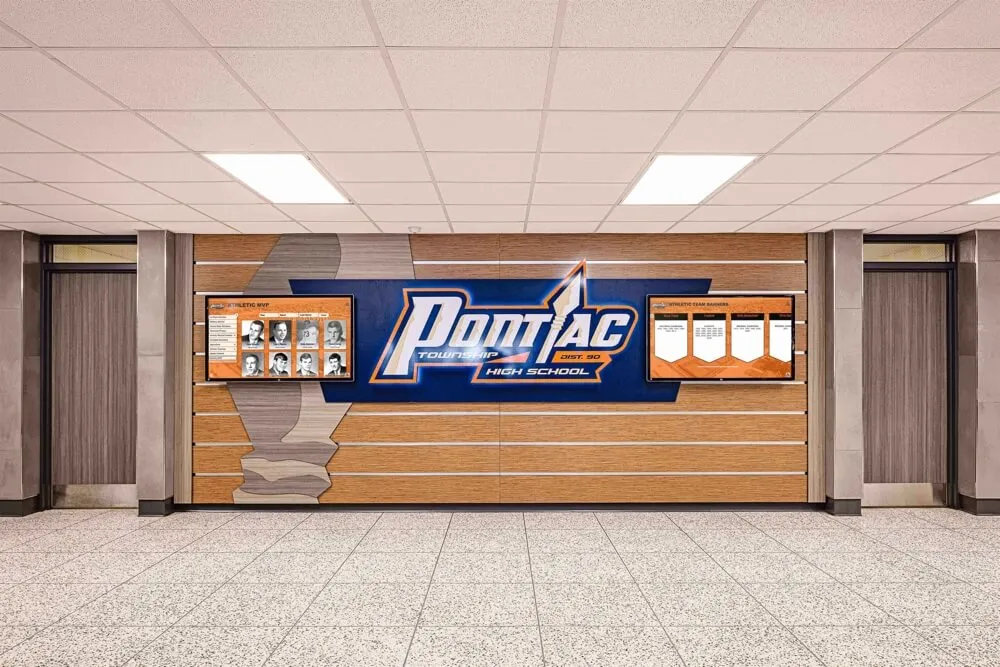
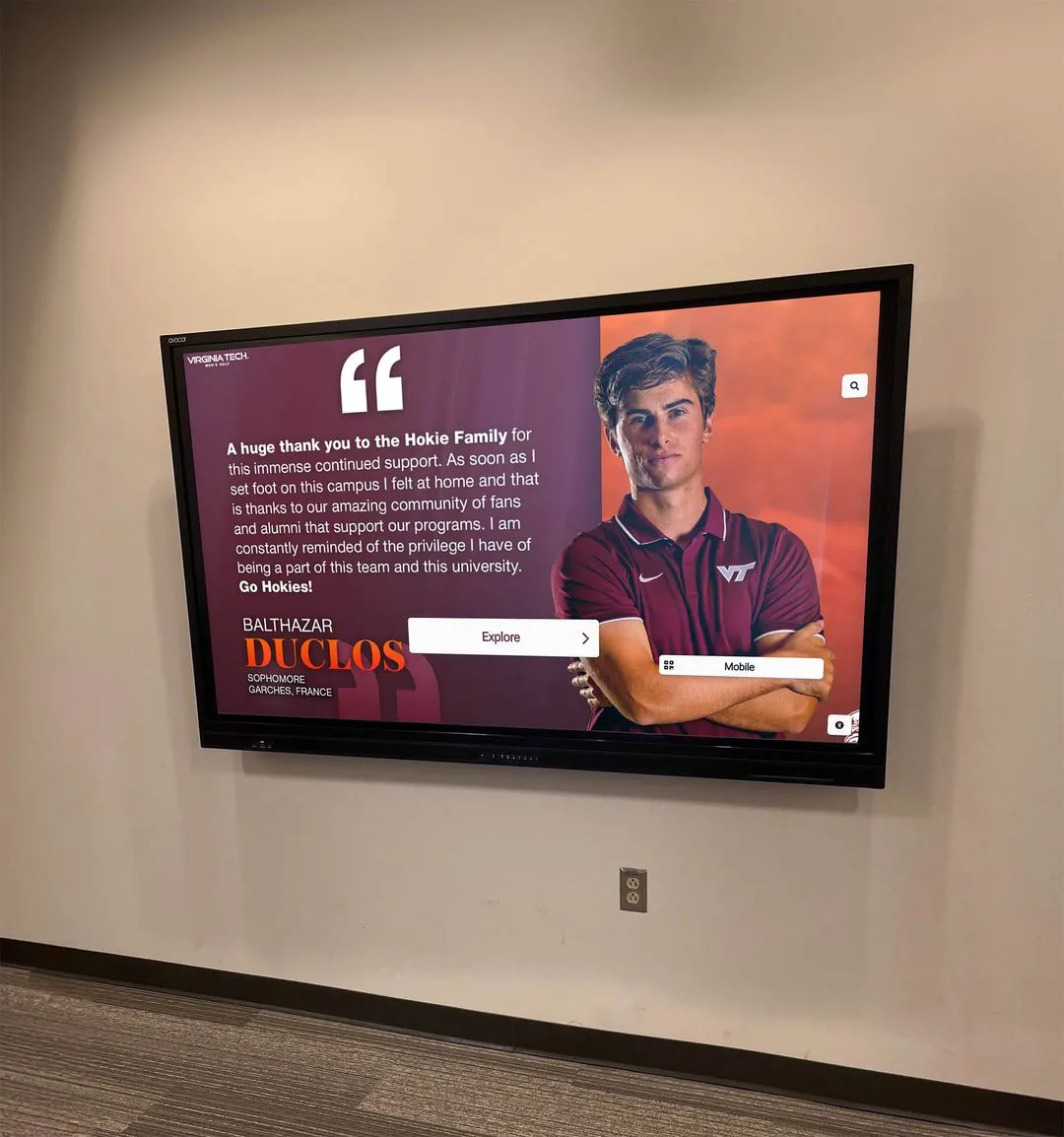
Digital displays integrate hall of fame recognition with school branding, creating cohesive institutional pride throughout campus facilities
Professional Distinction
Alumni halls of fame frequently honor career achievements that bring prestige to institutions, such as:
- National or international recognition in professional fields
- Leadership positions in major organizations or industries
- Entrepreneurial success and business achievement
- Public service contributions and civic leadership
- Arts, entertainment, or media accomplishments
- Scientific or medical breakthroughs
Professional achievement criteria typically emphasize accomplishments that reflect positively on the institution and demonstrate how education contributed to later success.
Service and Contribution
Service-based recognition honors individuals who contributed significantly to the school community, including:
- Long-term faculty or staff service
- Major philanthropic contributions
- Volunteer leadership in school organizations
- Community advocacy benefiting the institution
- Coaching or mentoring impact
- Program development that created lasting value
Service criteria acknowledge that hall of fame worthiness extends beyond personal achievement to include those who helped others succeed.
Setting Minimum Eligibility Standards
Clear eligibility standards prevent confusion and ensure consistent application of criteria across candidates. Effective standards typically address:
Time Requirements
Most programs establish minimum waiting periods between graduation and eligibility, commonly ranging from five to fifteen years. Waiting periods serve several purposes:
- Allow achievements to be evaluated in historical perspective
- Ensure recognition reflects sustained excellence rather than momentary success
- Enable evaluation of post-graduation accomplishments
- Reduce recency bias in selection decisions
- Create distance between personal relationships and objective assessment
Athletic programs often require shorter waiting periods (5-10 years) while professional achievement categories may require longer timelines (15-20 years) allowing careers to develop sufficiently for evaluation.
Achievement Thresholds
Specific achievement thresholds prevent subjective judgments and create transparent standards. Effective thresholds include:
- Quantitative measures: “First Team All-State selection” or “NCAA Division I scholarship recipient”
- Comparative standards: “Top 5% of graduating class” or “School record holder”
- Recognition-based criteria: “State championship participant” or “National Merit Scholar”
- Duration requirements: “Four-year varsity letter winner” or “Three-year team captain”
Schools implementing athletic halls of fame find that clear achievement thresholds reduce selection controversy and build community confidence in program integrity.
Character and Conduct Standards
Many halls of fame include character requirements ensuring inductees exemplify institutional values. Character criteria often specify:
- Sportsmanship and ethical conduct during school years
- Positive community reputation following graduation
- Absence of serious misconduct or criminal behavior
- Embodiment of school values and mission
- Positive role model status for current students
Character standards protect institutional reputation while acknowledging that hall of fame status carries ambassadorial implications.
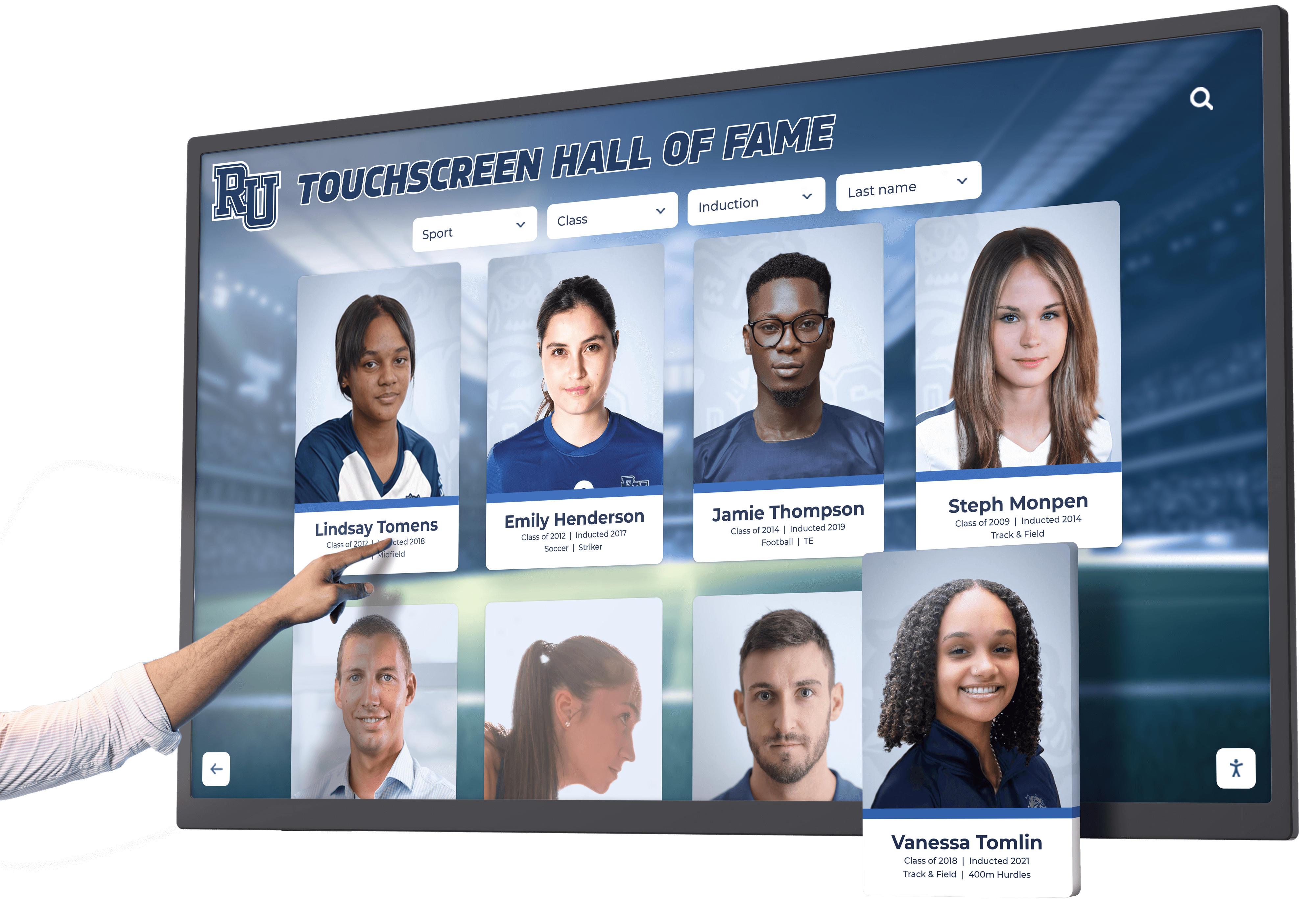
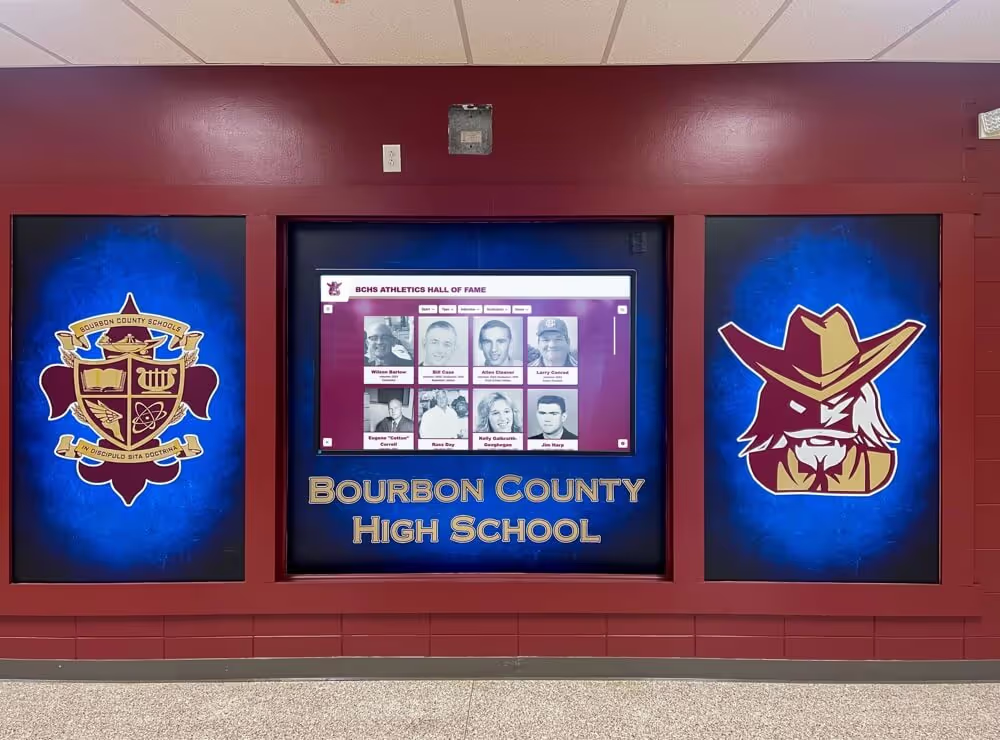
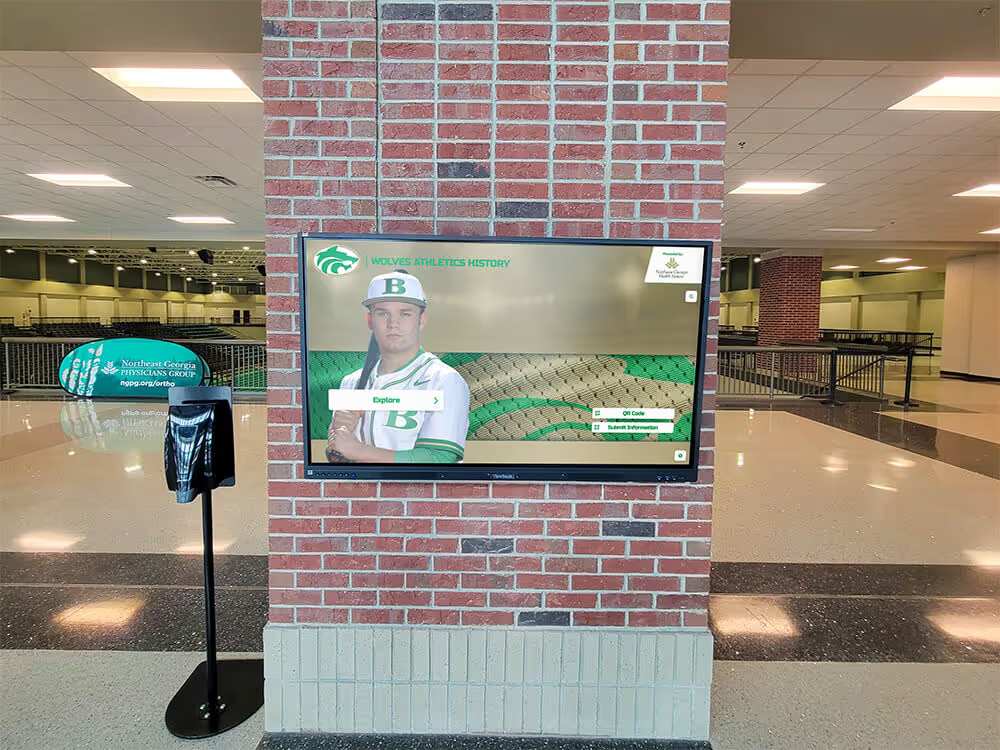
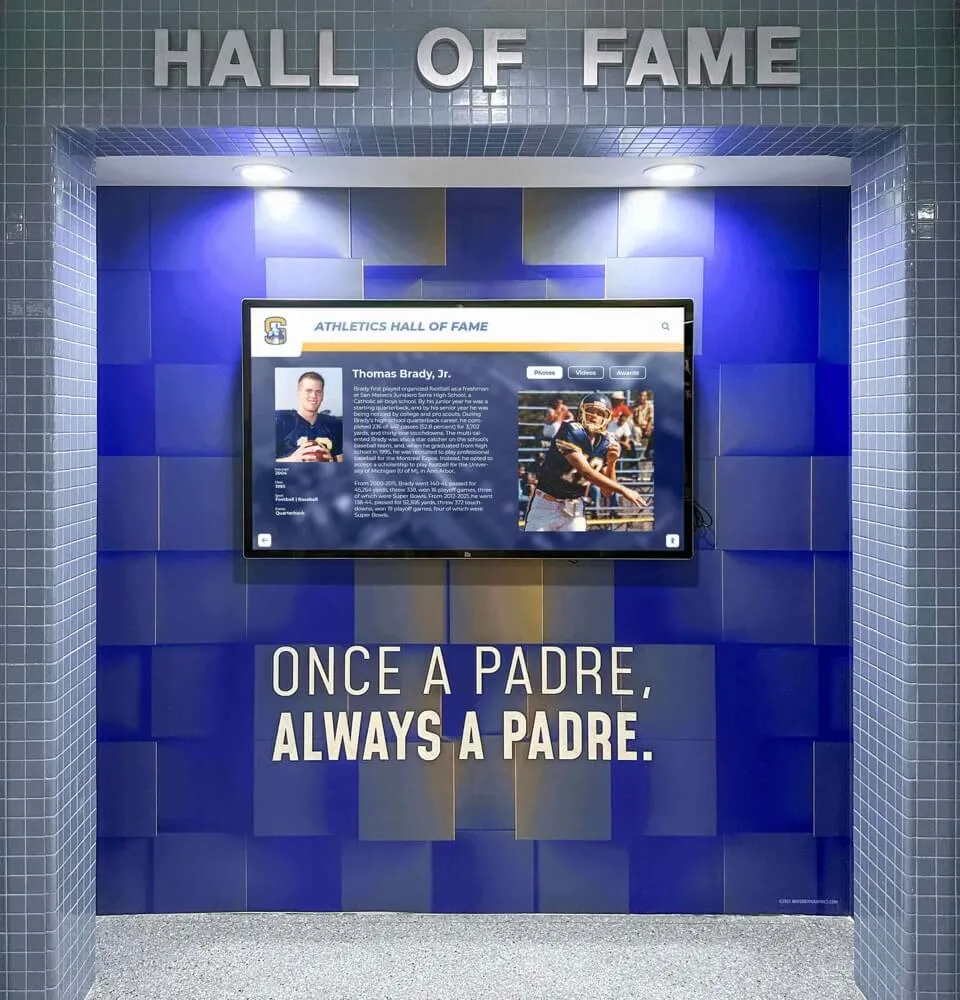
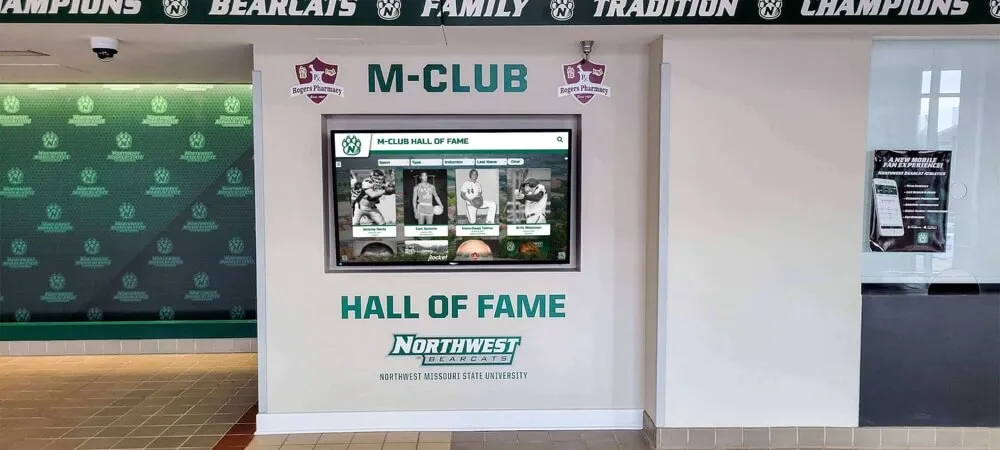
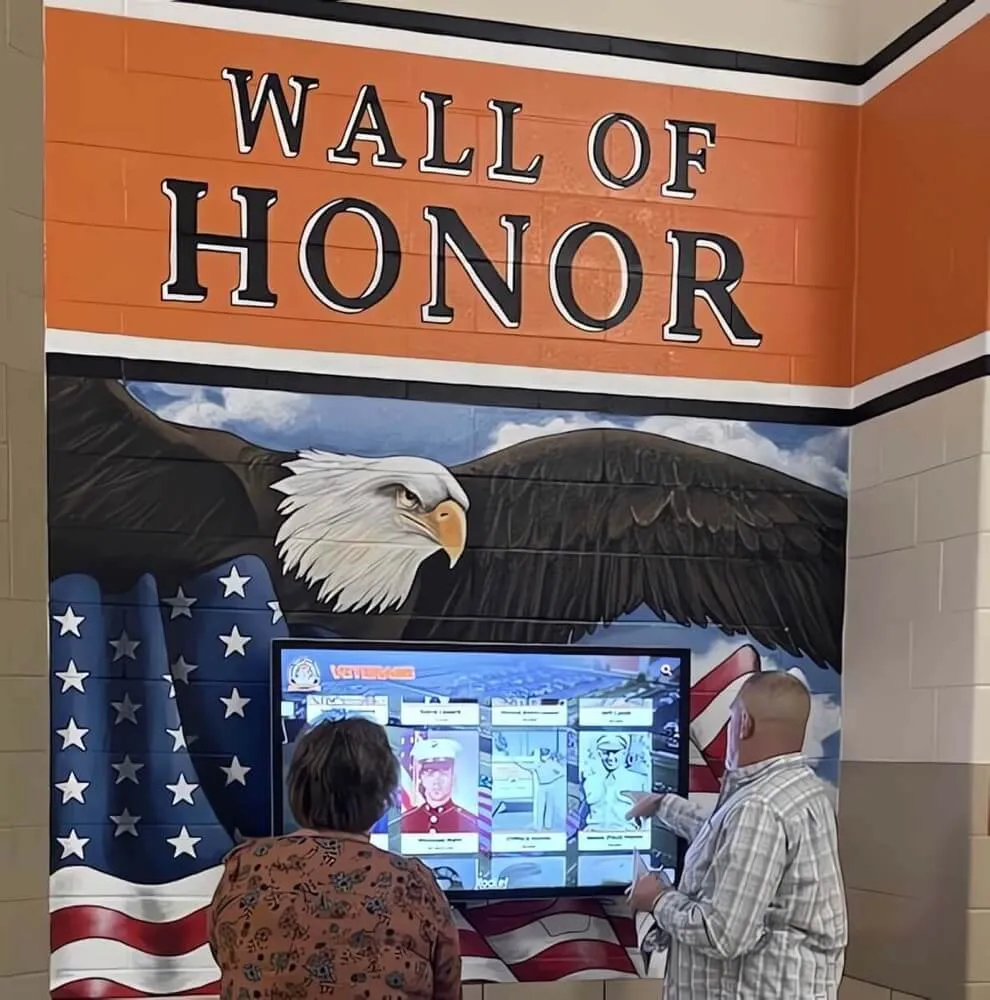
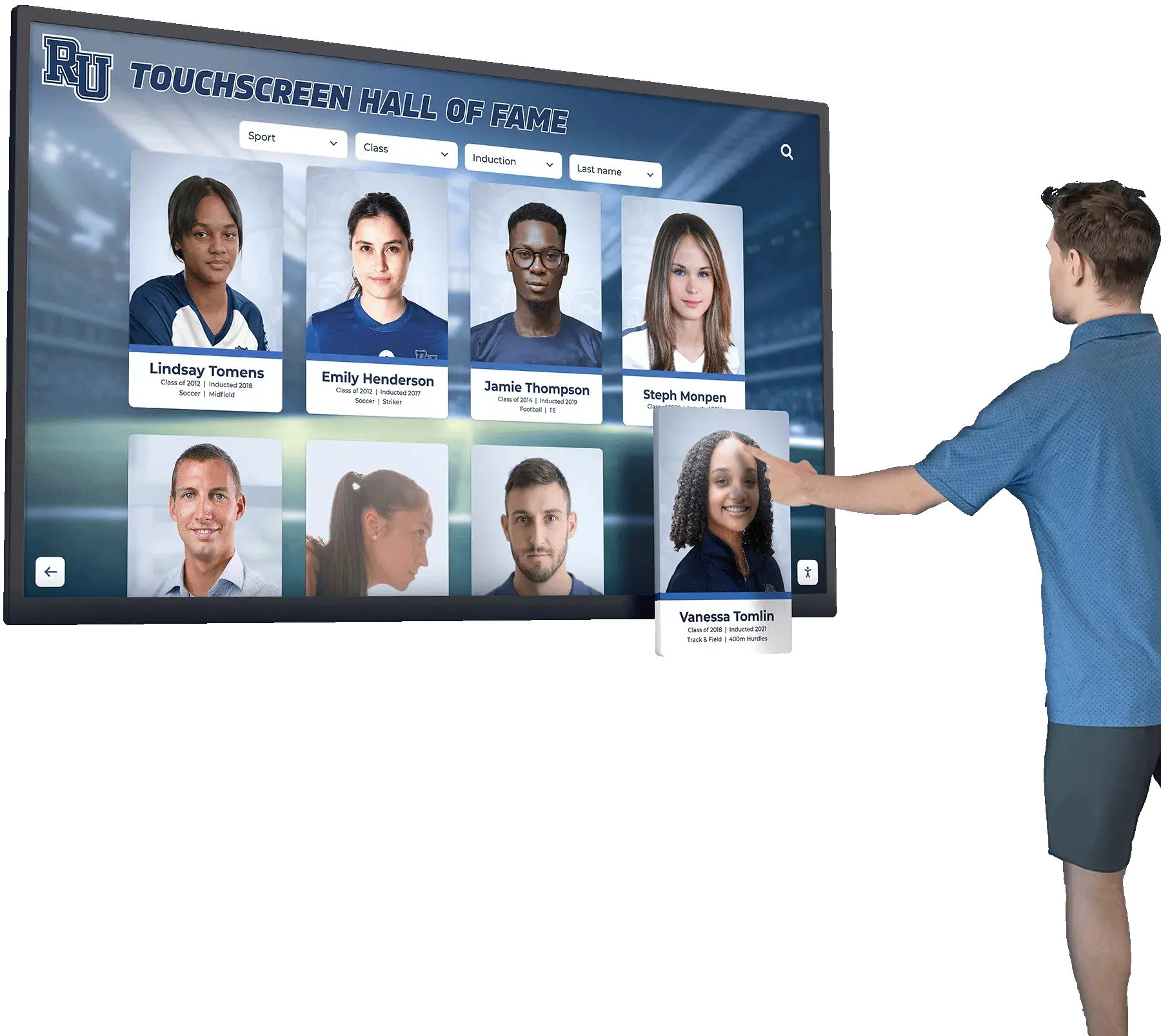
Digital touchscreens enable visitors to explore detailed inductee profiles, including achievements, statistics, photos, and biographical information
Establishing Selection Committees and Processes
Credible hall of fame programs require formal selection processes that ensure fairness, consistency, and community confidence. The selection committee structure and decision-making process significantly impact program reputation and longevity.
Committee Composition
Effective selection committees balance diverse perspectives while maintaining manageable size and clear decision-making authority. Successful committees typically include:
Core Committee Members
- Athletic Directors or Program Leaders: Provide institutional knowledge, historical perspective, and administrative continuity
- Administrators: Ensure alignment with school values and oversight of program integrity
- Faculty Representatives: Contribute academic perspective and maintain educational mission focus
- Alumni Board Members: Represent alumni constituency and provide graduate perspective
- Booster or Foundation Representatives: Connect recognition to fundraising and community support
Committee size typically ranges from 7-12 members, large enough for diverse perspectives but small enough for efficient deliberation and decision-making.
Rotating vs. Permanent Seats
Many programs combine permanent seats (athletic director, principal) with rotating positions that turn over every 2-3 years. Rotation provides fresh perspectives while maintaining institutional continuity and preventing entrenchment of particular biases.
Ex-Officio or Advisory Roles
Some committees include ex-officio members such as previous inductees or longtime coaches who provide historical knowledge without voting authority, preserving decision-making efficiency while accessing valuable institutional memory.
Nomination and Evaluation Process
Systematic nomination and evaluation processes ensure all eligible candidates receive fair consideration while managing committee workload.
Open Nomination Period
Most programs establish annual nomination periods during which anyone may submit candidate nominations, typically requiring:
- Completed nomination forms documenting achievements
- Supporting materials such as statistics, articles, or photos
- Verification of eligibility against published criteria
- Nomination statements explaining candidate worthiness
Open nominations ensure talented individuals aren’t overlooked while distributing research work beyond committee members.
Preliminary Screening
Committee chairs or administrative staff commonly conduct preliminary screening to:
- Verify eligibility against published standards
- Remove incomplete or ineligible nominations
- Organize materials for committee review
- Create standardized candidate summaries
- Identify additional supporting documentation needed
Screening reduces committee meeting time while ensuring members evaluate complete, comparable information for all candidates.
Committee Deliberation
Selection committees typically meet annually to evaluate candidates and vote on inductees. Effective deliberation processes include:
- Distribution of candidate materials weeks before meetings
- Presentation of each candidate’s achievements
- Open discussion of qualifications and concerns
- Voting procedures (often requiring 2/3 or 3/4 majority)
- Selection of induction class size appropriate to program capacity
Many schools implementing digital hall of fame displays find they can expand induction class sizes since digital platforms eliminate physical space constraints that previously limited recognition capacity.
Decision Documentation
Maintaining records of committee decisions protects program integrity and provides documentation if selection decisions are questioned. Documentation typically includes:
- Complete candidate files with nomination materials
- Committee meeting minutes recording deliberations
- Voting records showing selection outcomes
- Rationale statements explaining selections
- Communications with nominees and inductees
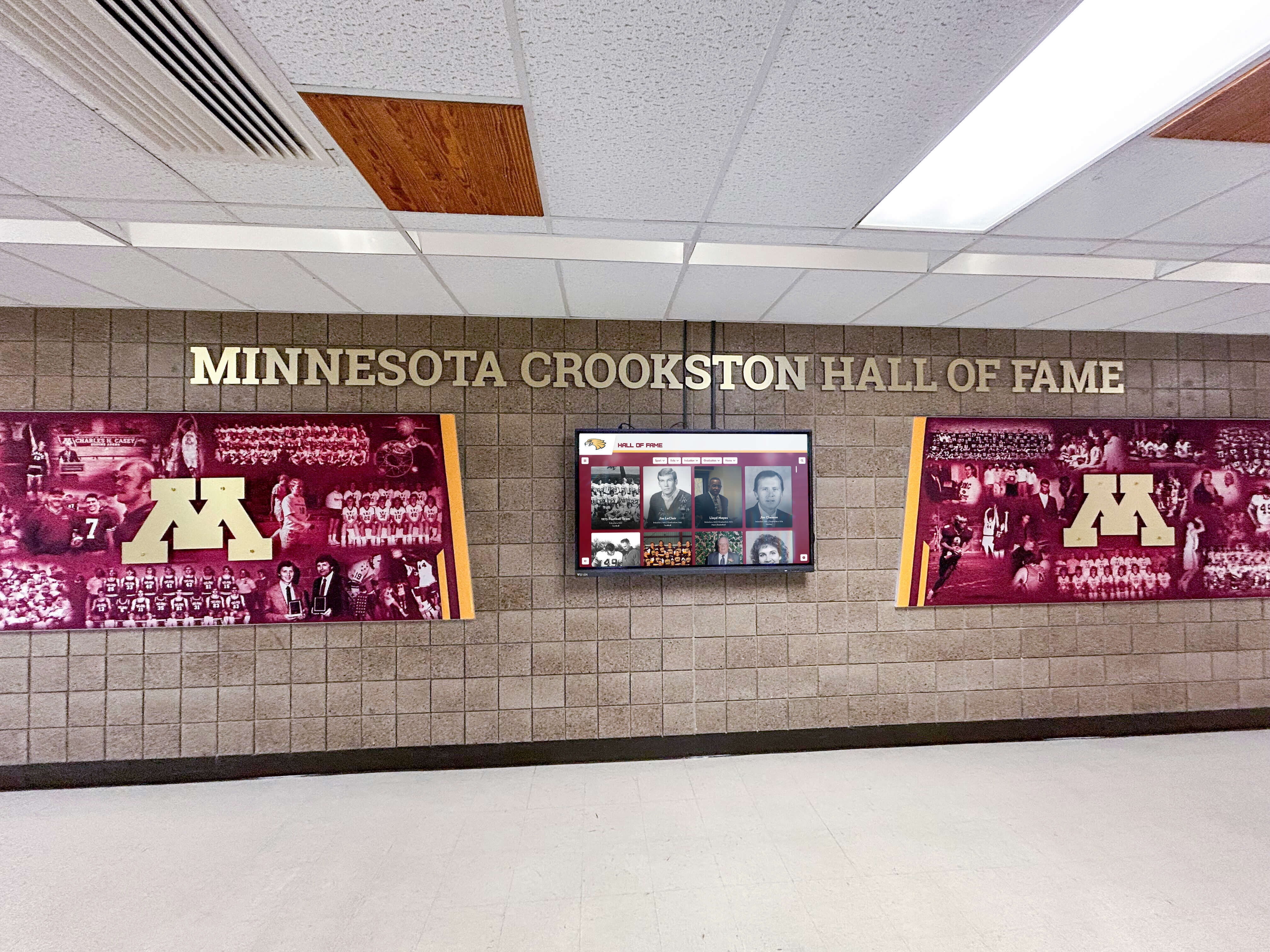
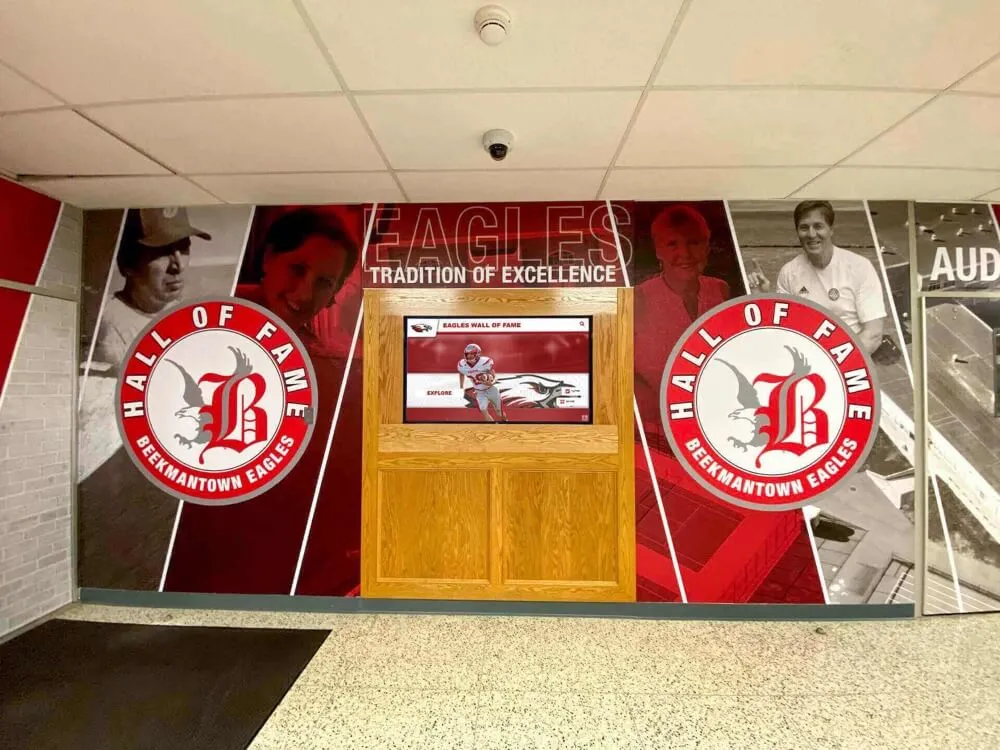
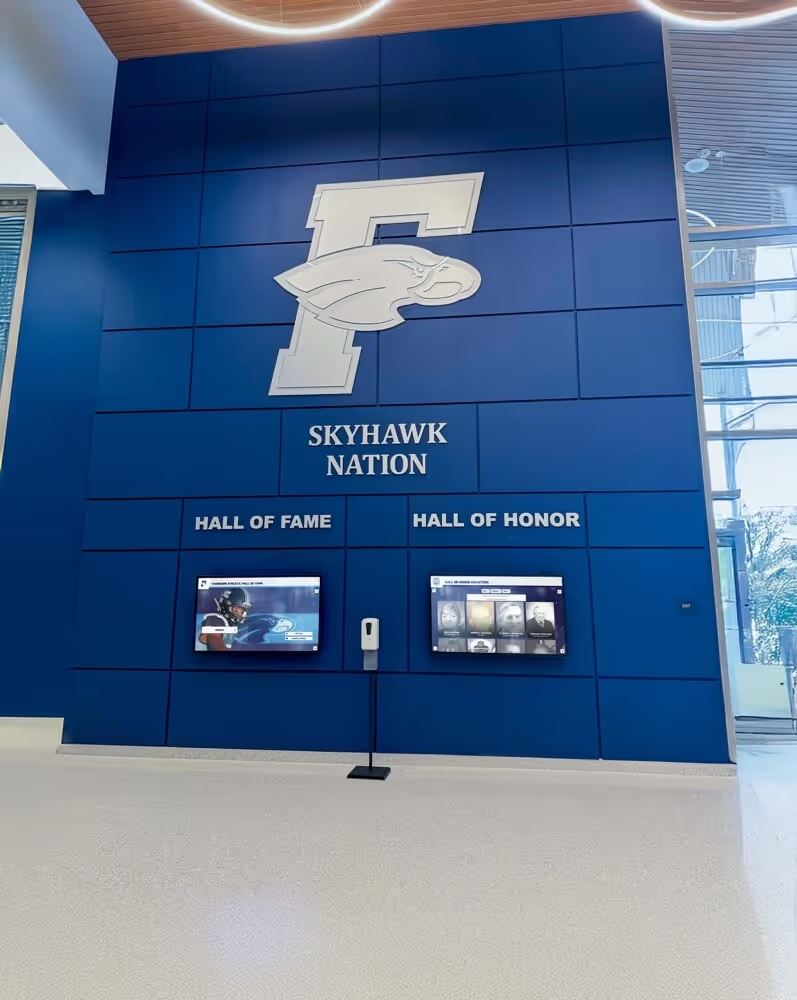
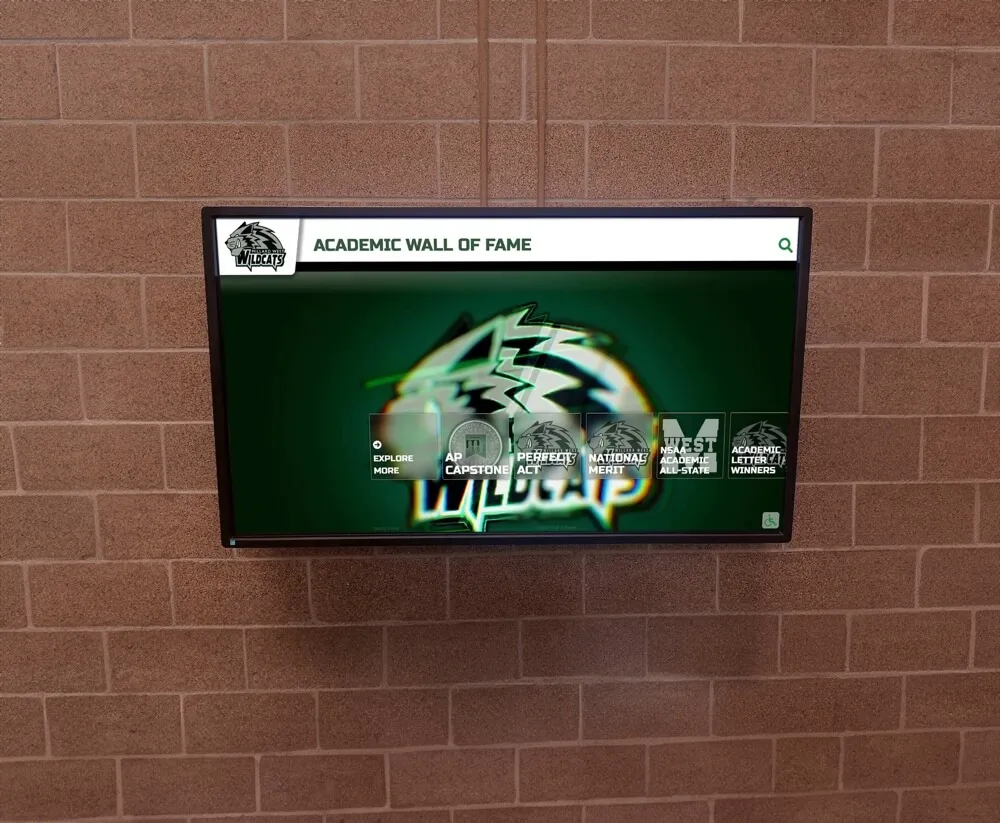
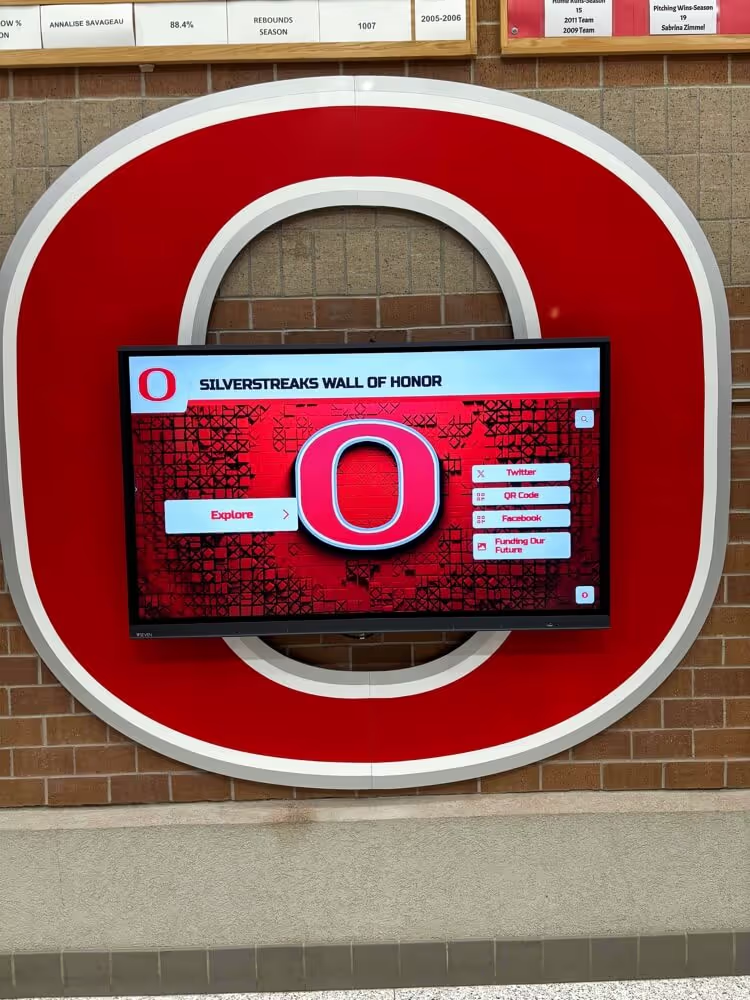
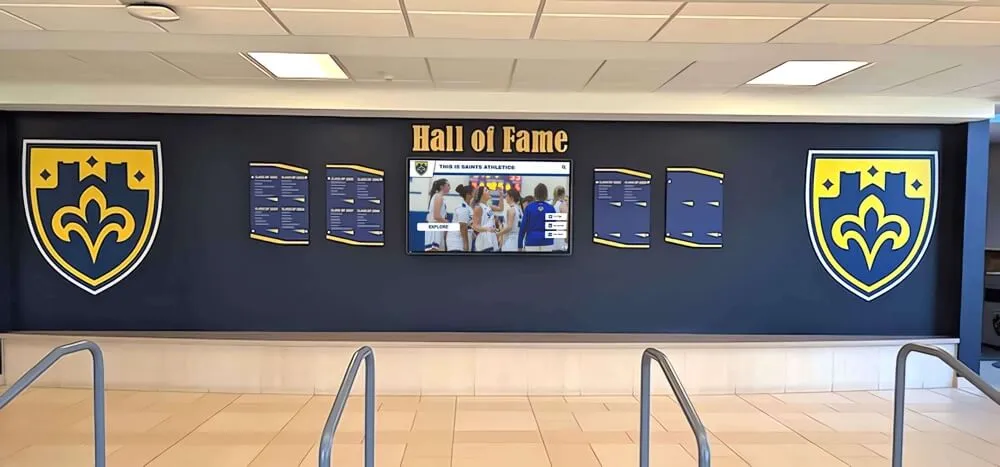
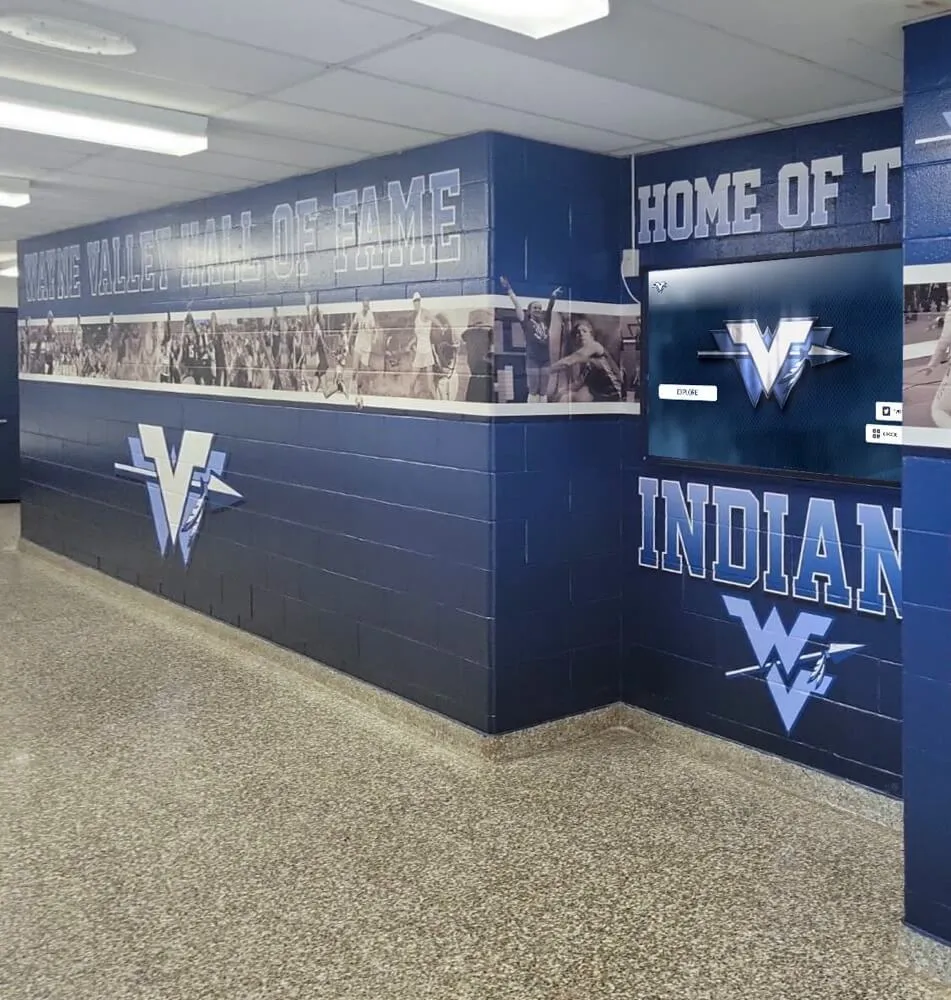
Modern digital displays integrate seamlessly with facility design, providing dynamic recognition that evolves with institutional achievements
Managing Selection Challenges
Even well-designed processes face common challenges requiring thoughtful policies and procedures.
Addressing Selection Controversies
Controversial selections or notable omissions can undermine program credibility. Effective strategies include:
- Publishing clear criteria and selection processes transparently
- Maintaining confidentiality of committee deliberations
- Providing appeals processes for procedural concerns
- Avoiding retroactive rule changes appearing to target individuals
- Acknowledging that reasonable people may disagree on borderline cases
Balancing Recent vs. Historical Achievements
Committees often struggle balancing recognition of older alumni whose achievements may be less documented against recent graduates with detailed performance records. Solutions include:
- Reserving induction slots for historical candidates
- Establishing different criteria for eras with limited documentation
- Conducting historical research to document older achievements
- Recognizing that complete achievement records may be impossible for distant eras
Managing Nomination Surges
Strong senior classes or championship seasons can generate large nomination groups, risking either overcrowded induction classes or worthy candidates waiting years for recognition. Strategies include:
- Establishing maximum annual induction numbers maintaining ceremony quality
- Allowing candidates to remain eligible multiple years
- Creating interim recognition categories for near-misses
- Adjusting class sizes occasionally to address backlogs
Schools using digital recognition systems have more flexibility since digital platforms accommodate unlimited inductees without physical space limitations.
Showcasing Inductees Through Digital Displays
Once selection decisions are made, effectively presenting inductee achievements determines program impact and engagement. Digital display technology has transformed how schools showcase hall of fame recognition, replacing space-constrained plaques with dynamic, interactive experiences.
Advantages of Digital Hall of Fame Displays
Digital platforms offer compelling advantages over traditional physical recognition:
Unlimited Capacity
Physical plaques consume wall space that eventually fills up, forcing difficult decisions about removing older recognition or stopping new inductions. Digital displays eliminate space constraints, allowing programs to:
- Induct new classes annually without removing previous honorees
- Recognize achievements across multiple categories and sports
- Add historical inductees as documentation is discovered
- Feature championship teams alongside individual achievers
- Include supportive content like coach profiles and program history
Rich Multimedia Storytelling
Traditional plaques display names, dates, and minimal text. Digital platforms enable comprehensive storytelling through:
- Photo galleries showing inductees in action
- Video highlights and career retrospectives
- Detailed biographical narratives
- Statistics and performance data
- News articles and historical documents
- Audio interviews or oral histories
This multimedia approach creates emotional connections impossible with static plaques, particularly for current students who may not remember inductees from previous eras.
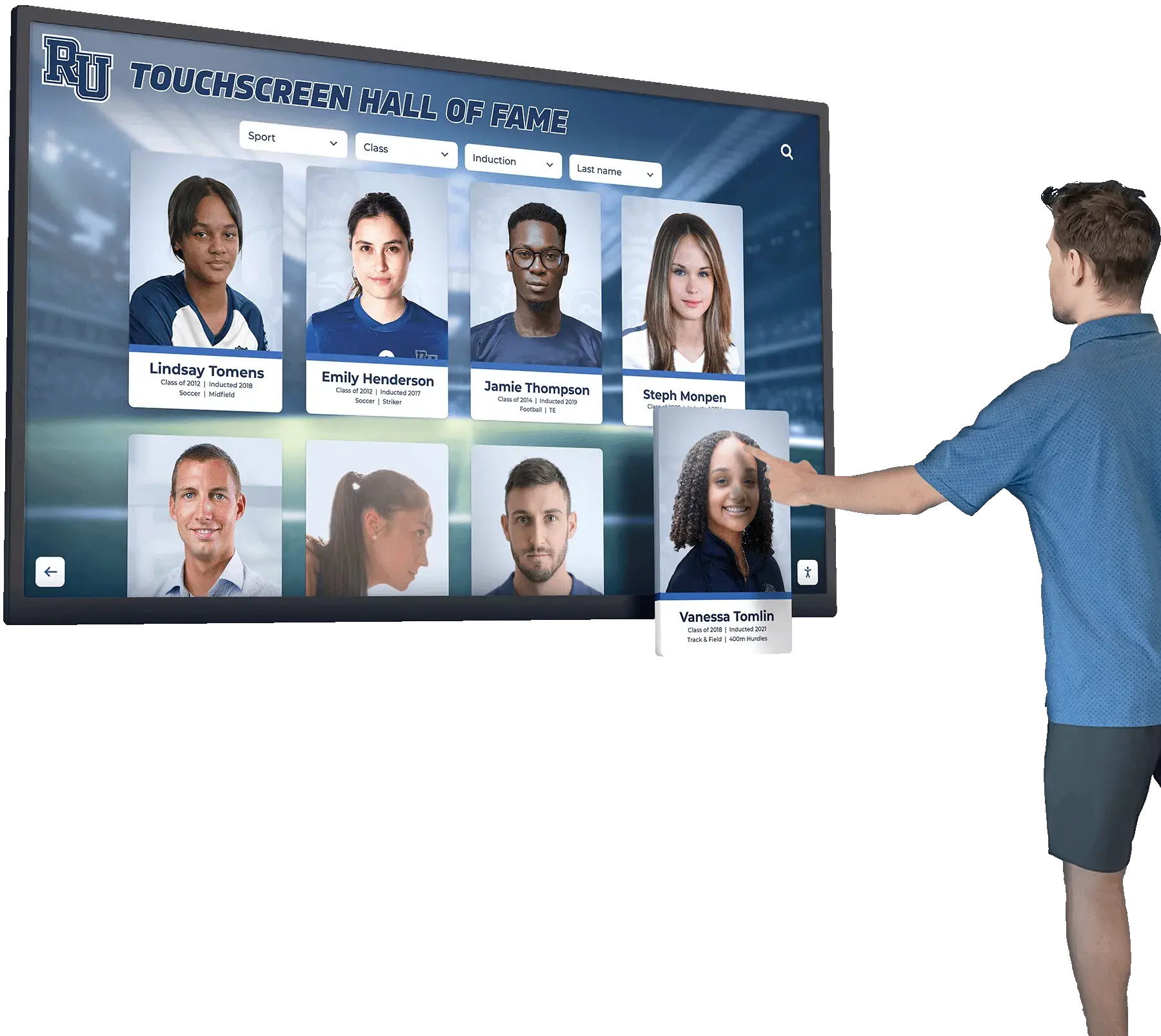
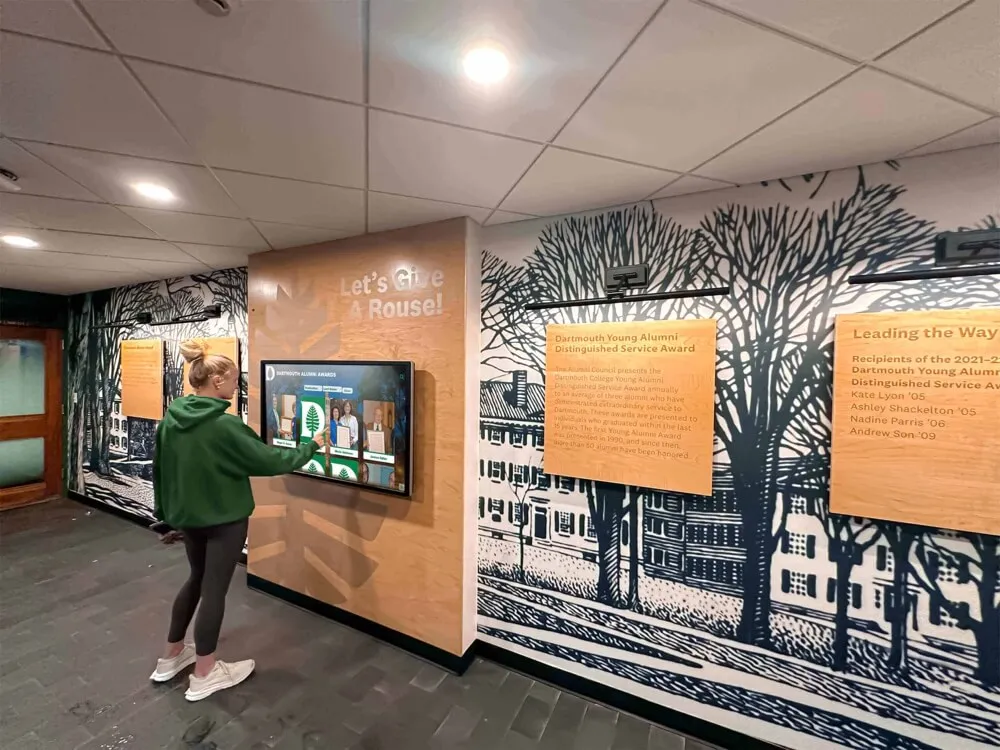
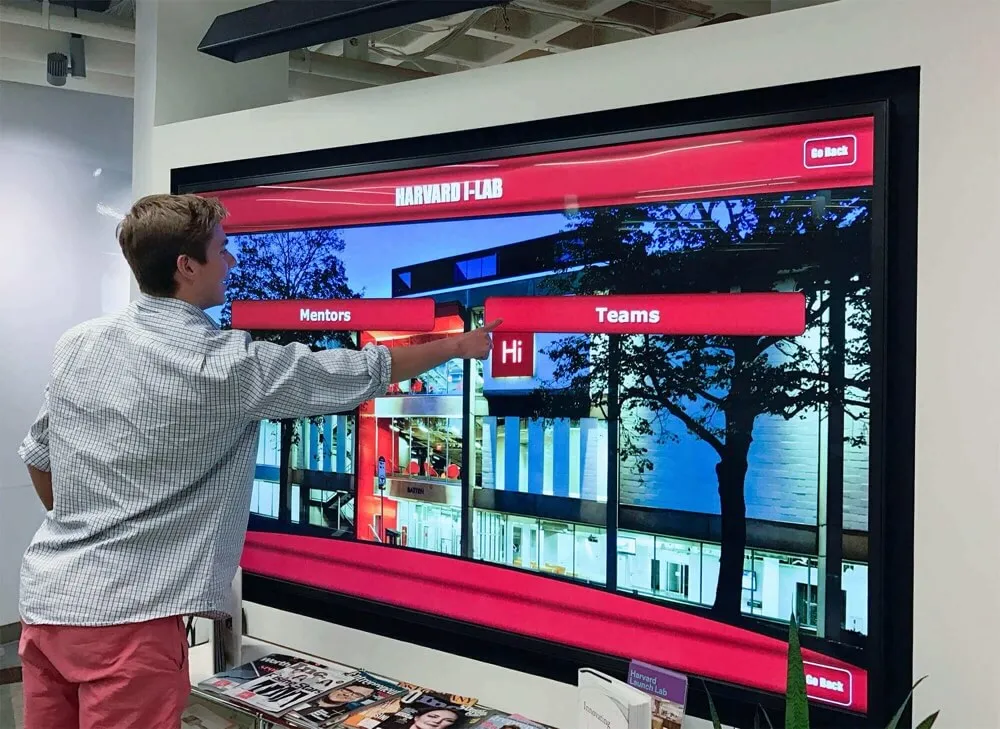
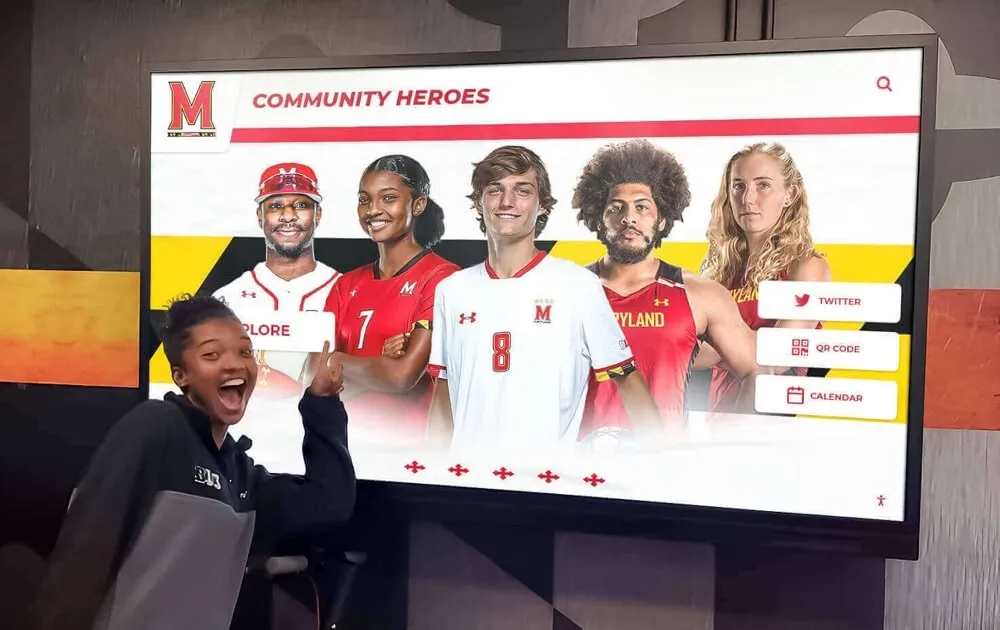
Interactive navigation allows visitors to explore inductees by sport, year, achievement type, or search for specific individuals
Instant Updates and Flexibility
Adding recognition to physical displays requires ordering plaques (weeks of lead time), scheduling installation, and permanent commitment to placement. Digital systems enable:
- Immediate updates when new inductees are announced
- Easy corrections of errors or updated information
- Addition of content as new photos or videos become available
- Seasonal features highlighting relevant achievements
- Special presentations for anniversaries or reunions
Enhanced Accessibility
Physical displays serve only those physically present in specific locations. Digital platforms extend access through:
- Web versions accessible from anywhere globally
- Mobile optimization for smartphone access
- Search functionality helping visitors find specific inductees
- Social sharing features enabling inductees to share recognition
- QR codes directing people from printed materials to digital profiles
Schools implementing comprehensive digital recognition platforms report significantly higher engagement as alumni explore recognition from home, share profiles with friends and family, and maintain stronger connections to institutional heritage.
Professional Presentation and Branding
Consistency and quality vary across physical displays accumulated over decades. Digital platforms ensure:
- Unified design templates maintaining visual consistency
- Professional layouts for all content
- Integration with school branding and colors
- Modern interfaces demonstrating institutional investment
- Scalable designs working across different display sizes
Essential Features of Digital Hall of Fame Systems
Evaluating digital display options requires understanding features that distinguish effective platforms from basic slideshow presentations.
Intuitive Content Management
The best systems provide simple interfaces allowing non-technical staff to add inductees, upload photos and videos, update information, and manage content without specialized training. Quality platforms offer:
- Drag-and-drop media uploads
- Visual editors showing real-time previews
- Template-based profile creation
- Bulk upload capabilities for multiple inductees
- No-code interfaces requiring no programming knowledge
Interactive Touchscreen Navigation
Physical touchscreen installations create engaging experiences where visitors actively explore rather than passively viewing rotating content. Effective navigation includes:
- Intuitive menu structures organized by sport, year, or category
- Full-text search finding specific inductees instantly
- Filtering options narrowing displays by achievement type
- Related content suggestions connecting similar achievements
- Home screen attractions drawing attention to displays
Web-Accessible Platforms
Hall of fame content should extend beyond physical locations through responsive web platforms providing worldwide access via smartphones, tablets, and computers. Web accessibility:
- Strengthens alumni engagement between campus visits
- Enables social sharing of individual profiles
- Provides permanent links for promotional materials
- Generates analytics showing engagement patterns
- Creates searchable archives of institutional history
Flexible Recognition Categories
Schools need systems supporting diverse recognition types with customizable templates, including athletic achievements, academic honors, professional accomplishments, service recognition, and historical timelines. Solutions like those from Rocket Alumni Solutions provide unlimited custom categories with independent designs accommodating different information needs.
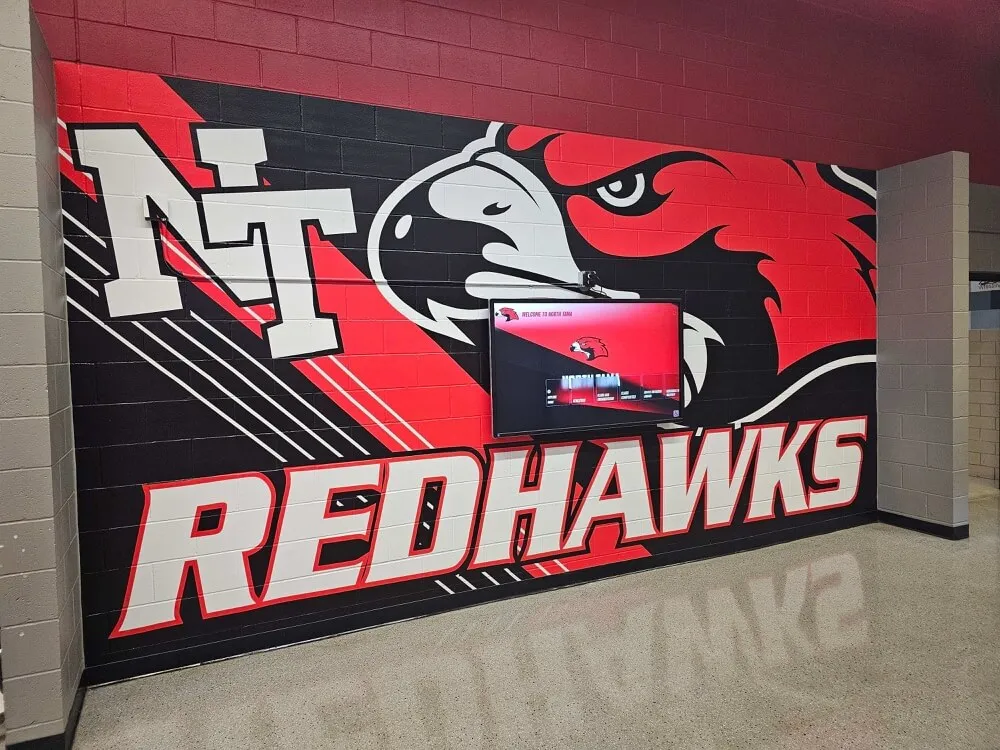
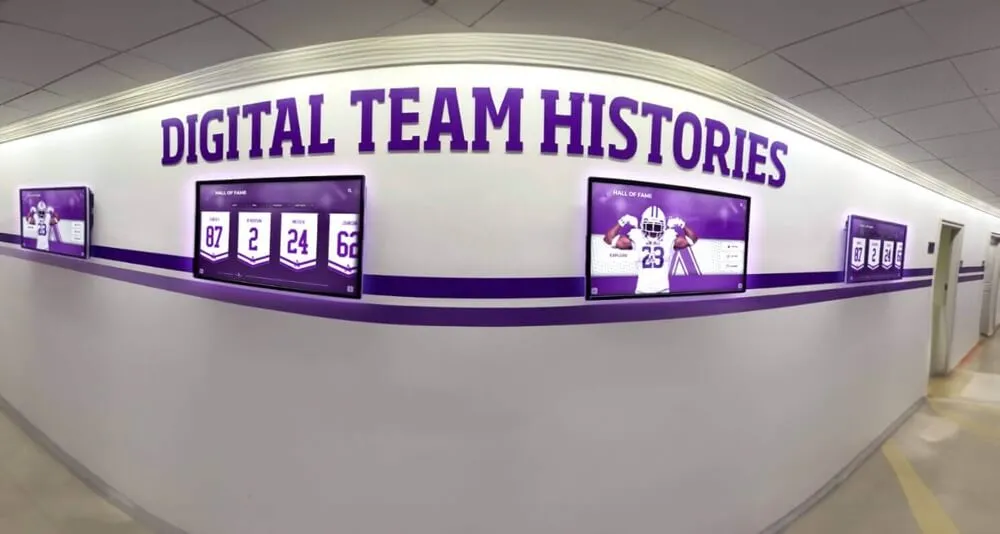
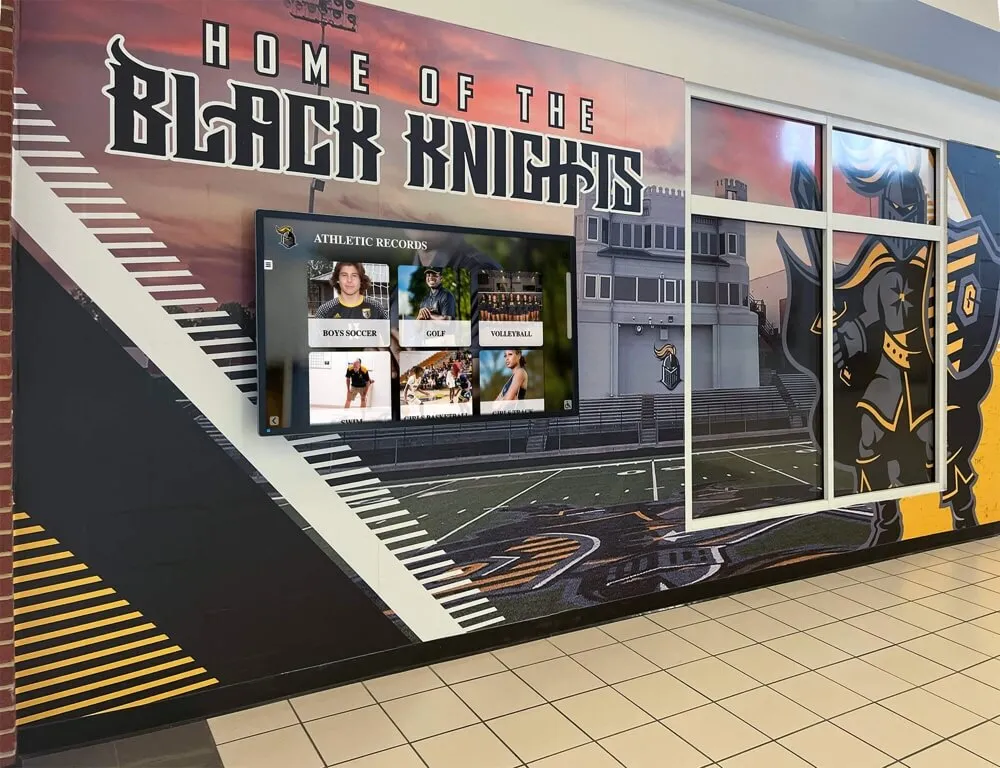
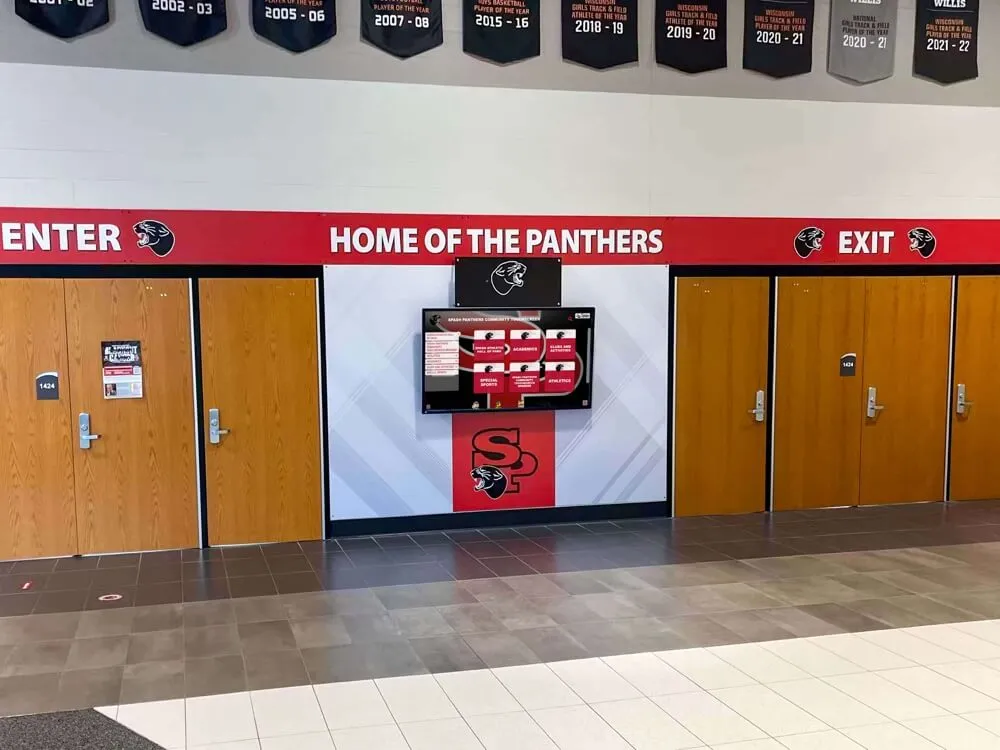
Strategic placement in high-traffic hallways ensures hall of fame recognition reaches daily audiences while building institutional pride
Implementation Considerations
Successfully launching digital hall of fame displays requires planning beyond technology selection.
Content Creation and Migration
Converting existing hall of fame recognition to digital formats involves significant work:
- Photographing or scanning physical plaques for historical documentation
- Collecting biographical information from alumni records
- Gathering action photos from yearbook and media archives
- Researching statistics and achievement details
- Writing consistent biographical narratives
- Organizing content by category and achievement type
Many schools find initial content creation the most time-intensive aspect of digital implementation. Platforms providing implementation support and template libraries significantly reduce launch timelines.
Hardware Selection and Placement
Digital hall of fame installations typically involve:
- Touchscreen displays (43-inch to 75-inch depending on location)
- Wall mounts or floor-standing kiosks
- Network connectivity (wired or wireless)
- Power access
- Optional surrounding graphics or branding
Strategic placement in high-traffic locations like building lobbies, athletic facility entrances, cafeterias, or hallways near gyms maximizes visibility and engagement. Schools implementing trophy case alternatives often position digital displays near or replacing traditional cases, creating modern recognition centers.
Ongoing Content Management
Digital platforms require ongoing attention maintaining relevance and accuracy:
- Adding new inductees immediately following selection
- Updating biographical information as alumni careers progress
- Incorporating newly discovered historical photos or documentation
- Creating special features for anniversaries or reunions
- Responding to correction requests or updated information
Assigning clear staff responsibility for content management prevents systems from becoming static rather than dynamic recognition tools.
Integration with Recognition Programs
Digital displays work best when integrated with broader recognition strategies:
- Induction ceremonies where honorees are introduced to communities
- Alumni newsletters featuring new inductees with links to digital profiles
- Social media campaigns highlighting individual achievements
- Reunion events showcasing relevant graduating class achievements
- Athletic event presentations recognizing hall of fame members in attendance
Programs implementing comprehensive recognition systems create cohesive experiences where selection, ceremony, digital display, and ongoing engagement reinforce each other.
Building Sustainable Recognition Programs
Successful hall of fame programs balance maintaining high standards with sustainable growth and community engagement.
Annual Program Rhythms
Establishing consistent annual schedules builds community awareness and anticipation:
Fall: Nominations Open
Launch nomination periods in fall when sports seasons begin and alumni engagement naturally increases. Promote nominations through:
- Website announcements and online nomination forms
- Alumni newsletter features encouraging submissions
- Social media campaigns highlighting previous inductees
- Athletic event announcements reaching active supporters
- Direct outreach to coaches and teachers who may suggest candidates
Winter: Committee Review and Selection
Schedule committee meetings in winter months, providing time for thorough candidate evaluation before spring ceremony planning. Effective meetings:
- Distribute candidate materials weeks in advance
- Allow sufficient discussion time for each nominee
- Use structured voting procedures ensuring fairness
- Document decisions and rationale
- Communicate results confidentially to inductees first
Spring: Induction Ceremonies
Most schools hold induction ceremonies in spring, coinciding with end-of-year celebrations and better weather for events drawing community attendance. Successful ceremonies:
- Honor inductees with formal presentations
- Include family recognition and attendance
- Provide permanent keepsakes or plaques
- Update digital displays simultaneously with ceremony
- Generate media coverage and social sharing
- Create video documentation for digital profiles
Summer: Content Enhancement
Use summer months for content improvement activities like historical research, photo collection from inductees, biographical interview projects, and digital display optimization based on usage data.
Measuring Program Success
Evaluate hall of fame program effectiveness through multiple indicators:
Engagement Metrics
Digital platforms generate valuable data including:
- Touchscreen interaction frequency and duration
- Web platform visits and session length
- Most-viewed inductees and popular content
- Search terms revealing what visitors seek
- Geographic distribution of web access
Community Impact
Qualitative indicators demonstrate broader program value:
- Alumni feedback and testimonials
- Media coverage of induction events
- Social media sharing and engagement
- Prospective family reactions during tours
- Donor cultivation conversations referencing recognition
Program Sustainability
Long-term indicators show program health:
- Consistent annual nomination quantity and quality
- Committee participation and engagement
- Funding adequacy for ceremonies and technology
- Content management sustainability
- Integration with broader school culture
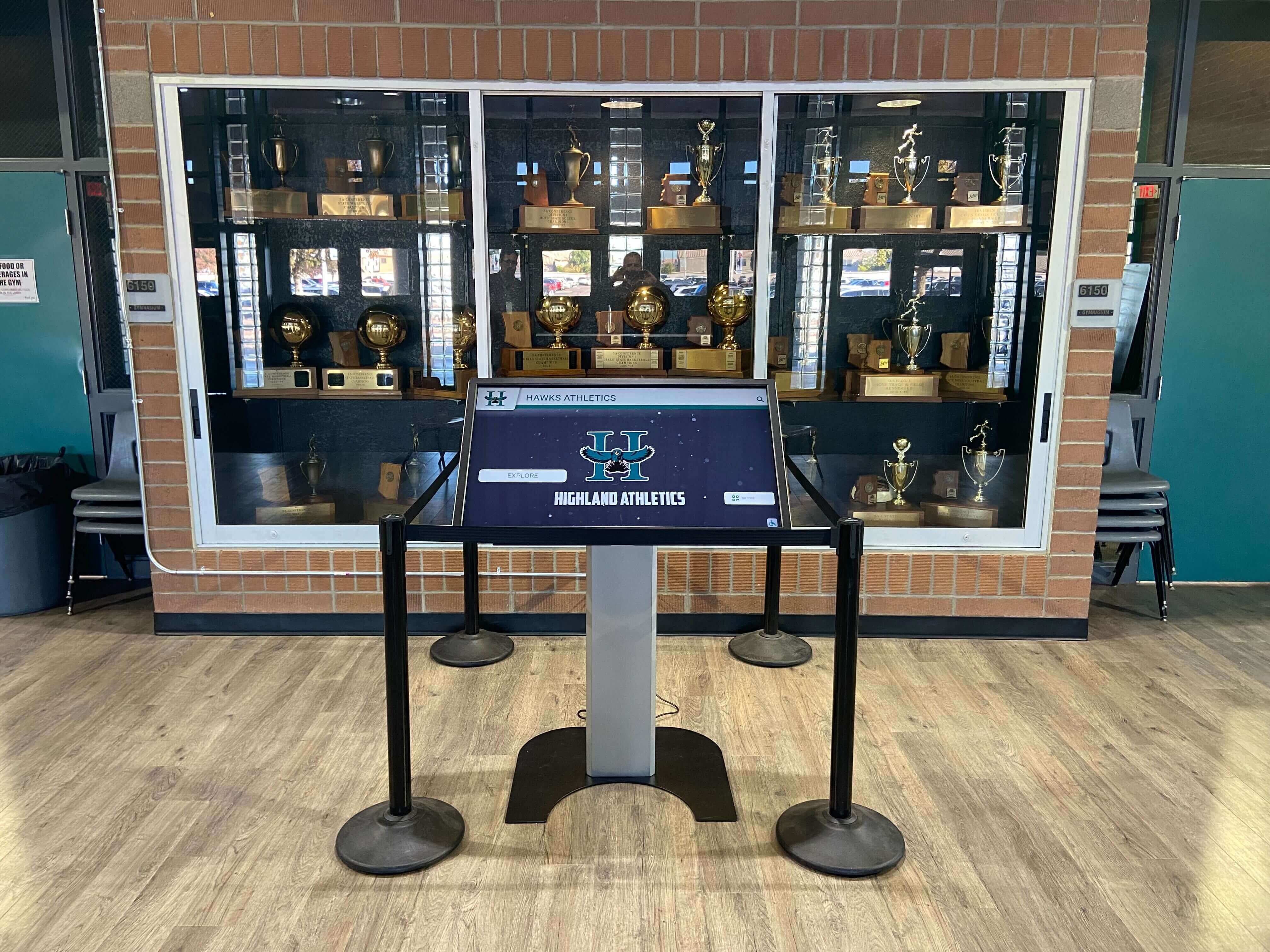
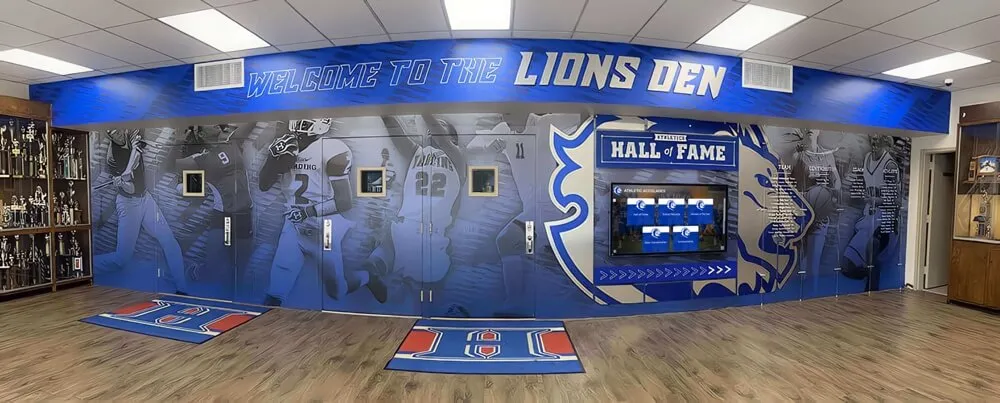
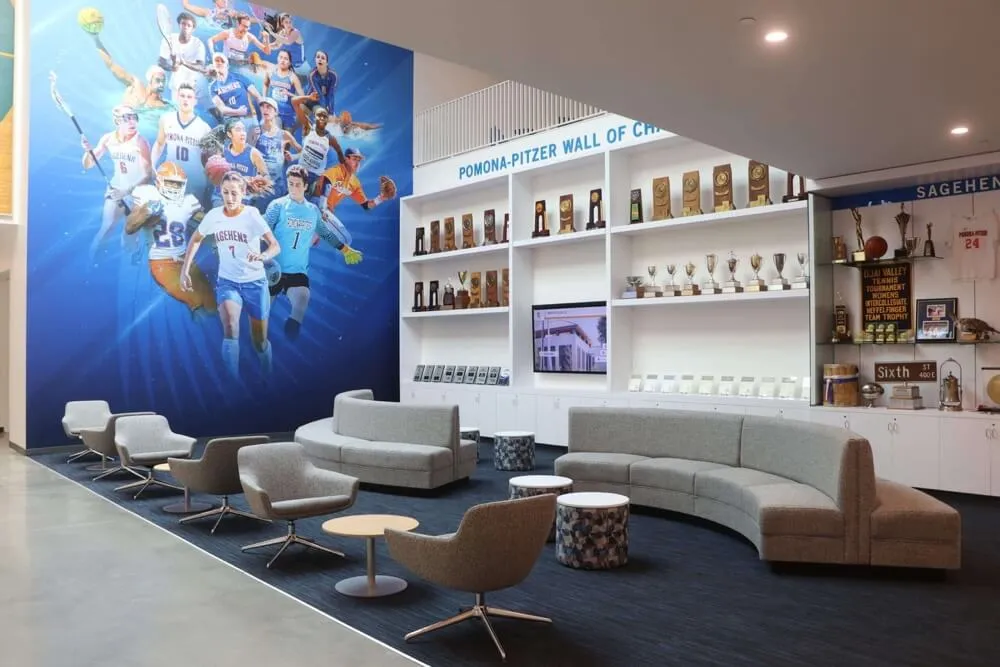
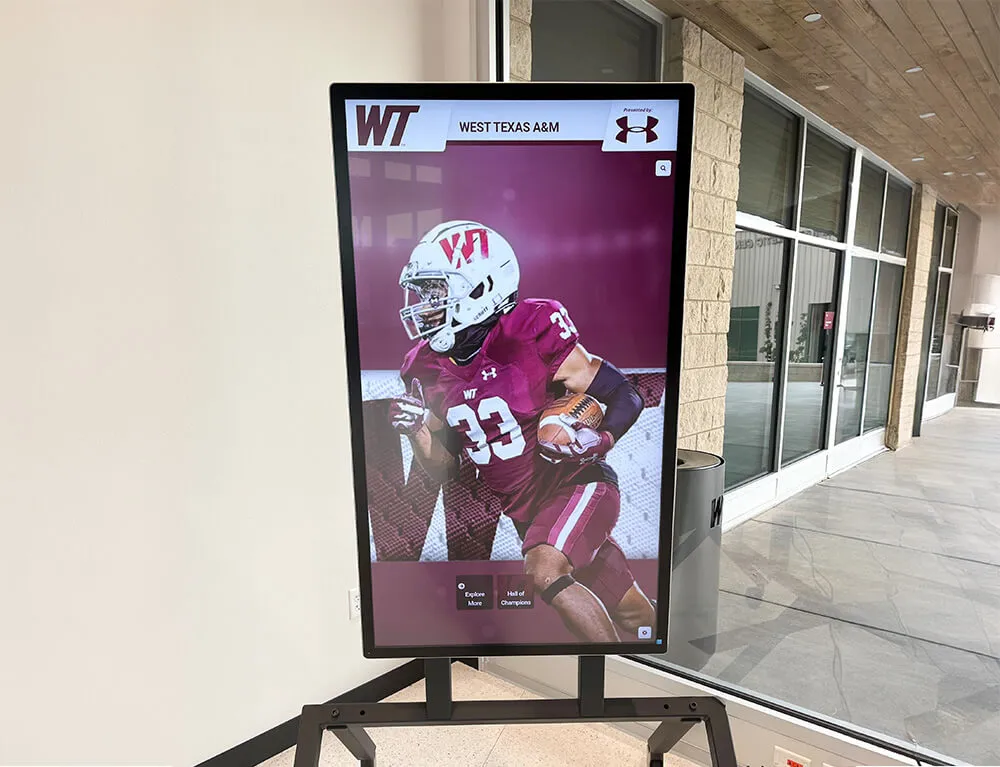
Digital kiosks can be positioned near or within existing trophy cases, creating comprehensive recognition centers combining physical artifacts with digital storytelling
Conclusion: Creating Recognition That Inspires
Hall of fame programs succeed when selection processes maintain credibility and presentation creates meaningful connections between past achievements and present community. Clear criteria, transparent selection procedures, and thoughtful committee composition ensure recognition rewards genuine excellence while building confidence across diverse constituencies.
Digital display technology transforms how schools present hall of fame recognition, replacing space-constrained plaques with unlimited capacity, rich multimedia storytelling, instant updates, and worldwide accessibility through web platforms. These capabilities don’t simply modernize recognition—they fundamentally expand what’s possible, allowing schools to celebrate broader achievement while creating engaging experiences that inspire current students and strengthen alumni connections.
Administrators establishing or enhancing hall of fame programs should begin by documenting clear selection criteria, assembling balanced committees with diverse perspectives, establishing sustainable annual processes, and exploring digital platforms that eliminate physical constraints while providing professional, engaging presentation of institutional excellence.
Solutions like Rocket Alumni Solutions integrate touchscreen displays, cloud-based content management, and web accessibility into comprehensive platforms designed specifically for school recognition programs, providing the tools needed to honor achievement while building institutional pride for decades to come.
Ready to explore how modern recognition technology can transform your hall of fame program? Schedule a demo to see how digital displays can celebrate your school’s legacy of excellence.