Graduation honors represent the culmination of years of academic dedication, transforming exceptional student achievement into prestigious distinctions that appear on diplomas, transcripts, and institutional records. For students, families, and educators navigating the landscape of academic recognition, understanding the different types of honors—from Latin honors like summa cum laude to honor roll designations and specialized academic distinctions—clarifies eligibility requirements, institutional variations, and the lasting value these achievements represent.
Yet confusion persists around graduation honors systems. Students wonder whether their 3.7 GPA qualifies for cum laude recognition, parents question how honor roll differs from dean’s list, and schools seek consistent frameworks for acknowledging excellence across diverse student populations. The terminology varies between institutions, grade point average thresholds shift, and additional criteria like class rank or credit hours create complexity around what initially seems straightforward.
This comprehensive guide demystifies graduation honors by explaining the major recognition systems used across K-12 schools and higher education, clarifying the specific criteria determining each distinction, and providing frameworks schools can use to implement equitable, meaningful honor programs that celebrate academic excellence while motivating continued achievement.
Understanding graduation honors requires distinguishing between the various recognition systems operating at different educational levels. While high schools typically emphasize honor roll and valedictorian/salutatorian designations, colleges and universities predominantly use Latin honors alongside dean’s list and departmental distinctions. Each system serves specific purposes within institutional cultures of academic excellence.

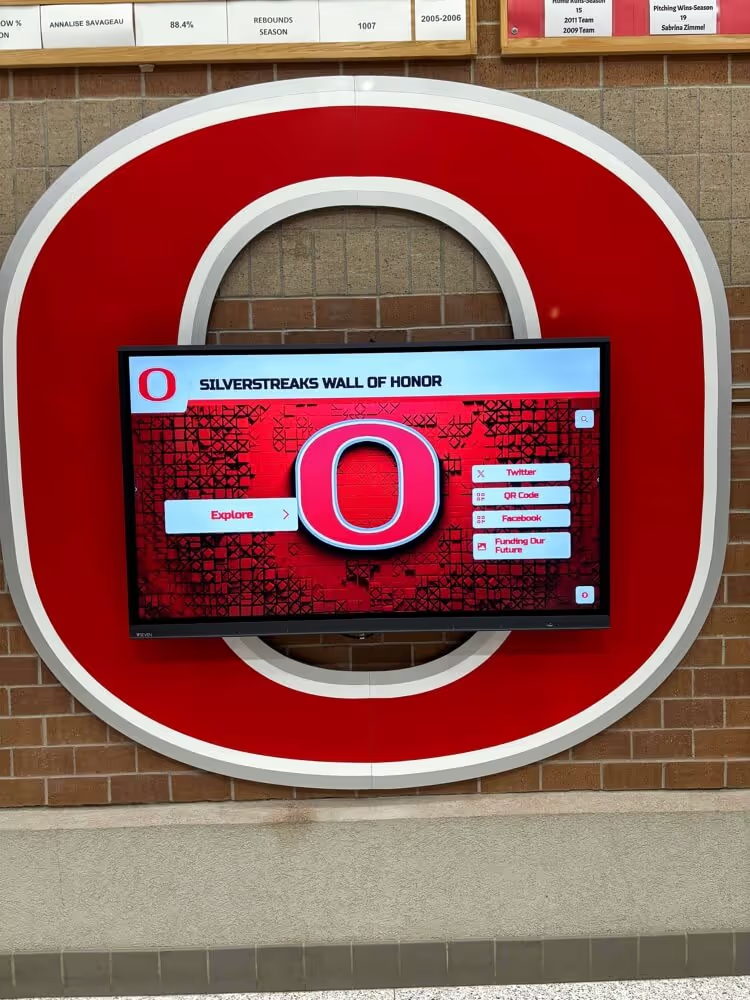
Modern recognition systems showcase graduation honors through engaging displays that celebrate academic excellence across entire school communities
Latin Honors: Understanding Summa, Magna, and Cum Laude
Latin honors represent the most prestigious academic distinctions awarded at college and university graduation, appearing directly on diplomas and transcripts to signify exceptional cumulative achievement throughout undergraduate studies.
The Three Traditional Latin Honors Levels
Summa Cum Laude (With Highest Distinction)
Summa cum laude represents the pinnacle of undergraduate academic achievement, typically reserved for students demonstrating extraordinary excellence across their entire degree program. Most institutions limit summa cum laude to the top 1-5% of graduating students, though specific criteria vary significantly.
Common summa cum laude requirements include:
- Cumulative GPA ranging from 3.85 to 4.0, depending on institutional standards
- Completion of minimum credit hours at the degree-granting institution (often 60+ credits)
- No academic integrity violations or disciplinary sanctions
- Satisfaction of all degree requirements within normal timeframes
- Some institutions add thesis requirements or comprehensive examinations
Elite universities like Harvard, Yale, and Princeton implement distinctive summa cum laude criteria beyond simple GPA thresholds, often requiring departmental recommendations, thesis defense, or comprehensive examination performance.
Magna Cum Laude (With Great Distinction)
Magna cum laude recognizes outstanding academic performance placing students well above their peers while acknowledging the exceptional tier reserved for summa recipients. This distinction typically encompasses the next 5-10% of high-achieving graduates.
Standard magna cum laude thresholds include:
- Cumulative GPA between 3.70 and 3.89 (institutional variation applies)
- Same credit hour and residency requirements as summa cum laude
- Clean academic standing throughout degree completion
- Full satisfaction of graduation requirements
- Demonstrated excellence across breadth of coursework, not isolated semesters
Students graduating magna cum laude represent consistently high performers who maintained exceptional standards across diverse academic challenges throughout their undergraduate careers.
Cum Laude (With Distinction)
Cum laude acknowledges commendable academic achievement, typically recognizing students in the top 15-25% of graduating classes. While representing the “entry level” of Latin honors, cum laude still signifies performance substantially above average.
Typical cum laude requirements:
- Cumulative GPA ranging from 3.50 to 3.69
- Minimum institutional credit completion
- Satisfactory academic conduct
- Completion of degree within reasonable timeframes
- Achievement of distinction across general education and major coursework
Though the most widely awarded Latin honor, cum laude remains a meaningful distinction differentiating recipients from the majority of graduates.

Digital displays create permanent recognition for students achieving graduation honors across all distinction levels
Institutional Variations in Latin Honors Systems
No universal standard governs Latin honors implementation, creating significant variation across institutions:
GPA-Based Systems
The majority of colleges and universities use fixed GPA thresholds determining honors eligibility. These systems provide transparency—students know exact targets—but may result in fluctuating percentages of honored graduates depending on overall class performance.
Example GPA-based framework:
- Summa cum laude: 3.90-4.00
- Magna cum laude: 3.75-3.89
- Cum laude: 3.50-3.74
Percentage-Based Systems
Some institutions award Latin honors to fixed percentages of graduating classes, ensuring consistent distinction regardless of absolute performance levels. This approach maintains exclusivity but creates less predictability for students.
Common percentage-based distribution:
- Summa cum laude: Top 3% of class
- Magna cum laude: Next 7% (4th-10th percentile)
- Cum laude: Next 10% (11th-20th percentile)
Hybrid Approaches
Many universities combine GPA minimums with percentage caps, requiring students to both exceed threshold GPAs and rank within top percentiles. This prevents grade inflation from diluting honor significance while maintaining meaningful standards.
Schools implementing comprehensive honor roll recognition programs create continuity between semester-based acknowledgment and cumulative graduation honors, building sustained achievement cultures.
Special Considerations for Latin Honors
Transfer Students and Latin Honors Eligibility
Transfer students often face modified Latin honors criteria reflecting reduced institutional credit accumulation. Many universities require 60-75% of degree credits completed at the degree-granting institution for full Latin honors eligibility, with some schools offering transfer-specific honors categories.
Graduate and Professional Programs
While Latin honors originated in undergraduate education, some graduate and professional programs have adopted similar distinction systems. Medical schools may award Alpha Omega Alpha honors, law schools recognize Order of the Coif membership, and graduate programs sometimes use “with distinction” designations replacing traditional Latin honors.
Departmental vs. University-Wide Honors
Some institutions separate departmental honors (awarded by major departments for excellence within specific fields) from university-wide Latin honors based on cumulative GPA. Students may graduate with departmental honors in biology while not qualifying for university-wide Latin honors, or vice versa.
High School Honor Roll and Academic Recognition Systems
While colleges emphasize Latin honors at graduation, K-12 schools primarily use semester or term-based honor roll systems acknowledging consistent academic performance throughout secondary education.

Interactive recognition systems allow schools to showcase honor roll students and graduation distinctions through engaging, accessible formats
Traditional Honor Roll Categories
High Honor Roll (Principal’s Honor Roll)
The highest tier of semester-based recognition typically requires:
- GPA of 3.75-4.0 or all A grades
- No grades below A- (in some systems)
- Full-time enrollment status
- Satisfactory conduct and attendance
- Completion of minimum credit load
High honor roll students demonstrate exceptional performance across all subjects, maintaining excellence consistently rather than achieving isolated high marks.
Honor Roll
Standard honor roll recognition acknowledges strong academic performance:
- GPA typically between 3.50-3.74
- No grades below B (common requirement)
- Full-time enrollment
- Good standing conduct-wise
- Satisfactory attendance records
Honor roll designation signals solid achievement across coursework while allowing for occasional lower grades in challenging subjects.
Merit Roll or Honorable Mention
Some schools implement third-tier recognition:
- GPA between 3.0-3.49
- Mixture of A and B grades
- No failing grades
- Satisfactory behavior and attendance
- Demonstration of consistent effort
This category ensures broader recognition opportunities while maintaining meaningful standards differentiating recipients from average performers.
Weighted vs. Unweighted GPA in Honor Calculations
Honor roll systems must address whether to use weighted GPAs (accounting for advanced coursework difficulty) or unweighted scales (treating all courses equally):
Weighted GPA Benefits
- Incentivizes challenging course selection
- Prevents strategic avoidance of AP, IB, or honors classes
- More accurately reflects actual achievement difficulty
- Aligns with college admissions practices
- Rewards intellectual risk-taking
Unweighted GPA Arguments
- Creates level playing field across students with different schedules
- Avoids penalizing students in schools with limited advanced offerings
- Simpler calculation and communication
- Prevents gaming through strategic course selection
- Focuses on mastery rather than course difficulty
Many schools implement parallel systems, publishing both weighted and unweighted honor rolls or setting weighted thresholds higher to achieve equity across different course-taking patterns.
Valedictorian and Salutatorian Distinctions
The highest individual graduation honors in high school recognize top-ranked students:
Valedictorian
The student with the highest cumulative GPA in the graduating class receives valedictorian distinction, typically including:
- Primary speaking role at graduation ceremony
- Special recognition in programs and publications
- Distinctive graduation regalia or insignia
- Trophy, plaque, or permanent recognition
- Enhanced transcript notation
Schools with multiple valedictorians (students tied for highest GPA) may recognize all qualifying students or implement tiebreaker protocols using credit hours, weighted GPA calculations, or additional criteria.
Salutatorian
The second-highest ranked student receives salutatorian honors with similar recognition, though typically secondary to valedictorian. Some schools with multiple top students forgo salutatorian designation entirely, recognizing only valedictorians.

Modern recognition technology enables students and families to explore academic achievements and understand honor criteria through interactive displays
Institutions developing monthly and semester-based student recognition programs create sustained motivation by connecting short-term acknowledgment to cumulative graduation honor eligibility.
Specialized Academic Distinctions and Departmental Honors
Beyond general graduation honors, many institutions award specialized distinctions recognizing excellence in specific domains or achievement types.
Departmental and Major-Specific Honors
Honors in the Major
Undergraduate programs often offer departmental honors requiring:
- Minimum GPA in major coursework (typically 3.5-3.7)
- Completion of honors thesis or capstone project
- Oral defense or presentation of research
- Faculty committee approval
- Additional seminar or research credit hours
Students may graduate with “Honors in Biology” or “Distinction in Economics” appearing on transcripts alongside or independent of university-wide Latin honors.
Honors Programs and Colleges
Some universities maintain separate honors colleges or programs with distinct admission, curricular, and graduation requirements. Completion earns special designation like “University Honors Scholar” recognizing participation in enhanced academic experiences beyond standard coursework.
Subject-Area Excellence Awards
Outstanding Achievement in Specific Disciplines
Subject departments frequently award outstanding student honors to top performers in individual fields:
- Highest achievement in mathematics, English, sciences, etc.
- Faculty-determined selection based on GPA and contributions
- Announced at graduation or departmental ceremonies
- Recognition in graduation programs
- Potential for named awards honoring donors or distinguished faculty
These distinctions acknowledge excellence within specific academic domains, complementing broader graduation honors.
Research, Service, and Leadership Distinctions
Research Honors
Universities with strong research cultures may award distinct research honors:
- Completion of independent research projects
- Presentation at undergraduate research symposia
- Publication in academic journals or conferences
- Faculty mentor endorsement
- Demonstrated contribution to disciplinary knowledge
Research honors particularly benefit students pursuing graduate education where research experience carries significant weight.
Community Engagement and Service Distinctions
Some institutions recognize community service alongside academic achievement:
- Minimum service hour completion (often 100-300 hours)
- Documented impact and reflection
- Integration with academic coursework
- Sustained commitment across multiple years
- Leadership in service organizations
Service distinctions acknowledge that excellence extends beyond classroom performance to encompass civic engagement and community contribution.
Schools creating comprehensive donor and community recognition programs model the values of acknowledgment and gratitude that underpin academic honor systems.

Digital recognition systems preserve institutional memory by showcasing both current honor recipients and historical academic achievers
National Honor Societies and Academic Organizations
Membership in prestigious academic honor societies provides another layer of graduation distinction, often noted on transcripts and in graduation programs.
National Honor Society (High School)
The National Honor Society (NHS) represents the premier high school academic organization, with membership based on:
Selection Criteria
- Cumulative GPA minimum of 3.0-3.5 (chapter-determined)
- Demonstrated leadership in school and community
- Documented service hours and community engagement
- Character evaluation through faculty recommendations
- Active participation in chapter activities
NHS membership appears on transcripts and represents holistic excellence beyond pure academic metrics, acknowledging leadership, service, and character alongside scholarship.
Phi Beta Kappa and Collegiate Honor Societies
Phi Beta Kappa
Founded in 1776, Phi Beta Kappa represents the oldest and most prestigious undergraduate academic honor society. Election requires:
- Exceptional GPA (typically top 10% of class)
- Breadth of liberal arts coursework
- Junior or senior standing
- Faculty chapter approval
- Institutional Phi Beta Kappa charter
Only about 290 institutions maintain Phi Beta Kappa chapters, making membership particularly prestigious. Election typically occurs junior or senior year, with inducted students wearing distinctive keys at graduation.
Discipline-Specific Honor Societies
Numerous field-specific honor societies recognize excellence within academic majors:
- Psi Chi (Psychology)
- Golden Key (multidisciplinary, top 15%)
- Alpha Epsilon Delta (Pre-Medicine)
- Beta Gamma Sigma (Business)
- Tau Beta Pi (Engineering)
- Sigma Tau Delta (English)
Each society maintains distinct eligibility requirements typically combining GPA thresholds with major-specific criteria and faculty nomination processes.
Professional and Graduate Honor Societies
Graduate and professional students may qualify for advanced honor societies:
Phi Kappa Phi
This multidisciplinary society accepts top-performing graduate and undergraduate students across all fields, typically recognizing the top 10% of graduate students and top 7.5% of juniors and seniors.
Professional School Societies
- Order of the Coif (Law, top 10%)
- Alpha Omega Alpha (Medicine, top quarter)
- Rho Chi (Pharmacy)
- Phi Delta Phi (Law)
Professional honor society membership carries significant career benefit, signaling excellence to employers and graduate programs.
Institutions showcasing achievement through digital record boards and achievement displays create visible reminders of excellence that motivate current students while celebrating honor recipients.
How Schools Determine and Calculate Graduation Honors
Understanding how institutions calculate and award graduation honors helps students plan appropriately while enabling schools to implement equitable, transparent systems.
GPA Calculation Methods
Semester vs. Cumulative GPA
Most graduation honors use cumulative GPA spanning entire degree programs rather than semester or term GPAs. This rewards sustained performance over time while preventing isolated strong semesters from conferring unearned distinction.
Honor roll systems, conversely, typically use semester or quarter GPAs, enabling students to qualify in some terms while not others based on current performance.
Treatment of Repeated Courses
When students repeat courses to improve grades, institutions vary in how they calculate GPAs:
- Some average both attempts
- Others count only the highest grade
- Some exclude first attempts but note repetition on transcripts
- A few count both attempts, potentially lowering cumulative GPA
Honor-eligible students should understand institutional policies before deciding to repeat courses, as policies significantly impact cumulative GPA and honor qualification.
Credit Hour Requirements and Residency Rules
Most institutions require minimum credit hour completion at the degree-granting school:
- Common minimum: 50-60 credits for four-year degrees
- Some schools require 75% of credits earned in residence
- Transfer credits often excluded from GPA calculations
- Study abroad grades may or may not factor into GPA
These requirements prevent students from completing easy coursework at other institutions then transferring for honors at more prestigious schools.

Interactive displays enable comprehensive showcase of honor recipients across multiple categories and achievement levels
Handling Grade Exclusions and Special Circumstances
Pass/Fail and Credit/No Credit Courses
Institutions vary in treatment of pass/fail coursework:
- Some exclude all P/F grades from GPA calculations
- Others convert to letter grades for honors purposes
- Many schools limit P/F credits counting toward degrees
- COVID-era policies created temporary P/F expansions
Students considering pass/fail options should verify impact on honor eligibility before electing these grading modes.
Incomplete Grades and Late Completions
Incomplete grades resolved after graduation conferral may affect honor designation:
- Some schools allow retroactive honor awards if GPA subsequently qualifies
- Others finalize honors at conferral regardless of later grade changes
- Policies typically require incomplete resolution within one semester
- Students should resolve incompletes before graduation when possible
Academic Integrity Violations
Most institutions disqualify students with academic integrity violations from graduation honors consideration, even with qualifying GPAs:
- Single violations may create permanent ineligibility
- Some schools impose probationary periods after violations
- Appeals processes may exist for minor infractions
- Policies strongly discourage dishonesty
The integrity component reinforces that honors recognize not just achievement but ethical conduct.
Schools implementing comprehensive school traditions and recognition ceremonies integrate honor celebrations into broader culture-building efforts that elevate academic achievement.
Implementing Effective Graduation Honors Programs
Schools and universities developing or refining honors programs should consider these evidence-based practices ensuring fairness, motivation, and meaningful recognition.
Establishing Clear, Published Criteria
Transparency and Accessibility
Students perform best when they understand exact honor requirements:
- Publish detailed criteria in student handbooks and websites
- Explain calculation methods including weighted/unweighted policies
- Clarify residency and credit hour requirements
- Document special circumstances and exceptions
- Update information annually and communicate changes
Transparent systems enable students to set appropriate goals while preventing disputes about honor eligibility.
Regular Communication of Progress
Schools should provide ongoing GPA and honor status updates:
- Semester-by-semester cumulative GPA reporting
- Clear indication of current honor standing
- Projected honors based on current trajectories
- Alerts when students approach eligibility thresholds
- Accessible transcript access enabling self-monitoring
Proactive communication transforms honors from surprise outcomes to strategic goals students actively pursue.
Creating Equitable Multi-Tier Recognition
Balancing Exclusivity with Accessibility
Effective honor systems acknowledge excellence at multiple levels:
- Premier distinctions maintaining prestige through selectivity
- Mid-tier honors recognizing strong performance
- Entry-level acknowledgment for commendable achievement
- Special categories for improvement and effort
- Subject-specific recognition complementing overall honors
This approach ensures recognition opportunities exist across student populations while preserving meaning through graduated distinction levels.
Addressing Grade Inflation Concerns
When increasing percentages of students qualify for honors, schools should:
- Analyze grade distribution trends over time
- Consider shifting to percentage-based rather than fixed GPA cutoffs
- Implement more rigorous top-tier requirements
- Add thesis, project, or comprehensive exam components
- Evaluate whether standards appropriately reflect excellence
Maintaining honor significance requires periodic review and adjustment as grading practices evolve.
Recognition and Celebration Strategies
Graduation Ceremony Acknowledgment
Honor recipients deserve visible recognition:
- Distinctive regalia (honor cords, stoles, medallions)
- Announced distinction levels as students receive diplomas
- Separate honor graduate seating sections
- Recognition in printed graduation programs
- Photography opportunities highlighting achievement
Public celebration reinforces honor value while creating memorable moments for families and students.
Permanent Recognition Displays
Beyond graduation day, schools can create lasting acknowledgment:
- Digital honor walls showcasing annual honor graduates
- Trophy cases featuring valedictorians and top scholars
- Online honor roll archives spanning multiple years
- Interactive displays enabling exploration of honor criteria
- Historical recognition connecting past and present excellence
Permanent displays inspire current students by showcasing academic achievement pathways and celebrate institutional cultures of excellence.

Recognition displays create ongoing engagement with honor programs, helping current students understand achievement pathways while celebrating recipients
Schools developing comprehensive recognition programs spanning multiple achievement domains create inclusive excellence cultures acknowledging diverse student contributions.
The Value and Impact of Graduation Honors
Understanding why graduation honors matter helps schools design effective programs while enabling students to assess the significance of pursuing academic distinctions.
Academic and Career Benefits
Graduate School Admissions
Graduate programs view honors as strong indicators of academic capability:
- Latin honors signal sustained excellence across undergraduate studies
- Departmental honors demonstrate field-specific competence
- Phi Beta Kappa membership particularly impresses admissions committees
- Honors complement GPA by providing comparative context
- Research honors especially benefit PhD applicants
Competitive graduate programs in law, medicine, business, and doctoral fields consistently favor honor graduates, viewing distinctions as predictors of graduate-level success.
Employment and Professional Opportunities
Employers increasingly value academic honors:
- Distinctions signal work ethic, intelligence, and achievement orientation
- Competitive industries (consulting, finance, technology) screen for honors
- Professional school admission (law, medicine, business) weighs honors heavily
- First-job interviews often inquire about honor status
- Lifetime credential appearing on resumes
While professional experience eventually supersedes academic credentials, honors provide significant early-career advantage, particularly in industries valuing educational pedigree.
Personal and Developmental Value
Validation of Effort and Excellence
Beyond external benefits, honors provide intrinsic value:
- Formal recognition of years of dedicated effort
- Tangible achievement complementing internal satisfaction
- Shared family pride and celebration
- Personal confidence in intellectual capability
- Motivation for continued excellence in future endeavors
Students consistently report that honor recognition affirms their academic investment and validates sacrifices made to achieve excellence.
Alumni Engagement and Institutional Connection
Honor graduates maintain stronger institutional connections:
- Higher rates of alumni participation and giving
- Greater likelihood of attending reunions and events
- Enhanced pride in institutional affiliation
- Willingness to mentor current students
- Participation in alumni networks and professional groups
Schools benefit from cultivating honor graduate relationships, as these accomplished alumni become institutional ambassadors and supporters.
Institutions implementing comprehensive achievement showcase systems create tools honor graduates can use to document and share their accomplishments professionally.
Common Questions About Graduation Honors
How do weighted and unweighted GPAs affect honor eligibility?
Schools use either weighted GPAs (adding points for advanced courses) or unweighted GPAs (treating all courses equally) when determining honors. Weighted systems typically set higher thresholds (e.g., 4.2 for high honors) while unweighted systems use lower cutoffs (e.g., 3.8). Students should verify which GPA type their institution uses for honor calculations, as this significantly impacts eligibility. Some schools publish separate honor rolls for weighted and unweighted GPAs to ensure fairness across different course-taking patterns.
Can transfer students earn Latin honors?
Most universities allow transfer students to earn Latin honors if they complete sufficient credits at the degree-granting institution—typically 50-75% of degree requirements. Some schools implement modified honors specifically for transfer students, while others apply identical criteria to all graduates. Transfer students should confirm institutional policies early in their enrollment to understand their honor eligibility and ensure they complete required residency credits.
What’s the difference between dean’s list and Latin honors?
Dean’s list recognizes semester-based achievement, typically requiring GPAs of 3.5 or higher during individual terms, while Latin honors acknowledge cumulative performance across entire degree programs. Students can make dean’s list in some semesters but not others, whereas Latin honors consider overall achievement. Dean’s list provides ongoing recognition motivating sustained excellence, while Latin honors represent final comprehensive acknowledgment appearing on diplomas.
Do graduation honors appear on diplomas and transcripts?
Latin honors appear on both diplomas and official transcripts, providing permanent documentation of distinction. High school honor roll typically appears on transcripts but not diplomas, while valedictorian and salutatorian designations may appear on both. Honor society memberships generally appear on transcripts when students request organizations be listed. Schools vary in exactly how they document honors, so students should review sample transcripts to understand institutional practices.
How do schools handle multiple valedictorians?
When multiple students tie for the highest GPA, schools adopt different approaches: some recognize all qualifying students as co-valedictorians, others implement tiebreaker protocols using weighted GPA or credit hours, and some limit valedictorian to a single student while creating additional honor categories. Increasingly, schools embrace multiple valedictorians rather than creating controversial tiebreaker systems, viewing widespread excellence as institutional success rather than a problem requiring resolution.
Are graduation honors worth pursuing?
For students capable of achieving honors, the benefits typically outweigh costs. Honors provide competitive advantages in graduate admissions and early-career employment, offer meaningful recognition of academic achievement, and create lasting credentials. However, students shouldn’t sacrifice mental health, meaningful extracurricular involvement, or adequate sleep solely to achieve honor status. The most successful students balance academic excellence with personal wellbeing and diverse developmental experiences.
Schools utilizing modern recognition technology create engaging ways to showcase honor recipients while providing interactive resources helping students understand achievement criteria.
Advanced Considerations for Honor Programs
Addressing Grade Inflation and Standard Evolution
Educational institutions face ongoing challenges with grade inflation potentially diluting honor significance:
Monitoring and Adjustment
Schools should implement systematic review processes:
- Annual analysis of honor recipient percentages
- Comparison with historical trends and peer institutions
- Faculty discussions about grading standards and rigor
- Student feedback on honor motivation and perception
- Periodic adjustment of thresholds maintaining exclusivity
Rather than static criteria, effective honor systems evolve alongside institutional grading practices to maintain meaningful distinction.
Percentage-Based Protections
Shifting from fixed GPA thresholds to percentage-based honors (top 5%, 10%, 15%) automatically adjusts for grade inflation by ensuring consistent proportions of students receive recognition regardless of absolute GPA levels. This approach maintains honor exclusivity while acknowledging that 3.7 today may represent different achievement than 3.7 historically.
Incorporating Holistic Achievement Measures
Some institutions expand beyond pure GPA when determining honors:
Comprehensive Achievement Frameworks
Progressive honor systems may consider:
- Quality of course selection and academic challenge
- Research, creative, or capstone project completion
- Community engagement and service contributions
- Leadership in academic or student organizations
- Overcoming significant personal obstacles or challenges
These holistic approaches acknowledge that raw GPA doesn’t capture all dimensions of academic excellence, particularly regarding intellectual courage, curiosity, and contribution to learning communities.
Separate Recognition Tracks
Rather than modifying traditional Latin honors, some schools create parallel distinction systems:
- Leadership honors recognizing service and influence
- Research honors for scholarly contribution
- Engagement honors for community impact
- Interdisciplinary honors for boundary-crossing work
Multiple recognition tracks enable students to pursue distinction aligned with their strengths and interests while maintaining GPA-based honors as pure academic achievement markers.
Schools creating comprehensive digital recognition systems can showcase diverse achievement pathways while highlighting traditional graduation honors.
Building Cultures of Excellence Through Graduation Honors
Ultimately, graduation honors serve as tools for creating institutional cultures that value, celebrate, and motivate academic excellence. When implemented thoughtfully, honor systems benefit entire educational communities by establishing clear achievement standards, providing visible recognition pathways, motivating student engagement and effort, celebrating diverse forms of excellence, and strengthening institutional identity and values.
The most successful honor programs balance exclusivity with accessibility, maintain rigorous standards while creating multiple recognition tiers, emphasize transparency enabling student goal-setting, integrate semester-based acknowledgment with cumulative honors, and connect recognition to broader institutional excellence initiatives.
Schools viewing honors as cultural tools rather than mere classification systems create environments where academic achievement receives celebration, support, and institutional priority, ultimately benefiting all students by establishing excellence as both achievable and worthy of pursuit.
Celebrate Academic Excellence Through Modern Recognition Systems
Graduation honors represent years of dedicated achievement deserving lasting recognition that inspires current and future students. Discover how comprehensive digital recognition systems showcase honor roll recipients, Latin honors graduates, and academic achievers through engaging displays that strengthen your school’s culture of excellence.
Explore Recognition Solutions to learn how interactive displays and digital platforms transform graduation honors from momentary acknowledgment into permanent celebration, creating visible pathways to excellence while honoring the exceptional students who define your institution’s academic standards.
Graduation honors—whether Latin distinctions, honor roll designations, or specialized academic achievements—provide powerful recognition of student excellence while motivating continued achievement throughout educational communities. Understanding the various honor systems, their specific criteria, institutional variations, and best implementation practices enables students to strategically pursue recognition while helping schools design equitable, meaningful programs celebrating diverse forms of academic success.
The landscape of graduation honors continues evolving as institutions address grade inflation, expand recognition beyond pure GPA measures, and create more inclusive excellence frameworks acknowledging achievement across multiple dimensions. Yet the fundamental purposes remain constant: honoring exceptional student accomplishment, motivating sustained academic engagement, and celebrating the intellectual dedication that represents education’s highest ideals.
Whether you’re a student planning your academic pathway, a parent understanding recognition options, or an educator designing honor programs, clarity about graduation honors systems—from the prestigious summa cum laude to comprehensive honor roll frameworks—enables informed decision-making and strategic planning. These distinctions represent more than credentials; they embody years of intellectual effort, personal sacrifice, and commitment to excellence deserving meaningful, lasting recognition that celebrates achievement while inspiring others to pursue their own academic potential.