School athletic archive salted paper photograph intake is the conservator-informed pre-digitization assessment process that examines a suspected early program portrait for the visual and physical characteristics associated with the salted paper process — a silver image embedded directly in the upper paper fibers rather than held in a surface coating — documents attribution uncertainty, condition, and current enclosure, and determines how each print should be re-housed, documented, and routed before any scanning approach is selected. When a school athletic archive holds portrait photographs from the earliest decades of its program history, the most elderly among them may be salted paper prints: images formed by silver particles distributed within the paper fibers themselves, without the egg-white or gelatin binders that later processes applied as a distinct surface layer. This structural difference has direct consequences for handling, enclosure selection, and digitization planning. A matte surface alone cannot identify the process or authenticate a date; several distinct photographic formats — including platinum, matte gelatin silver, and carbon — also produce matte prints and may span very different production periods. Attribution uncertainty and process uncertainty must be recorded honestly at intake, before any treatment decision is made.
This guide gives school athletic directors, recognition-program owners, IT coordinators, librarians, and archive staff a focused intake framework for possible salted paper portraits associated with early school or community athletic heritage: how to provisionally recognize salted paper characteristics from appearance while acknowledging what visual inspection cannot resolve, what condition observations to record, how to assess and correct enclosure choices, which handling actions to avoid, how to route fragile or uncertain prints to a photographic conservator, and how preserved master metadata connects an intake record to the recognition story the portrait documents.
School athletic archives that hold materials from their founding decades may include portrait photographs that predate the dominant albumen and gelatin silver formats by years or decades. These prints — most likely to have been made between the early 1840s and the mid-1860s, when salted paper was the prevailing photographic print process — carry images of early coaches, founding team members, and program leaders whose names appear on the oldest trophies and honor boards in the school’s collection. Their physical condition after more than a century in variable storage, their lack of any protective coating, and the high probability that neither the process nor the depicted subjects can be identified with confidence from appearance alone make a conservative, documentation-first intake essential before any scanning equipment is introduced.
What Salted Paper Prints Are and Why Attribution Uncertainty Matters
Salted paper printing was the first widely practiced photographic print process, developed by William Henry Fox Talbot and used commercially from roughly the early 1840s through the mid-1860s as the dominant format for paper prints. The process works by treating a sheet of writing or drawing paper with a solution of common salt, then sensitizing the dried, salted surface with silver nitrate. Where the silver nitrate contacts the sodium chloride in the paper fibers, silver chloride forms within the fiber structure of the paper itself. On exposure to light through a negative, the silver chloride reduces to metallic silver in the upper fibers of the paper, forming the image. A washing step removes the unexposed silver compounds and stabilizes the print.
The result is a photograph whose image is formed entirely within the paper fibers — not in a coating applied over the paper surface. The Canadian Conservation Institute’s preventive conservation guidelines for photographic materials address the identification and care of silver-based photographic print processes as a class, noting the range of formats that produced silver images in paper and the importance of distinguishing among them before making storage or handling decisions. The significance of the embedded-in-fiber image structure, rather than an image held in a binder coating, is that there is no distinct image layer to crack, flake, or separate from the support in the manner characteristic of albumen prints. The fragility of salted paper prints is instead concentrated in the paper support itself — which, after more than a century, may be brittle, yellowed, foxed, and mechanically weakened — and in the image silver, which sits exposed in the upper fibers without the protection of a binder coating and is therefore susceptible to atmospheric oxidants and contact abrasion.
Attribution uncertainty at two levels:
First, the process may not be salted paper at all. A matte, warm-toned print from an early athletic program collection could be a salted paper print, a platinum or palladium print (made through a completely different iron-based chemistry, used from the 1870s through approximately the 1930s), a matte albumen print (albumen applied more thinly, producing a less pronounced gloss), a carbon print, or a matte-surface gelatin silver print from a later decade. The same visual field — warm brown tones, matte surface, paper texture visible through the image — appears across multiple processes. A photographic conservator using fiber optic illumination, microscopy, or non-destructive analytical techniques can distinguish these processes in ways that visual examination at intake cannot.
Second, even if the process is confirmed as salted paper, the date range suggested by the process does not automatically date the specific portrait. Salted paper was used commercially from the 1840s onward; a specific print identified as salted paper could have been made over a span of roughly two decades. A donor-supplied date or an inscription date should be recorded as provenance information, not treated as a determination made from the object’s appearance or format identification.
At intake, both uncertainties belong in the condition record. Recording what is observed, what is uncertain, and what evidence supports any provisional identification is the standard that preserves the integrity of the archive record for every downstream use.

Athletic honor boards documenting school program history across decades draw on source materials that span multiple photographic formats — portraits from the earliest years of a school's program may be salted paper prints whose attribution uncertainty and fragile condition require documentation before any scanning approach is selected
Recognizing Possible Salted Paper Prints: Provisional Identification and Its Limits
The goal of visual assessment at intake is to produce a provisional identification strong enough to guide immediate enclosure and handling decisions — not to make an authoritative process determination. The following characteristics suggest the salted paper process, but each is shared to some degree with other processes and none is individually diagnostic.
Visual characteristics consistent with salted paper:
- Matte surface throughout the image area. Salted paper prints have no surface coating; the paper texture is visible through the image, and there is no gloss or sheen that would indicate a binder layer over the silver image. The absence of gloss distinguishes probable salted paper from the characteristic high gloss of albumen prints — but not from platinum, palladium, matte gelatin, or carbon prints, which are also matte.
- Warm image tones — reddish-brown, purplish-brown, or sepia. Salted paper prints in good condition tend toward warm reddish or brownish tones, distinct from the cooler gray-black of most gelatin silver prints. Deteriorated salted paper prints may show pronounced yellowing or fading that shifts the tone toward a pale warm neutral. Platinum prints also carry warm tones, though typically grayer. Process tones overlap, and deterioration alters them further.
- No distinct coating or binder layer visible under magnification or raking light. The image appears to sit within the paper surface, with the paper fiber texture visible as part of the image structure. Under raking light, there is no distinct surface film that catches or scatters light differently from the paper.
- Date or provenance consistent with the salted paper period. If a donor note, an inscription, or a photographer’s imprint on the mount suggests a date in the 1840s through 1860s, salted paper is a strong provisional candidate for a matte, warm-toned print from that period. However, a date should not be inferred from the matte appearance alone — platinum prints from the 1880s onward, for example, also appear matte and warm-toned.
- Unmounted or mounted on card. Early salted paper prints were often presented unmounted or mounted on thin card stock, unlike the heavier cabinet card and carte de visite mounts associated with albumen prints from the same period. However, mounting practices varied, and a print’s mount type alone does not confirm the process.
What visual inspection cannot resolve:
- Whether the process is salted paper rather than platinum, palladium, matte gelatin silver, carbon, or another matte format
- Whether the date suggested by the format aligns with the specific print’s production date
- Whether the image silver is stable or deteriorating in ways not visible to the naked eye
- Whether surface contamination or prior storage history has introduced condition problems not apparent from inspection alone
When any of these questions would change a handling or conservation decision for a fragile or potentially significant print, route to a photographic conservator before proceeding. Visual intake assessment is sufficient for enclosure replacement and safe interim re-housing; it is not sufficient for treatment, washing, chemical testing, or format-dependent decisions about scanning approach.
School Athletic Archive Salted Paper Photograph Intake: A 5-Step Workflow
Step 1: Prepare the Intake Area
Establish a controlled, clean inspection area before any suspected early program portrait is removed from its current housing or storage location.
Required at the intake station:
- Cotton or nitrile gloves worn throughout all handling — bare hands introduce oils and moisture to paper surfaces
- A padded, clean, flat work surface: archival foam board or a clean blotter pad, not a hard tabletop
- A camera or smartphone capable of close-up photography with a consistent working distance
- Diffuse overhead illumination for overall image and tone examination; a portable low-angle raking light for surface and fiber structure examination
- A ruler or archival label scale reference to include in every documentation photograph
- Archival enclosures prepared before handling begins: acid-free, buffered or neutral-pH paper folders, interleaving tissue, and an archival box of appropriate dimensions
- An intake form or log for recording observations, provisional identification, and routing decisions
Exclude from the intake area at all times:
- Water, cleaning solutions, solvents, or any liquid of any kind
- Brushes, cotton swabs, or any material intended to clean or abrade the print surface
- Pressing boards, weights, or implements for attempting to flatten a curled or cockling print
- Rubber bands, adhesive tape, paper clips, or staples
- Heat sources of any kind
Keep these materials physically absent from the intake station, not simply set aside. When a brittle or curled print is encountered, the absence of flattening materials at the intake area removes the risk of an improvised and damaging intervention.
Step 2: Document the Physical Object and Its Context
Before examining the image surface, record the physical context of the print: the support, any mount, all inscriptions, and any accompanying documentation. For salted paper portraits in a school athletic archive, this information — names, dates, team identities, donor notes, photographer imprints — is often the most historically significant material associated with the object and is the primary source for connecting the portrait to its recognition story.
Support and mount documentation:
- Support type: Is the print on its original paper support only, unmounted? Mounted on thin card? Mounted on a heavier board or in a presentation format?
- Support condition: Is the paper brittle — does it resist handling at the edges without crackling or bending? Is it cockling or curled? Are there tears, losses, foxing, water staining, or insect damage visible on the support?
- Mount condition: Is the mount intact and flat, or torn, warped, or partially detached from the print?
- Mount dimensions: Record approximate height and width of the mount or print, whichever is the outer dimension.
Inscriptions and provenance — record verbatim:
- Any handwritten text on the front or back: subject names, team name, school name, season or year, trophy dedication, event identification
- Any printed studio imprint: photographer name, studio address, city — record exactly as it appears; studio operating dates can sometimes help establish approximate production date ranges
- Any accompanying letter, donation form, clipping, or note that arrived with the photograph
- Donor-supplied identification of subjects or dates: record as “donor-supplied information” in the intake record, not as determined from the object itself
Do not attempt to remove a print from its mount or a mount from a frame. The reverse of a mount or the area behind a frame may carry additional inscription information — if it is inaccessible, document that limitation in the record. Separating a print from its mount or a mount from its frame is a specialist-level intervention; attempting it in-house risks mechanical damage to the image surface and the loss of information carried on the mount back.
Attribution uncertainty field:
Every salted paper photograph intake record should include an attribution uncertainty entry: what is known, what is supplied by the donor, what is visible in inscriptions, and what remains unverified. This field is the metadata link between the physical artifact and its recognition story — and it documents honestly what confidence level attaches to any identification of the depicted subjects before those identifications enter a recognition database.
Step 3: Assess and Document the Image Surface and Print Condition
With the print resting face-up on the padded work surface, examine the surface condition sequentially under diffuse overhead light and then under low-angle raking light. Raking illumination reveals surface texture, fiber lift, cockling, and any contamination not visible under flat overhead light, without requiring contact with the print surface.
Observations to record for the image and surface:
- Overall image tone: Describe the image color (reddish-brown, purplish-brown, faded pale warm neutral, yellowish, or other). Note whether the tone appears consistent across the image or whether localized fading, discoloration, or staining is visible in specific areas — highlight areas, shadow areas, or the border zone.
- Image fading: Is the image rendering still legible and tonal? Are highlight or shadow areas losing distinguishable detail through fading? Salted paper image silver sits in the upper paper fibers without the protection of a binder coating, making it susceptible to atmospheric oxidation over time; progressive fading may not be recoverable through scanning adjustments.
- Silver mirroring: Is a blue-silver metallic sheen visible in the low-density areas (highlights, light background areas) of the image when viewed at an angle? Silver mirroring in salted paper prints is a surface oxidation of image silver and is a distinct deterioration finding from fading, though both may occur together.
- Paper surface condition: Is the paper brittle — does the edge feel rigid and crackling rather than flexible? Are there surface cracks or breaks in the paper fiber visible under raking light? A brittle paper support cannot be pressed flat without the risk of fiber fracture; note any indicators of brittleness in the record.
- Foxing, mold, or biological staining: Are there brown or orange spots (foxing) distributed across the paper surface? Any evidence of active mold (powdery or fuzzy surface growth)? If active mold is visible, isolate the print from adjacent materials immediately and route to a conservator before any further handling.
- Surface contamination: Is there visible dust, particulate, or surface soiling on the image area? Note its presence and location. Do not attempt to clean the surface with any implement; cleaning a salted paper print — where the image silver is in the surface fibers — can abrade and remove image material.
- Tears, losses, and physical damage: Note the location and extent of any tears, punctures, or losses in the paper support, and whether they occur within the image area or in margin areas.
- Cockling and curl: Note whether the print is lying flat, mildly bowed, or significantly curled. Do not apply pressure or weighting to bring a curled or cockling print to a flat position; cockling is not correctable in-house for a brittle or fragile print without specialist assessment of whether relaxation treatment is safe.
Step 4: Classify, Route, and Record Enclosure Assessment
Based on the condition observations from Step 3, assign a condition classification and routing decision for each print. Review the current enclosure and replace it if the materials are not appropriate for long-term photographic print storage.
Enclosure assessment for suspected salted paper prints:
Silver-based photographic prints, including probable salted paper prints, are generally housed in acid-free, buffered or neutral-pH paper enclosures — unlike cyanotypes, which require unbuffered enclosures because alkaline chemistry bleaches the iron-based image. Replace any enclosure that uses acidic or chemically unstable materials (glassine, PVC, or vinyl sleeves) with appropriate archival paper folders and interleaving tissue. If the current enclosure appears to be in contact with the image surface and the print resists sliding freely, stop — do not force the print out of the enclosure. Route to a photographic conservator for assessment of the adhesion before any separation is attempted.
Condition classification for routing purposes:
| Condition Classification | Observed Characteristics | Handling Guidance | Digitization Path | Conservator Referral |
|---|---|---|---|---|
| Stable — Legible, No Active Damage | Image legible and tonal; paper flexible; no active foxing, mold, or silver mirroring; no tears in image area | Handle from edges with cotton gloves; support fully | Non-contact overhead camera or careful flatbed; confirm no surface fragility before glass contact | Not required at this time; re-inspect periodically |
| Stable — Fading or Mirroring Present | Image partially faded or showing silver mirroring; paper not brittle; no active damage | Handle conservatively; document fading extent in condition record | Non-contact overhead camera; note fading condition in scan record; do not attempt to correct fading at point of capture | Recommended before final digitization decisions; document findings for conservator |
| Brittle Paper Support | Paper edge cracks when gently held; does not flex without crackling; print may be cockling or curled | Handle with maximum support — slide, do not pick up by edge; do not press or weight; support full print at all times | Non-contact digitization only; do not place on flatbed scanner glass; do not press flat for scanning | Required before any pressing, humidification, or relaxation attempt; recommend before digitization if paper appears fragile |
| Active Foxing or Mold | Brown spotting throughout; powdery or fuzzy growth visible on surface | Isolate from all adjacent materials immediately; handle minimally | No digitization until conservator has assessed and addressed biological risk | Required before any further handling or storage near other collection materials |
| Tears, Losses, or Adhesion to Enclosure | Tears in image area; material losses; print resists sliding from its current enclosure | Do not force from enclosure; do not attempt in-house repair; support fully in current housing | No digitization until conservator has assessed | Required; transport in current housing without attempting removal |
| Uncertain Process or Condition | Characteristics do not clearly suggest salted paper or any other confirmed process; condition not assessable safely | Treat as fragile; apply most conservative handling | No digitization until process identified and condition assessed | Required for process identification and condition assessment |
Step 5: Re-House, Assign Accession Number, and Prepare the Condition Record
After classification and routing, re-house each print in its new enclosure before returning it to storage. Assign an accession number and record it on the enclosure exterior — never on the print surface, the image side, or the mount.
Re-housing for stable prints:
- Place the print face-up in an acid-free folder of appropriate size; use interleaving tissue between the print and the folder if the folder will hold the print in direct contact with its interior surface
- Store horizontally in an archival box sized to the print dimensions; do not allow prints to shift or overlap in storage
- Do not return to the same enclosure if that enclosure was assessed as acidic, glassine, or PVC
Re-housing for brittle or fragile prints:
- Place the print face-up on a rigid archival mat board or in a clamshell box so the print cannot flex during storage or transport
- Do not place any material on top of the print surface
- Label the enclosure: “FRAGILE — BRITTLE PAPER — DO NOT PRESS OR FLEX — CONSERVATOR REFERRAL”
Condition record fields for each intake print:
- Accession number and physical location reference
- Support type and dimensions; mount description and dimensions
- All inscriptions transcribed verbatim; accompanying provenance documentation noted
- Attribution uncertainty field: what is confirmed, what is donor-supplied, what is unverified
- Provisional process identification: possible salted paper / process uncertain / basis for identification
- Image tone description; fading present (location and extent); silver mirroring (present / not observed / uncertain)
- Paper condition: flexible / brittle; cockling or curl; tears and losses (location and extent)
- Surface contamination; foxing or mold (present / not observed; if present, extent and routing action)
- Enclosure condition at receipt; enclosure action taken (retained / replaced; materials used)
- Condition classification assigned (from Step 4 table)
- Routing decision: proceed to non-contact digitization / conservator referral required / interim re-house and re-inspect
- Date of intake and name of staff member completing intake
Evidence and Routing Table: What Salted Paper Intake Observations Indicate
The table below summarizes what different observations during salted paper photograph intake indicate for routing and digitization decisions. It is proposed school intake guidance for workflow management — not a conservation grading standard and not a substitute for specialist assessment.
| What You Observe | What It May Indicate | Proposed School Intake Criterion | Digitization Approach |
|---|---|---|---|
| Matte surface, warm reddish-brown tones, paper texture visible; no gloss | Characteristics consistent with salted paper — but also platinum, matte gelatin, and other matte processes | Provisional identification as possible salted paper; proceed with conservative handling; document process uncertainty | Non-contact overhead camera if paper is not brittle; note process uncertainty in scan record |
| No distinct coating layer visible under raking light; image appears within paper fiber structure | Consistent with no binder coating — a primary salted paper characteristic, also shared with some other processes | Support provisional salted paper identification; route to conservator if process confirmation changes treatment decision | Non-contact digitization; condition noted |
| Matte, warm-toned print with platinum-gray shadow tone character | Characteristics overlap with platinum prints — different chemistry and care requirements | Process uncertain; do not treat as confirmed salted paper; route to conservator for identification | Defer digitization until process confirmed |
| Image fading visible — pale, washed-out tones; shadow areas losing density | Image silver deterioration in upper paper fibers; common in aged salted paper prints | Document fading extent; proceed to non-contact digitization with condition labeled in preservation capture; do not attempt in-house fading correction | Non-contact capture; preservation capture reflects actual condition; corrected display derivatives labeled separately |
| Silver mirroring visible in highlight areas at oblique angle | Surface oxidation of image silver; common deterioration finding; not a direct handling hazard but indicates silver instability | Document presence and extent; recommend conservator review before final digitization; no treatment in-house | Non-contact capture; note mirroring in scan record |
| Paper edges brittle, crackling when gently handled | Paper support embrittled by age and storage history; pressing or weighting risks fiber fracture | Conservative handling only; no pressing or weighting under any circumstance; conservator referral before relaxation or humidification | Non-contact digitization only; no flatbed glass contact; no pressing to flatten for scanning |
| Active foxing visible — brown or orange spots distributed on paper surface | Biological or chemical damage to paper support; may indicate prior high-humidity storage | Document and isolate from other materials; conservator referral before any further handling or scanning | No digitization until conservator has assessed |
| Print resists removal from current enclosure | Possible adhesion between print surface and enclosure material | Stop handling; do not force; transport in current housing; conservator referral | No digitization until conservator has assessed adhesion |
Planning Non-Contact Digitization for Salted Paper Portraits
For school athletic archive salted paper photographs that complete the intake workflow above and are classified as stable for digitization — no active damage, no process uncertainty requiring specialist confirmation, no adhesion or brittleness precluding safe handling — the selection of digitization approach must reflect the absence of a protective coating and the potential brittleness of the paper support.
Why flatbed scanning carries specific risks for salted paper prints:
Standard flatbed scanning requires placing the print face-down on glass. For a print with a salted paper image — where the image silver is in the upper fibers of the paper surface — placing the image surface against a glass platen introduces contact between the image and the scanner glass. For a print with a brittle or inflexible paper support, pressing it flat against the scanner platen introduces mechanical stress that can crack or fracture the paper. Neither risk is acceptable for a historic program portrait that may be the only surviving visual record of a school’s founding team.
Non-contact digitization approaches:
Overhead camera capture — the print lying face-up on a stable, evenly illuminated surface with a camera mounted directly above — eliminates both contact and pressing. The print is not physically touched during capture, its orientation does not need to change from face-up to face-down, and a brittle or cockling print can be captured without being pressed flat. Some commercial digitization services operate repro-stand or overhead-scanner setups specifically for fragile and non-flat originals; confirming that the contracted service has this capability before prints are transported is part of digitization planning.
When contracting digitization services for early program portraits:
- Provide the intake condition record for each print to the scanning operator before transport
- Specify that no print classified as brittle, curled, or fragile may be pressed against a scanner platen or physically manipulated to achieve flatness
- Require that prints showing any adhesion, active damage, or condition uncertainty be returned unscanned rather than handled in a way that risks damage
- Request capture under both diffuse even illumination (for image content) and raking illumination (for surface condition documentation) for prints with significant condition findings — both images belong in the preservation record
Preserving the master metadata link:
The Canadian Conservation Institute’s preventive conservation guidelines for photographic materials underscore the importance of storage conditions — stable, moderate temperature and relative humidity — for preserving silver-based photographic prints from further deterioration. Those conditions govern the long-term stability of prints that are not yet scheduled for digitization alongside prints that have already been scanned. Equally important is preserving the metadata link between the digitized image file and its intake record: the accession number, the verbatim inscriptions, the attribution uncertainty field, and the condition classification at time of digitization. A digital file that has been separated from its intake documentation loses the evidence of who is depicted, when the photograph was made, and what the physical condition of the original was at the time the scan was captured.
The preservation master — the highest-resolution, unmodified scan file — should carry embedded metadata that includes the accession number, the provisional process identification, the attribution uncertainty note, and a reference to the full condition record. Any display derivative produced afterward — a JPEG resized for a recognition database, a color-corrected version for display — should be labeled as a derivative and should not replace or overwrite the preservation master in the archive.

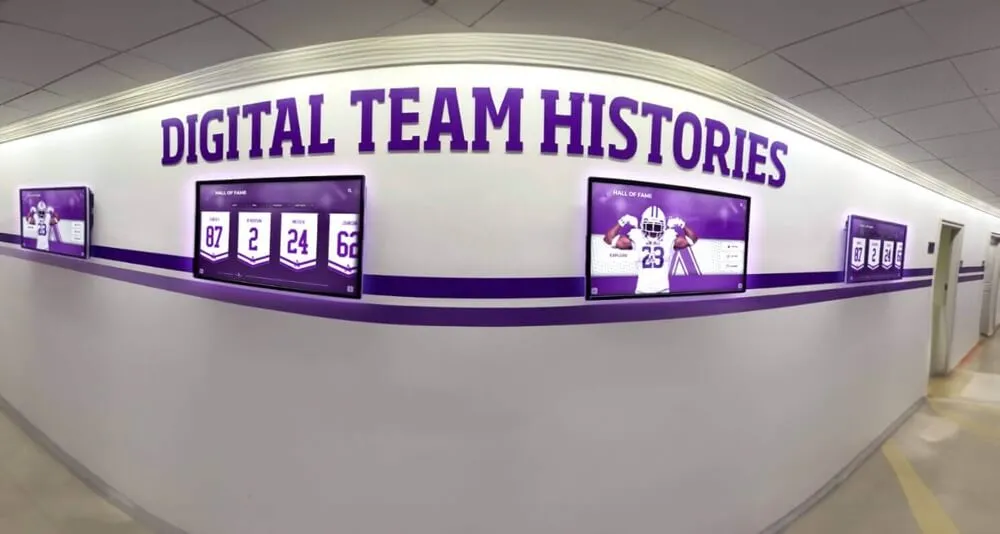
Touchscreen hall of fame displays that surface athlete portrait cards across any era of school athletic history depend on a digitized archive built from carefully assessed source materials — salted paper photograph intake is what ensures early program portraits enter the digital record with their condition documented and their attribution evidence preserved
Connecting Salted Paper Photograph Intake to Athletic Recognition Programs
The practical goal of salted paper photograph intake is a preservation master — a non-contact digitized image captured from a stable, assessed original — linked to a complete intake record that documents who is depicted (to the extent known), what the original physical condition was, and what level of certainty attaches to every identification. That master record, not a display derivative, is the foundation of every downstream recognition use.
A school athletic archive’s earliest surviving portraits — faces from founding teams, coaches from the first documented seasons, players whose names appear on trophy base dedications that are now themselves historic — carry documentary value that extends beyond any individual recognition display. When those portraits are digitized correctly and their provenance documented honestly, they can support an induction ceremony announcement, a centennial display, a digital yearbook page tracing the school’s athletic history, or a hall-of-fame entry spanning many decades. When they are digitized without intake documentation, the recognition story they could tell is built on an unverified foundation.
Before any program portrait enters a recognition database or display system, its provenance and subject identification should be as well documented as the intake conditions allowed. The comprehensive documentation structure for artifacts received into an athletic recognition collection — including fields for donor identity, chain of custody, condition at receipt, and subject attribution — is covered in detail in the athletic hall of fame accession form guidance, which provides a framework applicable to photographs as well as physical artifacts such as trophies, jerseys, and championship hardware.
For early program portraits where ownership history and chain of custody span many decades and multiple hands, the provenance documentation required for display rights and accurate attribution goes beyond the physical condition record. The relationship between provenance evidence, ownership history, and display authorization for historic athletic materials is addressed in the athletic memorabilia provenance form guidance, which applies directly to historic program portraits whose donor documentation is incomplete or whose subject identifications are supplied informally rather than through archival evidence.
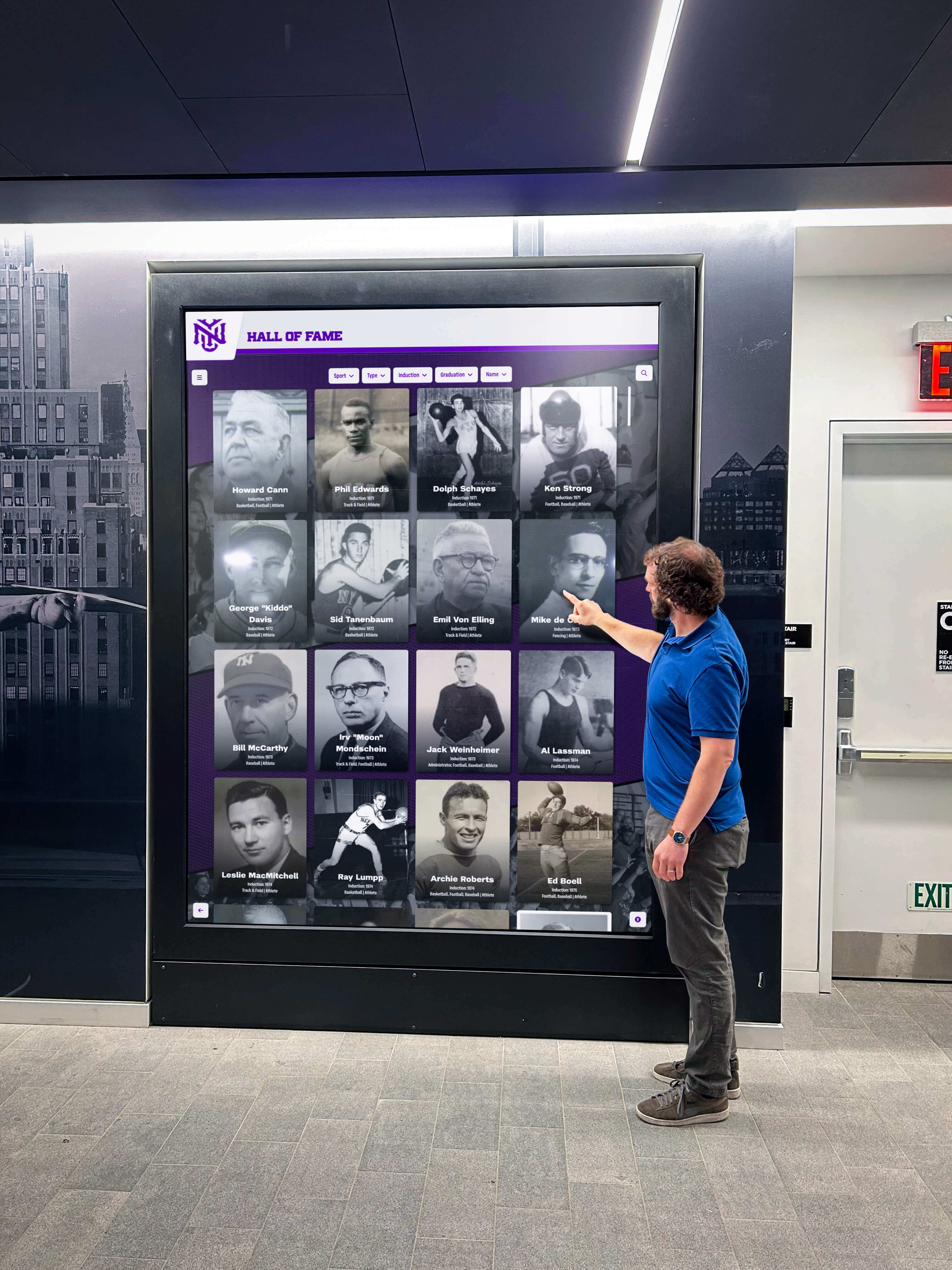
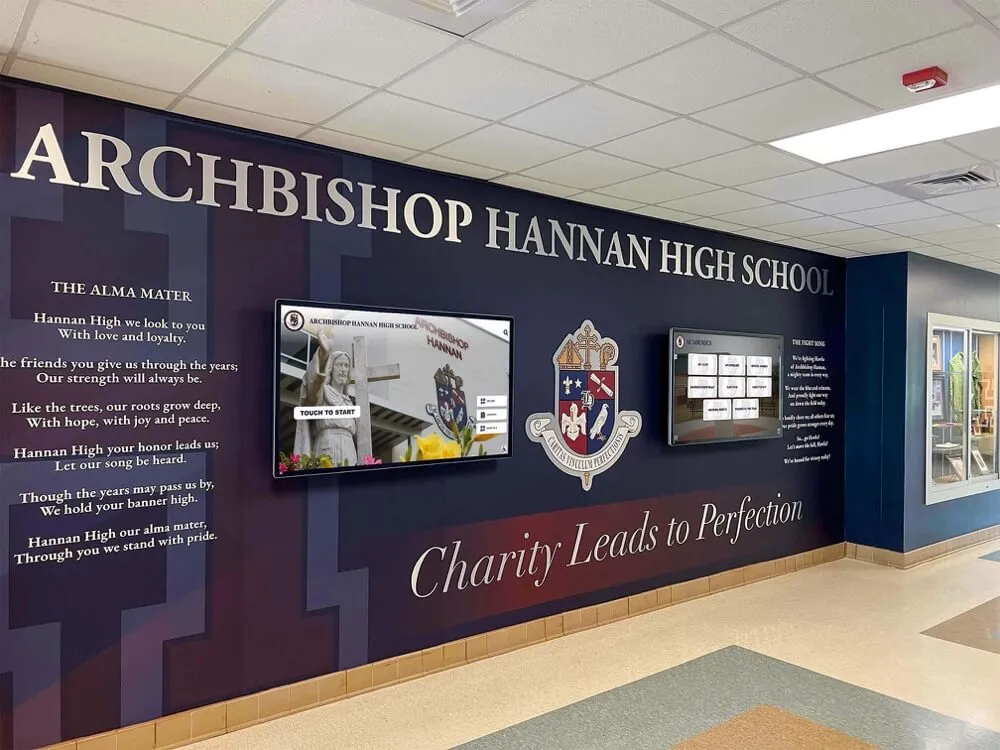
Interactive hall of fame lobby screens that present school athletic history across multiple eras depend on source materials managed correctly from intake — early program portraits entering the digital archive through documented salted paper intake carry the attribution evidence and condition history that make them reliable recognition records
School athletic archives that hold early program portraits alongside physical artifacts from the same eras — founding-era trophies, award hardware with decorative inlays, and other fragile historic materials — are managing multiple categories of objects that share the need for documented condition assessment before any handling, cleaning, or display decision. The same conservative intake discipline that governs salted paper portrait handling applies to ornate historic objects: understanding what material is present before intervening is the principle that protects both. For schools managing historic trophies with decorative inlays — materials whose fragility and care requirements are not apparent from appearance — the condition and handling checklist for historic school trophies with mother-of-pearl inlays provides a parallel documentation-first approach for a common historic athletic artifact that shares cabinet space with early program portraits.
Once salted paper portraits have been digitized and their digital files are loaded into an athletic recognition system, the display hardware presenting those files to athletes, alumni, and the school community introduces its own operational considerations. Recognition display screens in school lobbies and trophy rooms are often on continuously or for extended periods; confirming that screen management features are working correctly — including screen wake lock behavior during interactive display cycles — is a separate technical checkpoint. The testing approach for screen wake lock release and reacquisition in school athletic recognition displays covers how to verify that display screens maintaining a connection to recognition content behave correctly through normal use cycles.
The tactile experience of interacting with a recognition touchscreen to browse historic portraits also depends on display hardware performance that is distinct from photograph quality or database accuracy. Verifying that a touchscreen display used to present early program portraits meets acceptable response characteristics is a practical step before public installation. The touchscreen latency UX checklist for interactive displays provides a structured framework for confirming that the interactive display system presenting historic athletic portraits meets user-experience expectations for response time, which directly affects how visitors engage with the historical record.
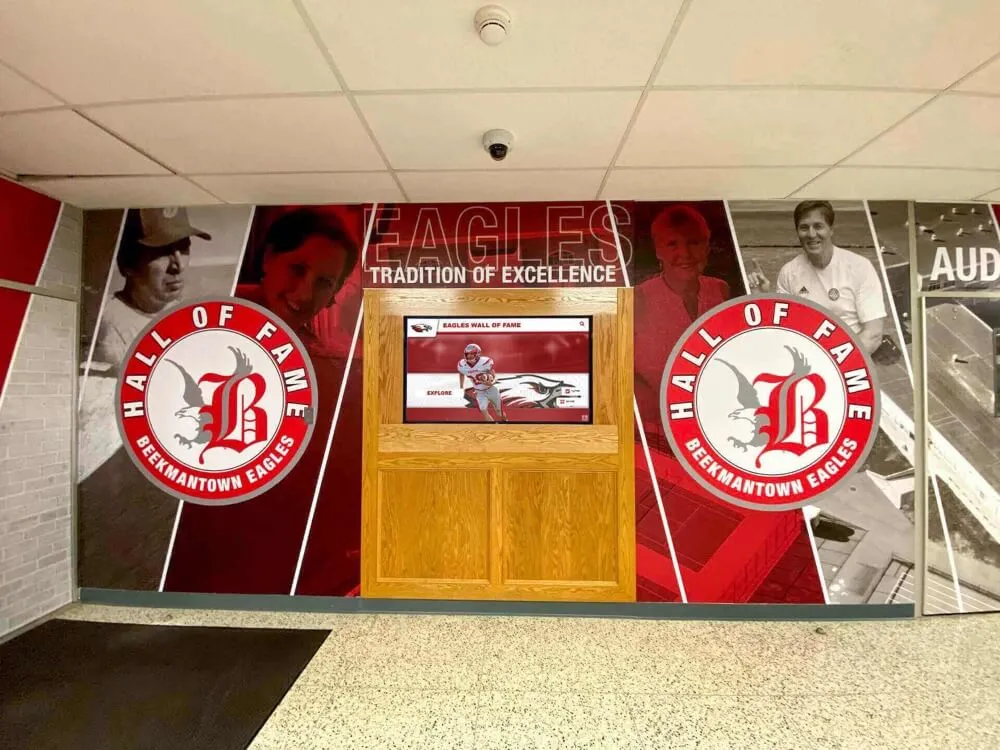
Hall of fame kiosks in school hallways that present program history from founding seasons onward depend on a digitized archive whose earliest materials were assessed, documented, and recovered without damage — salted paper photograph intake is the foundation that makes those founding-era portraits available for display
Artifact: Salted Paper Portrait Intake Record Template
The following template provides a print-level intake record structure for possible salted paper program portraits. It is a reference guide for school archive staff — not a legal document and not a conservation assessment instrument. Fields should be completed by the intake staff member responsible for the examination.
SALTED PAPER PORTRAIT INTAKE RECORD (Example field structure — adapt to school archive management system)
| Field | Content |
|---|---|
| Accession Number | [Assigned at intake — record on enclosure exterior] |
| Intake Date | [Date of examination] |
| Examined By | [Staff member name and role] |
| Prior Storage Location | [Where found within school; building, room, container] |
| Support Type | Unmounted paper / mounted on card / mounted on board / other |
| Support Dimensions | [Height × width, in inches or cm] |
| Mount Dimensions | [If mounted: height × width of mount] |
| Inscriptions — Front | [Verbatim transcription; none observed] |
| Inscriptions — Verso | [Verbatim transcription; inaccessible; none observed] |
| Photographer’s Imprint | [Verbatim, if present; none observed] |
| Accompanying Documentation | [Donor letter, form, note: describe or attach] |
| Donor-Supplied Attribution | [Names, team, date — recorded as donor-supplied, not confirmed] |
| Attribution Uncertainty | [What is confirmed / what is donor-supplied / what is unknown] |
| Provisional Process ID | Possible salted paper / process uncertain / other matte process suspected |
| Basis for Provisional ID | [Matte surface / warm image tone / date range / other — specify] |
| Image Tone | [Reddish-brown / purplish-brown / pale warm neutral / other] |
| Image Fading | None apparent / mild / moderate / severe — location and extent |
| Silver Mirroring | Present (location) / not observed / uncertain |
| Paper Condition | Flexible / slightly stiff / brittle (crackling at edges) |
| Cockling or Curl | Flat / mild cockle / significant curl |
| Foxing or Mold | None observed / foxing (extent) / active mold (isolated; conservator referral) |
| Tears or Losses | None observed / tears (location and extent) / losses (location and extent) |
| Surface Contamination | None observed / present (described) |
| Enclosure at Receipt | Type of enclosure found; condition; pH if known |
| Enclosure Action | Retained / replaced with [material specified] |
| Condition Classification | Stable — no active damage / stable — fading or mirroring / brittle paper / foxing or mold / adhesion / process or condition uncertain |
| Routing Decision | Non-contact digitization / conservator referral / interim re-house and re-inspect |
| Conservator Referral Reason | [If applicable: specific condition requiring specialist assessment] |
| Notes | [Any observation not captured above] |
Who This Intake Workflow Serves
| Role | Primary Concern | How Salted Paper Photograph Intake Helps |
|---|---|---|
| Athletic Director | Completeness and accuracy of the school’s earliest athletic history record | Identifies which early program portraits can be digitized immediately and which carry condition requiring conservator referral before the image enters the digital archive; ensures attribution uncertainty is documented before subjects are named in recognition programs |
| Recognition Program Owner | Display-ready, accurately attributed content for hall-of-fame and athlete recognition programs | Ensures that early program portrait images and their associated inscriptions are captured from stable, assessed prints, and that attribution uncertainty is preserved in the recognition record rather than replaced with unverified identifications |
| IT / Data Staff | Efficient digitization workflow with complete metadata linking images to records | Produces a condition-classified print inventory that sequences digitization priorities, specifies the scanning approach required for each print, and establishes the accession link that connects the digital file to its full intake documentation |
| Librarian / Archivist | Collection-level condition documentation and long-term preservation planning | Produces a print-level condition record that supports both immediate digitization decisions and ongoing collection care; documents enclosure actions taken at intake |
| Facilities Staff | Safe handling of historic, fragile physical materials | Establishes clear handling protocols that identify which prints require specialist involvement, removing uncertainty about whether in-house staff should attempt to flatten, clean, or re-mount brittle early portraits |
| School Administrator | Institutional record completeness and defensible preservation practice | Documents that the school assessed historic program portrait condition systematically before digitizing, that attribution uncertainty was recorded honestly, and that fragile prints were routed appropriately before any scanning was attempted |

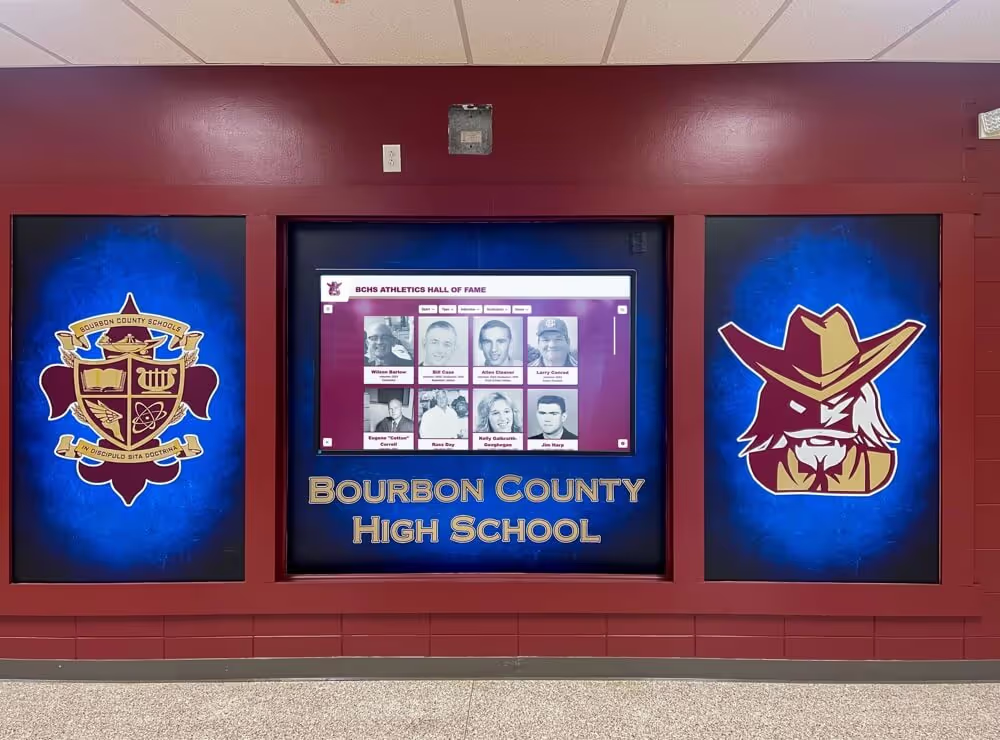
Hall of fame digital displays presenting a school's full program history from earliest seasons onward rely on source photographs that were assessed, documented, and recovered without damage — salted paper photograph intake is the first step in that chain for any school whose program records reach back to the mid-nineteenth century
Frequently Asked Questions
How do I tell a salted paper print from a platinum print in a school athletic archive?
Both processes produce matte, warm-toned prints without a distinct surface coating, and visual inspection alone cannot reliably distinguish between them in most cases. Platinum prints — produced by a completely different iron-based chemistry, dominant from the 1870s through approximately the 1930s — tend toward cooler, grayer shadow tones than salted paper, but the tonal difference is subtle and altered by deterioration. If the distinction matters for a handling or conservation decision, a photographic conservator can identify the process through non-destructive methods not available at a school intake station. At intake, treat any matte, early-era print conservatively and document the process as uncertain if you cannot identify it with confidence; that is a legitimate and accurate intake finding.
Can I use a chemical test or washing procedure to identify or clean a suspected salted paper print?
No. Chemical testing of photographic materials — including simple moisture tests, solvent spot tests, or any washing procedure applied to the print surface — is a specialist-level intervention that requires controlled conditions and specialist expertise not available in a school setting. Introducing water or any liquid to a salted paper print surface risks dissolving or redistributing the image silver in the upper paper fibers, causing irreversible image loss. No in-house chemical test or washing procedure is part of a school intake workflow for suspected salted paper prints.
The early program portrait has names listed on the donor form but they don’t match any names in our existing athletic records. What should I do?
Document the donor-supplied names exactly as provided in the attribution uncertainty field of the intake record, and flag them for independent verification before those names enter any recognition database or are associated with the portrait in a public display. Discrepancies between donor-supplied names and existing athletic records are not uncommon for portraits from the earliest program decades, where independent documentation may be limited. The intake record should accurately reflect the state of knowledge at intake — what is confirmed from primary sources, what is donor-supplied, and what is unresolved — so that subsequent research can address the discrepancy from a documented starting point rather than an assumed one.
Should I press a curled salted paper portrait flat to improve scan quality?
No. Pressing or weighting a brittle or fragile print to achieve flatness risks fracturing the paper support — the same paper fiber fracture that removing a crease would require you to press across. A curled salted paper print that lies reasonably flat without force is a candidate for non-contact overhead digitization in its current, mildly curved state; the camera or overhead scanning system captures the image without requiring the print to be flat on a platen. A print with significant curl that cannot be brought anywhere near flat without force should be routed to a photographic conservator who can assess whether relaxation treatment is safe before any scanning approach is selected.
What if the inscription on the portrait names a specific athlete and event, but we can’t verify the event from any other school record?
Document the inscription verbatim in the intake record and note that independent verification from school athletic records has not been established. Do not enter the event as confirmed in a recognition database until verification is complete; the intake record preserves the inscription evidence as a starting point for that research. Schools holding historic program portraits alongside award and event records in a recognition database can use the accession number to link the portrait’s intake record to any subsequent verification findings, maintaining a documented evidence chain from the physical artifact to the recognized achievement.
How do I find a photographic conservator who works with early paper print processes?
The American Institute for Conservation maintains a Find a Conservator directory at culturalheritage.org that allows filtering by specialty, including photographic materials. Regional conservation centers, state historical societies, and university library conservation programs also maintain referral lists for photographic material conservators. When contacting a conservator, bring your intake documentation — photographs of each print’s current condition, provisional identification notes, storage history, and verbatim inscription or provenance information — so the conservator can scope the assessment before materials are transported.
A complete school athletic archive salted paper photograph intake converts an unknown-risk group of early program portraits into a documented collection where every print has an assessed condition, a verbatim inscription record, an explicit attribution uncertainty notation, and a confirmed routing path — before any scanning equipment approaches a brittle paper surface that has survived more than a century to document the people and teams at the beginning of a school’s athletic story.
Ready to connect your documented, digitized early program portrait archive to an athletic recognition program that makes school history visible across generations?
Request a Rocket Alumni Solutions demo and see how schools are turning carefully preserved historic athletic archives — early program portraits, founding-team records, and championship documentation — into searchable hall-of-fame displays, digital yearbook programs, and touchscreen recognition installations that bring every era of athletic history to life for athletes, alumni, and the school community.