Athletic archive microfilm redox blemish inspection is the pre-digitization assessment process that examines rolls of silver-gelatin microfilm — containing school sports newspapers, athletic programs, and award lists — for the red, orange, or golden-yellow spots caused by oxidative deterioration of the silver image layer, and determines which rolls can proceed to scanning, which require specialist evaluation, and how image loss in affected areas should be documented before any copy or digitization workflow begins. When a school’s run of sports newspapers, seasonal athletic programs, or records of letter-winner and award recipients survives on silver-gelatin microfilm rather than in original print form, the silver that forms every word and face in those frames is vulnerable to a chemical degradation process: oxidizing gases or moisture in the storage environment can attack the image silver, causing it to migrate and re-deposit as colloidal silver at or near the film surface. That re-deposited silver reflects and absorbs light differently than the original image silver, producing the characteristic red, orange, or golden blemishes that preservation specialists call redox blemishes. Where blemishes overlap printed text or a student’s name on an award list, the image information in that area may have been altered or lost. Scanning a blemished frame captures the blemish, not the original image beneath it — digitization cannot reverse silver loss or recover obscured content.
This guide gives school athletic directors, archive staff, IT coordinators, and recognition program owners a practical inspection workflow for silver-gelatin athletic archive microfilm: a plain-language explanation of what redox blemishes are and how they form, a numbered inspection procedure, a decision table for routing affected rolls, documentation steps, guidance on distinguishing blemishes from dust or other surface defects without making a definitive unaided diagnosis, and the criteria for specialist referral. Chemical treatment of microfilm, attempts to remove or mask blemishes, and claims that obscured text or names can be recovered through digitization alone are outside the scope of this guide and are not appropriate for in-house school archive handling.
Redox blemish inspection for athletic archive microfilm addresses a distinct deterioration mode from the conditions assessed in film curl inspection, shrinkage measurement, or perforation damage review. Those assessments address the mechanical integrity of the film base and its transport characteristics through a scanner. Redox blemish inspection addresses the chemical integrity of the silver image layer itself — whether the information recorded in silver is still present and intact, or whether oxidative deterioration has altered it in ways that affect both the quality of any digitized copy and the completeness of the athletic record being preserved.

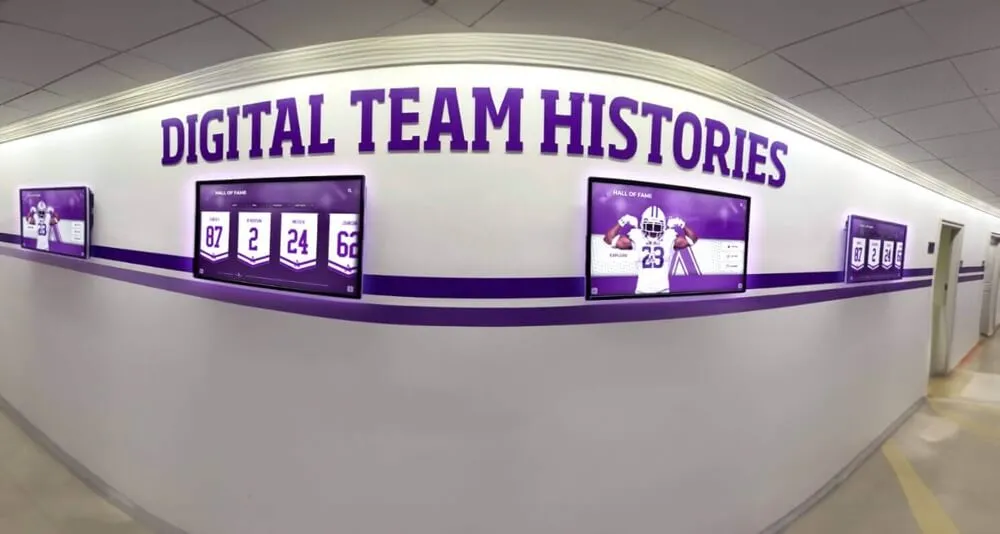
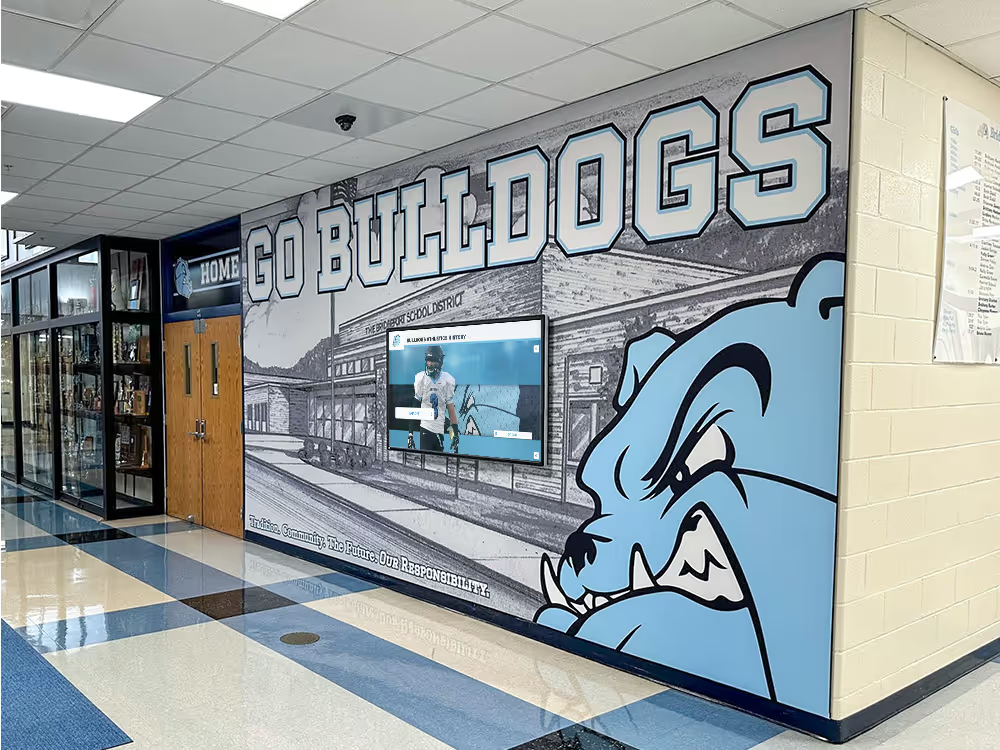
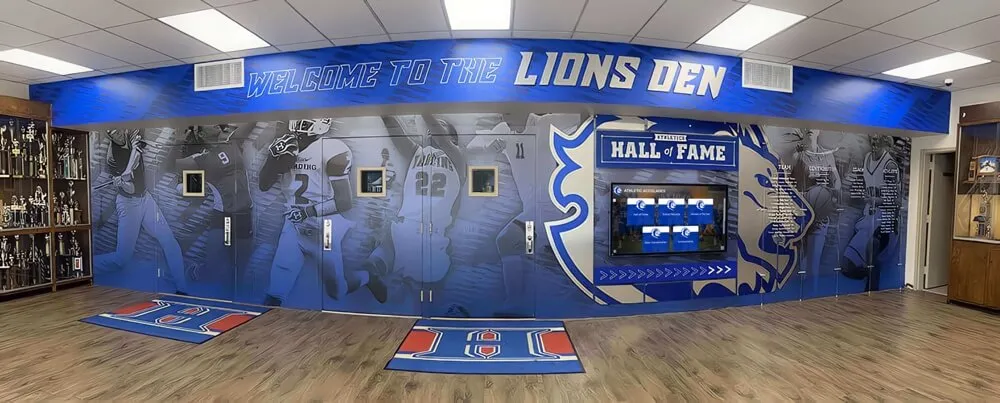
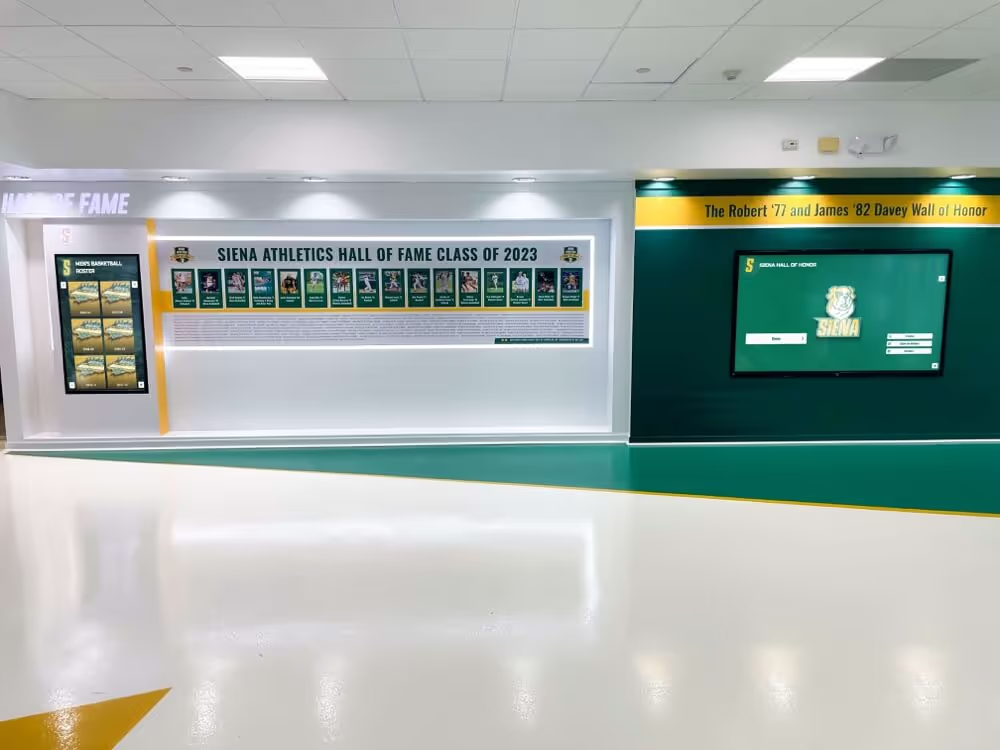
School hallway displays presenting decades of athletic records and team history depend on source documents recovered from microfilm — redox blemish inspection before digitization ensures that condition findings are documented and image loss in affected frames is identified before scanning, rather than discovered after the fact in a completed digitized file
What Redox Blemishes Are and How They Form
Redox blemishes take their name from the oxidation-reduction chemistry that produces them. In a silver-gelatin microfilm frame, the visible image is formed by metallic silver suspended within a thin gelatin binder layer coated onto a film base. That metallic silver is chemically stable under proper storage conditions, but it is vulnerable to oxidizing agents — ozone, nitrogen oxides, hydrogen peroxide, and other reactive gases present in many storage environments. When an oxidizing agent contacts the image silver, it converts metallic silver atoms to silver ions. Those silver ions become mobile within the gelatin layer and may migrate toward the film surface, where they can be reduced back to metallic silver — but in a different physical form. Re-deposited at the surface as colloidal clusters rather than the original image-forming grains, this silver absorbs and scatters light differently, producing colors in the red, orange, and golden-yellow range rather than the neutral gray-black of healthy image silver.
Research published in the Journal of Research of the National Bureau of Standards (now NIST) documented the mechanism of redox blemish formation in processed microfilm and identified the role that relative humidity plays in blemish development: blemishes form more readily and spread more extensively at elevated relative humidity levels because moisture accelerates the mobility of silver ions within the gelatin layer. The same research identified residual processing chemicals — particularly thiosulfate left in the film from incomplete fixing and washing during original processing — as a factor that can accelerate deterioration when combined with atmospheric oxidants and humidity. The full text of that research is available from NIST and provides the technical foundation for current preservation guidance on redox blemish prevention and control.
The National Archives notes in its guidance on film-based holdings preservation that silver-gelatin microfilm requires controlled storage environments — specifically cool temperatures and moderate relative humidity — to minimize the chemical deterioration processes that produce blemishes and other forms of silver image loss. The guidance emphasizes that storage environment is the primary variable under an institution’s control for protecting the long-term integrity of film-based holdings.
For school athletic archives, the typical storage history of microfilm — filing cabinets in administrative offices, shelves in media rooms, boxes in storage areas without climate control — frequently provides the elevated humidity and atmospheric oxidant exposure that accelerate blemish formation. Rolls that have been stored in unsealed cardboard boxes, kraft paper envelopes, or with rubber bands around them have had their silver image layer in contact with materials that can off-gas oxidizing or reducing agents over decades.
The Role of Storage Environment and Enclosure Materials
Redox blemishes do not develop evenly across a microfilm collection. The condition concentrates in rolls that were exposed to the highest levels of atmospheric oxidants, the highest sustained humidity, or enclosure materials that actively release reactive compounds. Understanding which rolls in a collection carry the highest risk before inspection begins allows athletic archive staff to triage efficiently and focus detailed examination where blemish probability is greatest.
Storage conditions associated with elevated redox blemish risk:
- Storage areas without mechanical climate control, particularly in buildings with seasonal humidity variation
- Proximity to photocopiers, laser printers, or HVAC systems that generate ozone
- Storage in unsealed cardboard boxes, kraft paper envelopes, or materials that have not been tested for photographic activity
- Rolls stored with rubber bands, which can off-gas sulfur compounds in contact with the gelatin layer
- Long-term storage in areas exposed to traffic from cleaning products, paints, or other chemical off-gassing sources
Storage conditions associated with lower redox blemish risk:
- Rolls stored in polyester or polypropylene sleeves or canisters that have passed photographic activity testing
- Rolls held in a dedicated, climate-controlled storage area at moderate relative humidity (around 30–40% RH) and cool temperature
- Rolls in original manufacturer canisters that have remained sealed in stable environments
Schools planning long-term athletic archive protection can find relevant context for storage environment management in guidance on humidity control for school trophy cases and archival materials — the same principles of controlling relative humidity to protect physical artifacts apply directly to microfilm storage, where humidity is a primary driver of silver oxidation and blemish formation.
Redox Blemishes vs. Related Conditions: Core Distinctions
Before the full inspection workflow, it is useful to understand how redox blemishes differ visually from other conditions that may appear on school athletic microfilm. No unaided inspection can definitively confirm a diagnosis that requires microscopy or chemical analysis — the goal of the distinction table below is to guide documentation and routing decisions, not to replace specialist evaluation.
| Observation on Film | Most Likely Condition | Key Visual Characteristics | Specialist Needed? |
|---|---|---|---|
| Discrete red, orange, or golden-yellow spots or blotches; may be concentrated in image areas | Redox blemishes | Color distinguishes from image silver; spots may be circular or irregular; may cluster near edges or in image areas | Yes — before digitization if extensive; document and route |
| Discrete dark specks or irregular particles that shift position or can be dislodged with gentle air | Surface dust or debris | Not embedded in film; position changes; no color tint to the film material itself | No — document; clean per standard microfilm handling protocols before scanning |
| Linear marks along the film surface, parallel to the film edge or at an angle | Scratches or abrasion | Linear geometry; may affect image area or base | Depends on severity; document and note for scanner operator |
| Bluish or silvery metallic sheen at the film surface, typically in low-density areas or near edges | Silver mirroring (distinct from redox blemishes) | Reflective metallic appearance without the red/orange color of redox spots; typically more uniform than discrete blemish spots | Yes — specialist evaluation; silver mirroring on microfilm is a different condition from redox blemishes on the same or related material |
| Yellowing or tan discoloration across large areas of the frame, not discrete spots | Fading or base discoloration | Broad rather than discrete; affects image density overall | Specialist evaluation for silver image fading |
| Irregular white or light patches with no image detail | Image loss (silver lost) | No image information present; may be associated with severe blemish history or processing failure | Document thoroughly; specialist evaluation |
Silver mirroring on photographic prints or negatives — the bluish-silver metallic sheen caused by oxidized image silver migrating to the material surface — is a related but distinct condition from redox blemishes on microfilm. On prints and film negatives, silver mirroring typically appears as a reflective metallic layer in low-density areas; on microfilm, redox blemishes appear as the colored spots described above. The two conditions share a chemical family but differ in their appearance, distribution, and conservation implications. An inspection finding that clearly shows the red-orange coloration of redox blemishes should be documented as such and routed for specialist confirmation rather than treated as equivalent to silver mirroring.
Why School Athletic Microfilm Holds Specific Preservation Stakes
The content recorded on school athletic archive microfilm — sports newspaper issues announcing championship results, game-day programs listing player rosters and coaching staff, award lists recording letter winners, academic athletes, and recognition recipients by name — is often the only surviving copy of that record. If the original newspaper issues or programs were not retained, the microfilm is the institution’s only access to the information those documents contained.
A redox blemish that overlaps a student’s name on an award list, or that obscures a championship score in a sports newspaper headline, represents image information that may not be recoverable from this source. Digitizing a blemished frame produces a digital file of the blemished image — it does not restore image detail beneath the blemish. For school athletic archives whose mission includes preserving the names of award recipients, honoring the athletic achievements documented in those newspapers and programs, and making that history accessible through digital recognition programs, the stakes of undocumented blemish condition are direct: a digitized record with undocumented blemishes will show degraded or missing content that the institution cannot explain or contextualize after the fact.
Knowing which frames on which rolls carry blemishes — before digitization begins — allows the archive to:
- Prioritize scanning of unblemished rolls to secure clean digitized copies while the film remains stable
- Identify frames where image content may be partially or fully obscured, and document that condition for the institutional record
- Route affected rolls to a specialist for evaluation of whether any recovery approach is appropriate for the specific material
- Avoid investing digitization resources in rolls where blemish condition has already progressed to the point where scanning would produce files of limited value without prior specialist assessment
Athletic Archive Microfilm Redox Blemish Inspection: A 5-Step Workflow
Step 1: Prepare the Inspection Area
Establish a consistent inspection station before handling any microfilm rolls. The inspection environment for redox blemish assessment requires controlled, consistent illumination that allows color detection on the film surface — conditions that are not standard in most administrative or media room settings where school microfilm collections are commonly held.
Required at the inspection station:
- Clean, lint-free cotton or nitrile gloves (worn throughout all film handling)
- A microfilm reader or light table capable of providing transmitted light for viewing individual frames
- A small, focused directional light source — a focused LED flashlight or adjustable desk lamp — for oblique surface illumination (raking light) of the film surface
- A jeweler’s loupe or magnifying glass (7× to 10× magnification) for close frame examination
- A camera or smartphone capable of close-up photography for condition documentation
- A scale reference (ruler or archival label) for documentation photographs
- Archival-quality individual canisters or polyester sleeves for housing after inspection
- An inspection log or form for recording roll-level and frame-level findings
Exclude from the inspection station:
- Any liquid, solvent, or chemical of any kind — including water, isopropyl alcohol, or cleaning solutions marketed for film
- Any implement that could be used to rub, scrape, or apply pressure to the film surface
- Heat sources
- Rubber bands, adhesive tape, or any non-archival securing material
Redox blemishes are an existing chemical condition in the film. They cannot be reduced, masked, or removed by any in-house cleaning or treatment. Correct inspection handling is observation, documentation, and careful re-housing — not intervention.
Step 2: Initial Roll Survey Under Transmitted and Oblique Light
Begin each roll with a brief initial survey before detailed frame examination. The initial survey identifies rolls with obvious, extensive blemish presence that warrants immediate routing decisions without detailed frame-by-frame examination.
Initial transmitted-light survey:
Load the roll on a microfilm reader or advance it by hand under a light table in short sections, scanning the overall image and border areas at normal viewing distance. Redox blemishes visible at this scale — meaning they are large enough or dense enough to be noticed without magnification — are likely to be moderate or severe in extent. Note the approximate location on the roll (beginning, middle, end sections) and the rough proportion of frames showing visible coloration.
Initial oblique-light surface survey:
Hold a section of the film against a dark background and angle a focused light source at a low angle to the film surface (approximately 20 to 30 degrees from the film plane). Oblique illumination makes surface deposits, foreign material, and the red-orange surface coloration of redox blemishes more visible than straight-on transmitted light. Observe the film edge area — the border between the image frame and the film edge is a location where blemishes sometimes concentrate first, because edge areas may have had more direct exposure to atmospheric oxidants than central image areas.
Classify the roll at the initial survey level:
After the initial survey, assign a preliminary classification to each roll:
- No visible blemishes at initial survey level: Proceed to Step 3 for close examination of a representative frame sample before assigning a final classification.
- Scattered visible blemishes in border areas only: Proceed to Step 3 with close examination focused on whether blemishes are confined to borders or extend into image areas.
- Visible blemishes overlapping image areas: Proceed to Step 3 with close examination; document roll as a priority referral candidate.
- Dense or extensive coloration covering large portions of multiple frames: Document immediately; route for specialist evaluation before any digitization attempt.
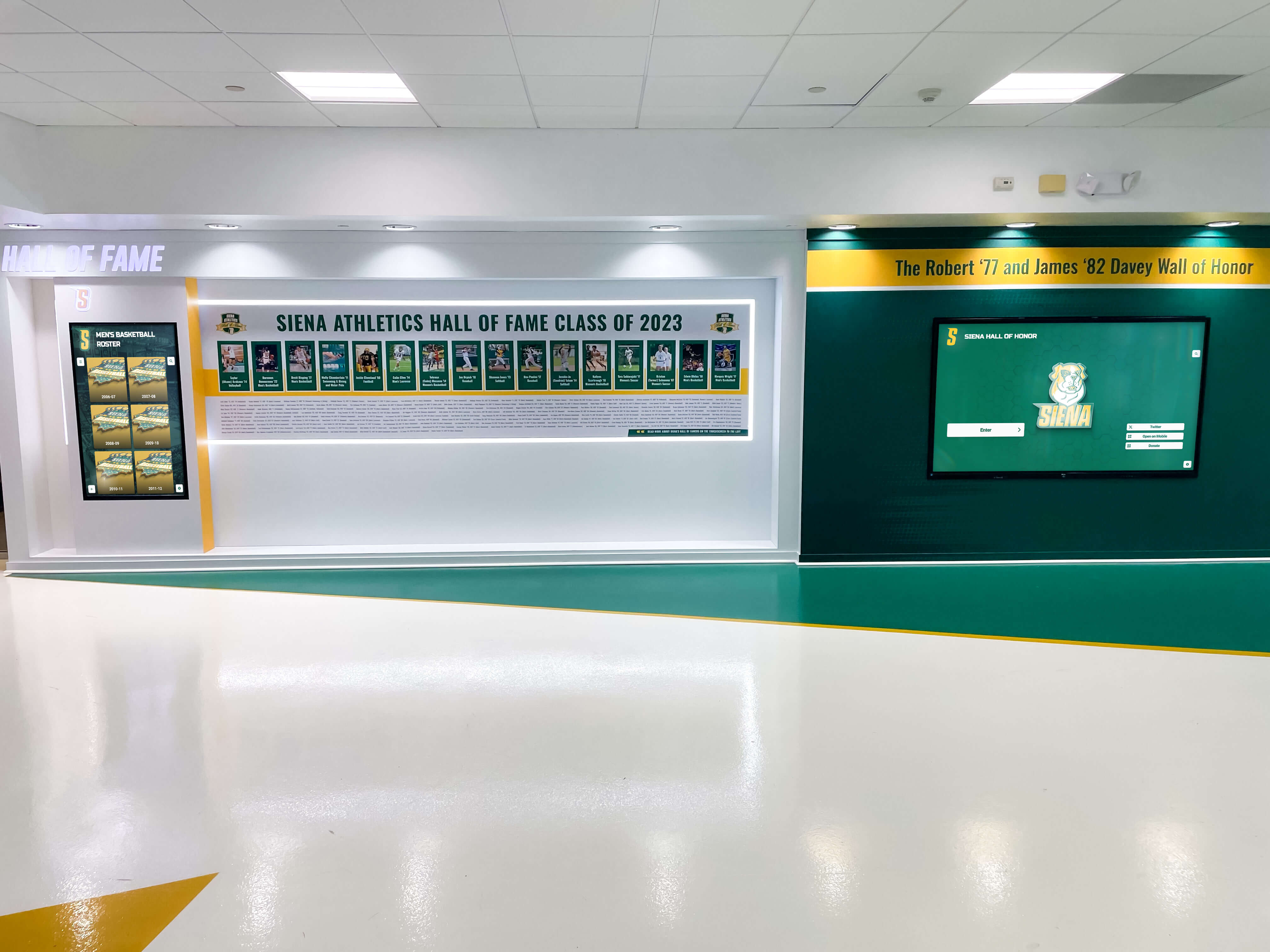
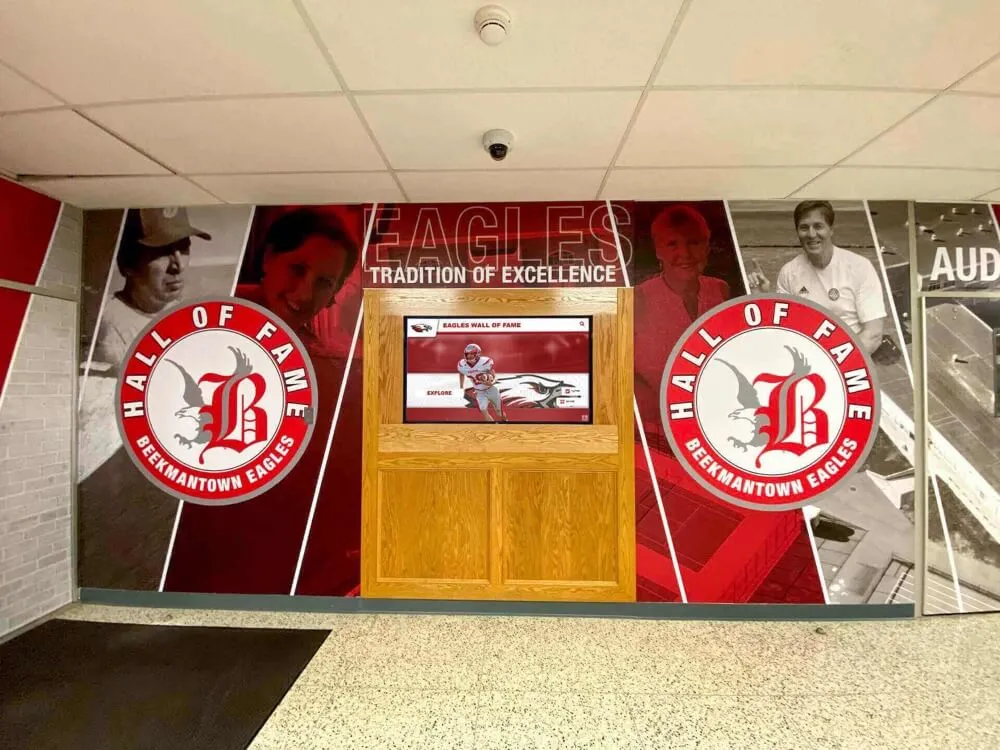
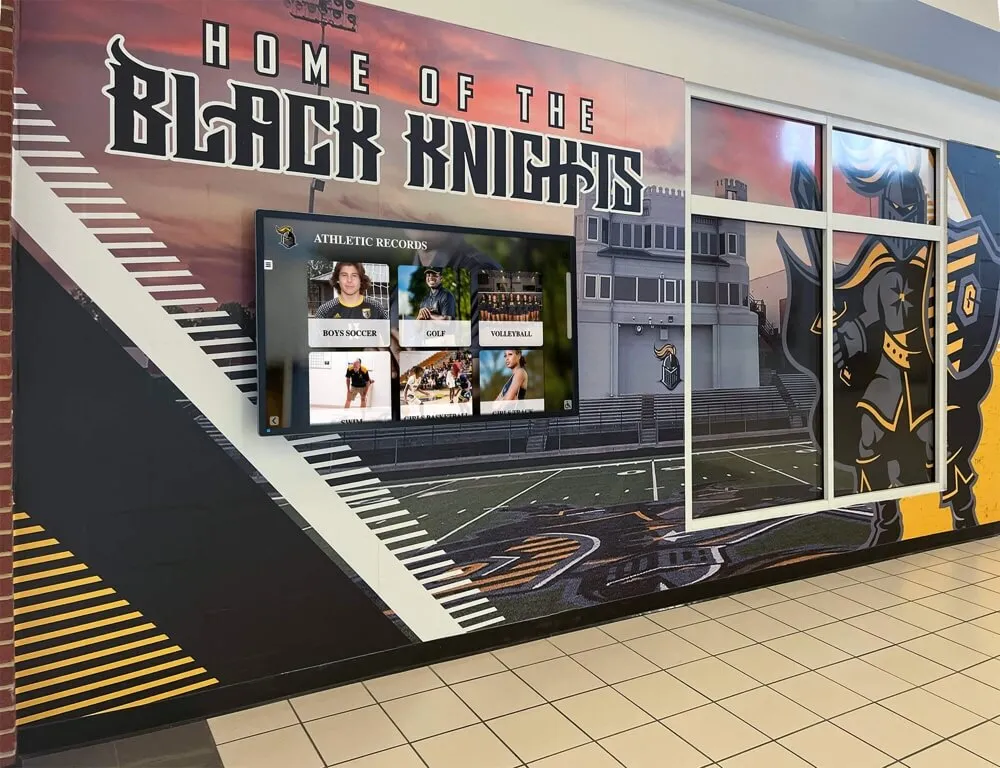
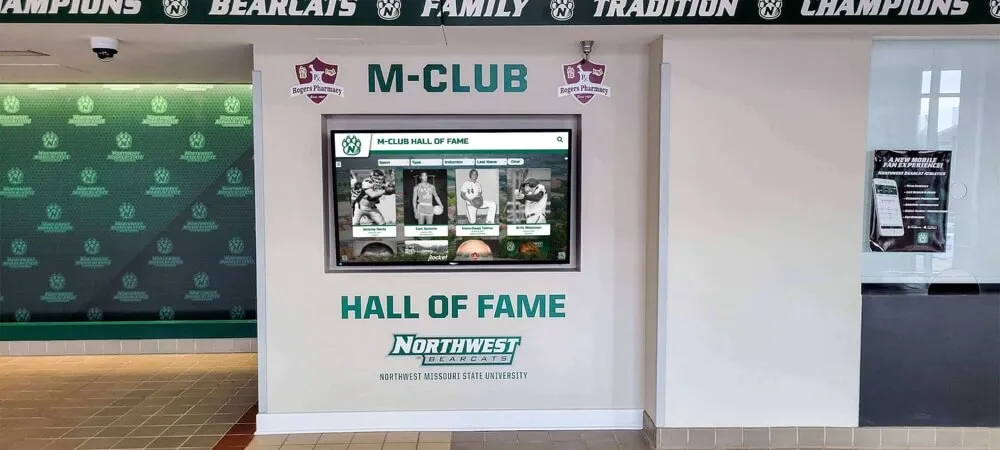
Hall-of-fame displays presenting championship history and award recipients depend on records recovered from their source documents — when those documents survive on microfilm, redox blemish inspection before digitization identifies which rolls can be scanned immediately and which need specialist evaluation first
Step 3: Close Frame Examination for Blemish Characteristics and Distinction from Other Defects
For rolls that pass the initial survey without immediate routing to a specialist, conduct close frame examination on a representative sample of frames across the roll’s length (beginning, middle, and end sections). This step distinguishes redox blemishes from other surface conditions and establishes the spatial relationship between any blemishes found and the image content.
Frame examination under transmitted light through the loupe:
Advance the roll to a frame in each section and examine it through the loupe under transmitted light. You are looking for:
Color tint in the image or border area: Healthy silver image frames show gray-black tones. A red, orange, or golden-yellow coloration in any area of the frame — whether in the image content, in the text block of a sports newspaper column, in the border area, or in the frame edge — is the primary indicator of possible redox blemish presence. Document color, extent, and spatial location relative to image content.
Spatial relationship to image density: Blemishes may appear anywhere within the frame. Their overlap with high-density image areas (printed text, photographic images of athletes or teams) versus low-density or clear border areas determines whether image information may be affected.
Frame examination under oblique light through the loupe:
After examining each sample frame under transmitted light, examine the same area under oblique light with the directional source held at a low angle. You are looking for:
- Surface deposits that move or dislodge: If a colored spot or dark speck shifts position when the film is gently advanced or if it is clearly on the surface rather than within the film, it is more likely to be particulate contamination (dust, debris) than a blemish embedded in or on the gelatin layer.
- Color that is within the film material rather than on its surface: Redox blemishes are in or at the gelatin layer, not loose on the surface. Their color does not shift with oblique illumination angle the way a surface-deposited particle would.
Important limitation: Unaided visual examination — even with a loupe — cannot definitively distinguish redox blemishes from all other possible surface conditions, confirm the depth of silver alteration, or assess whether image silver beneath a colored area is intact or lost. The goal of close examination is to document observable characteristics and provide enough information to route the roll appropriately. Definitive diagnosis is a specialist function.
Step 4: Document and Record Each Finding
Documentation for redox blemish inspection creates the condition record that travels with each roll through the rest of the archive’s workflow — to the scanner operator, to the specialist if referral is warranted, and into the long-term condition history for each roll.
Photographs to capture for each roll showing blemish presence:
Roll identification photograph: The roll canister or housing with the roll’s accession number, title reference (e.g., “Sports Newspaper 1978–1982”), and any existing labels visible in frame. Establishes the chain of custody and condition record for this specific roll.
Transmitted-light frame image: The most blemish-affected frame visible in the sample, photographed on the light table or microfilm reader screen. Include a scale reference. This photograph communicates the visual character and extent of blemish presence to a specialist without requiring them to handle the roll for an initial remote assessment.
Oblique-light surface image (if blemish-like coloration is present): A frame section photographed under oblique light to document surface characteristics. This helps distinguish in-film coloration from loose surface contamination.
Context image showing blemish-to-content relationship: A photograph that makes the spatial relationship between the colored area and image content — text blocks, athlete names, score lines in a newspaper — visible. This is the most important document for evaluating the athletic record preservation stakes of the finding.
Condition record fields for each inspected roll:
- Roll accession number and title reference
- Film format (35mm, 16mm, or other), approximate date range of content
- Storage location and housing type at time of inspection
- Initial survey classification (no visible blemishes / border area only / image area overlap / dense/extensive)
- Close examination findings: color observed (red, orange, golden-yellow, or ambiguous), distribution (scattered spots / clustered / linear / edge-concentrated), approximate extent (less than 10% of examined frames / 10–50% / more than 50%), and relationship to image content areas
- Any associated observations: yellowing of film base, vinegar odor (which would indicate a separate acetate degradation condition requiring separate assessment), unusual surface texture
- Date of inspection and name of inspector
- Routing decision and rationale
Recording consistent condition fields for each roll allows the archive to sort and prioritize its collection systematically — identifying which rolls need specialist evaluation urgently, which can proceed to digitization, and which are at moderate risk and should be scheduled for a second inspection within a defined period.
Step 5: Classify and Route Each Roll
After completing Steps 1–4, assign a final classification to each roll and route it to the appropriate handling path.
| Classification | Inspection Finding | Digitization Path | Specialist Referral |
|---|---|---|---|
| Grade 0 — No blemishes detected | No red/orange coloration visible under transmitted or oblique light at initial survey or close examination; image silver appears neutral | Proceed to standard digitization intake | Not required at this time; schedule for periodic re-inspection |
| Grade 1 — Border area blemishes only | Coloration confined to frame borders and edges; no overlap with printed text, image content, or named record areas | Proceed to digitization; note condition in scan record so scanner operator is aware; monitor for progression | Specialist consultation recommended before final disposition decisions for the collection |
| Grade 2 — Scattered image-area blemishes | Coloration overlaps image content in a minority of examined frames; affected content can be identified and documented | Digitize with priority; document all frames with image-area blemish presence; note extent of possible image loss in the digital record | Specialist evaluation recommended; route roll alongside documentation package |
| Grade 3 — Moderate image-area blemishes | Coloration overlaps image content in a significant proportion of examined frames; text or named information in affected frames may be partially obscured | Specialist evaluation before digitization; do not invest primary digitization resources until specialist has assessed recoverability | Required; include documentation photographs and condition record |
| Grade 4 — Extensive or dense blemishes | Dense coloration across large portions of many frames; image content substantially affected in multiple sections of the roll | Specialist evaluation before any digitization; document thoroughly | Required urgently; this roll’s image silver is at significant risk of further change |
| Ambiguous finding | Colored areas present but characteristics do not clearly confirm redox blemish vs. other surface condition | Do not proceed to digitization until identification is confirmed | Required for identification |
Digitization Priority Planning After Inspection
The output of a completed redox blemish inspection is a condition-classified inventory that allows the archive to make informed, defensible decisions about digitization sequencing. For school athletic archives with limited digitization resources — a common situation when scanning services are procured annually on a project basis — the inspection classification directly determines where those resources go first.
Priority 1 — Grade 0 rolls: Rolls with no detected blemishes should be digitized first. They contain intact image silver that is recoverable at current quality. Delaying digitization of stable rolls while addressing deteriorated rolls inverts the priority: stable content is the most reliably recoverable and should be secured while the film is in its best condition.
Priority 2 — Grade 1 rolls: Border-area-only blemishes do not currently affect image content. These rolls can be digitized to produce complete records, with the blemish extent noted in the condition record for monitoring.
Priority 3 — Grade 2 rolls: Scattered image-area blemishes mean some content is already affected. Digitization now captures the current state — which may be better than the state in one or five years if blemish progression continues. Frame-level documentation of affected content allows the school to note specific frames where names or data may be partially obscured in the digital record.
Do not prioritize Grade 3 or Grade 4 rolls for standard digitization without specialist assessment. Digitizing a roll with moderate or extensive image-area blemishes without specialist guidance may produce a digitized archive that captures the blemish condition without any evaluation of whether recovery-informed scanning approaches could improve the result. A specialist may recommend illumination adjustments, resolution choices, or other scanning parameters that improve image recovery from blemished microfilm — or may advise that specific frames be photographed or duplicated using alternative methods before or alongside standard scanning.
Schools building out an athletic awards recognition program — including the kind of display that presents specific student names and their achievements — will want to know how athletic awards rubrics identify the leadership, sportsmanship, and statistical achievements that appear on the award lists in their microfilm collection. Understanding what information those lists contain is directly relevant to prioritizing which frames get the most careful blemish documentation — because those are the frames where a partially obscured name represents a real gap in the school’s athletic honor record.
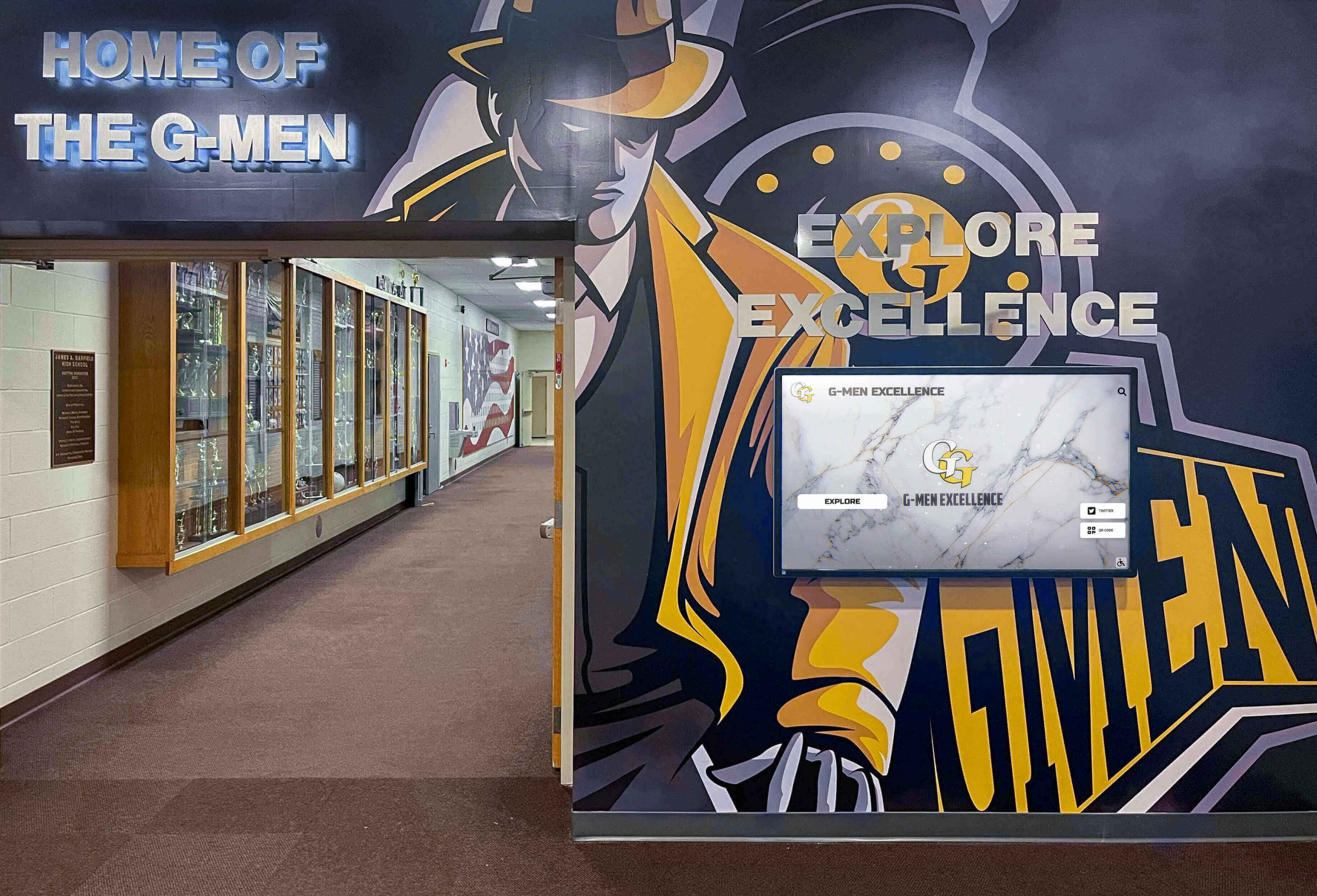
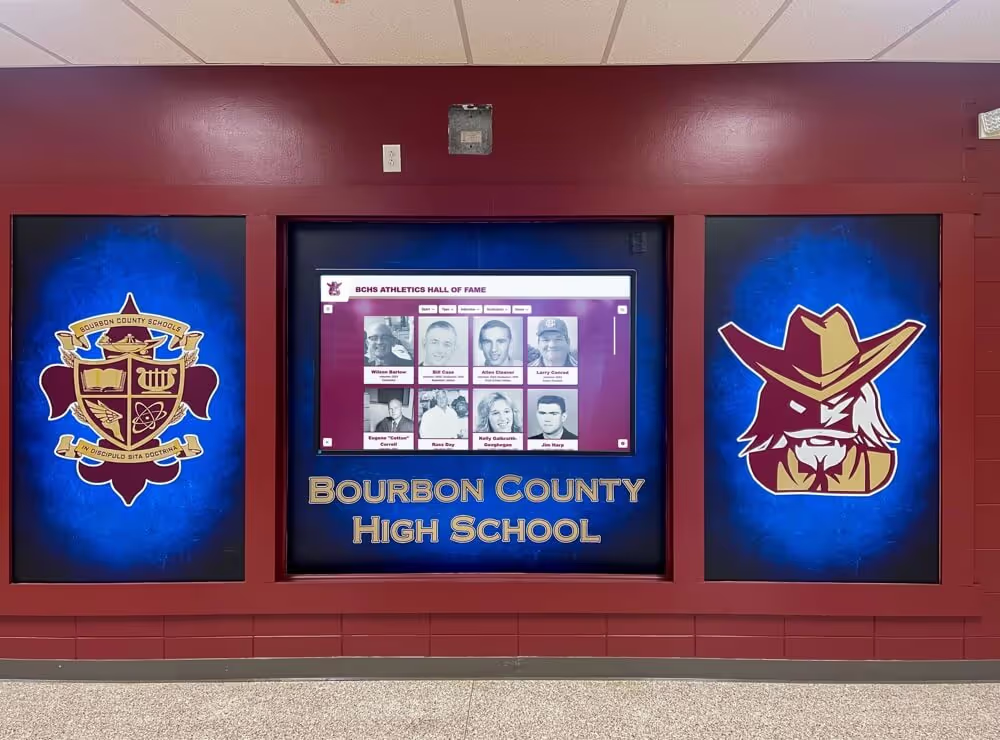
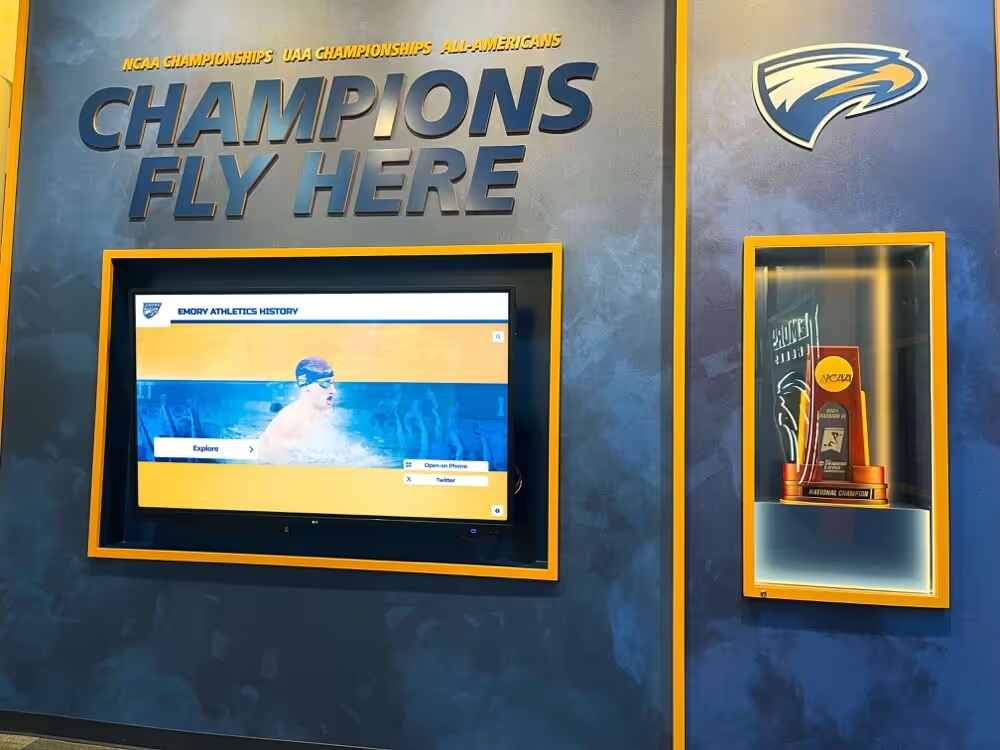
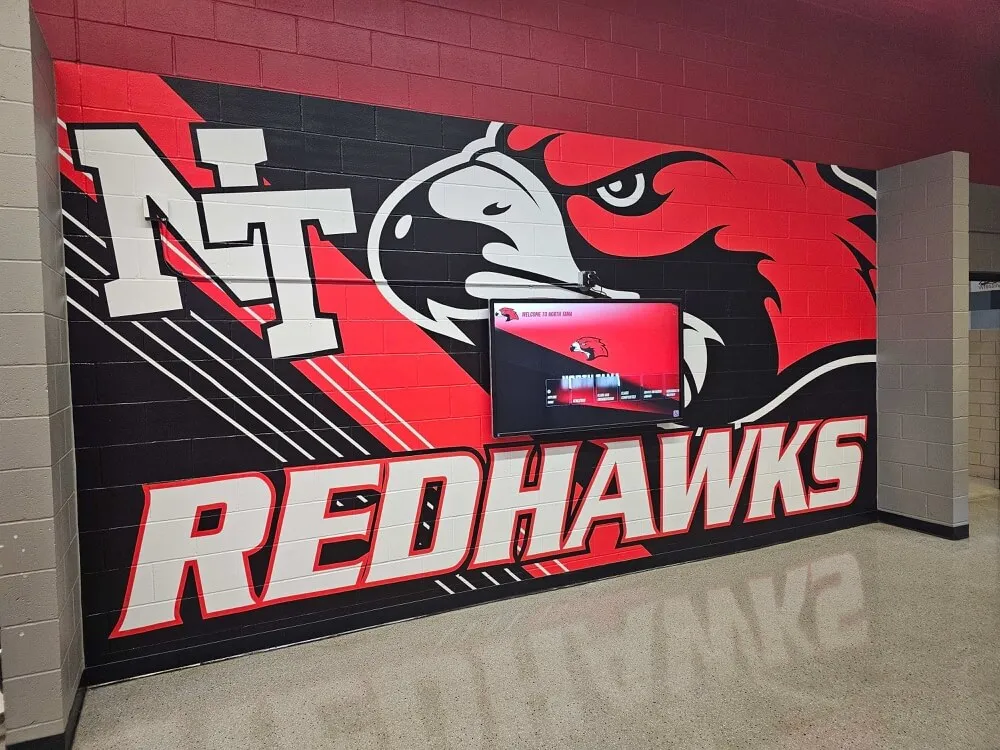
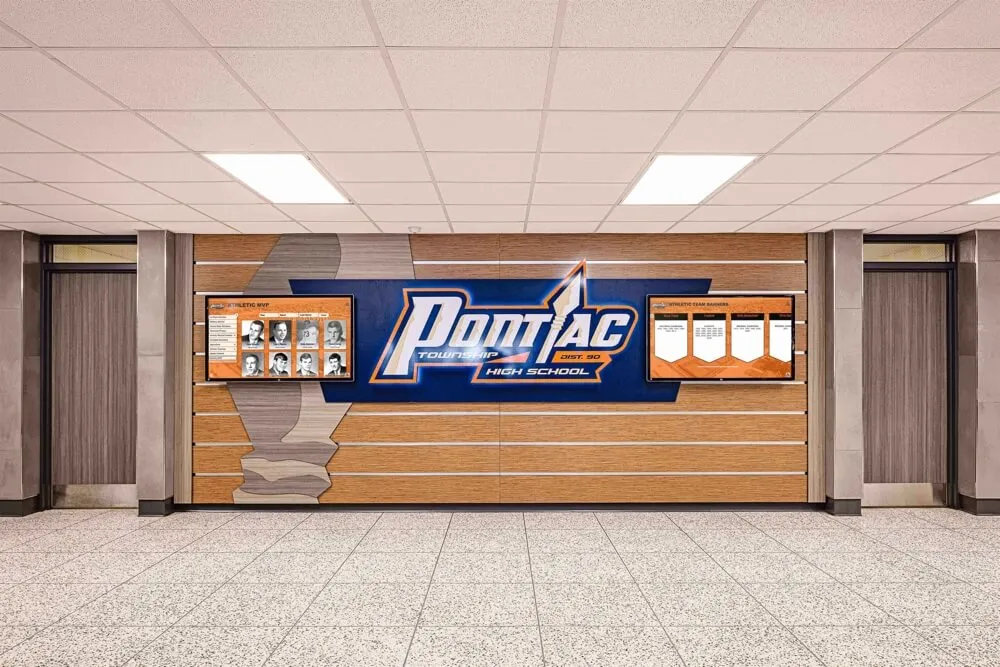
School hallway displays combining physical trophies with digital recognition panels depend on complete, accurate records recovered from source documents — microfilm blemish inspection before digitization identifies which award lists and newspaper records can be scanned at full quality and which require specialist assessment before image recovery is attempted
Connecting Microfilm Inspection to Athletic Recognition Programs
The practical goal of redox blemish inspection — and of the digitization workflow it informs — is the clean, documented digital record of school athletic history that feeds into recognition programs: the award lists that name letter winners by year, the sports newspaper issues that reported championship victories, the game-day programs that recorded coaching staffs and rosters from seasons now decades past.
For school athletic programs, preserving those names and stories is itself the mission. A student who won an athletic award in 1975 is an alumnus or alumnae today whose recognition in a hall-of-fame installation or digital display depends on a legible, retrievable record. A sports newspaper issue that reported a conference championship in 1983 is the primary source for the achievement narrative that belongs in a school’s athletic history archive. Microfilm blemish inspection before digitization is what separates a school that can reliably build that recognition program from one that discovers, after scanning, that specific award lists are illegible and specific championship records are partially obscured.
Rocket Alumni Solutions versus static display options:
Schools that digitize their athletic microfilm collection and then manage the resulting files through a static approach — folder structures on a shared drive, PDF archives accessed by staff, or printed binders reproduced from scans — gain digitized records but face ongoing effort to present that content to athletes, alumni, and visitors in a compelling, current form. Updating a static folder structure when new historical information is located, connecting specific award-list names to current athlete recognition profiles, and surfacing relevant content for specific audiences all require manual intervention each time.
Rocket Alumni Solutions allows schools to connect a well-organized digitized athletic archive — built on the foundation that a complete pre-digitization inspection provides — to a living recognition program: touchscreen hall-of-fame displays that search by athlete name or year, digital yearbook archives that present sports newspaper content alongside team portraits, and recognition installations that can be updated without technical staff involvement as additional historical material is located and scanned. The distinction is not between digitization approaches; it is between what happens to the digitized files after scanning is complete. A school whose microfilm inspection produced a documented, prioritized digitization sequence has the foundation for either path — the question is whether that foundation supports a static record repository or a dynamic recognition experience.
When schools connect their digitized athletic records to public-facing recognition programs, the transition to a digital trophy case offers context for how schools are rethinking how athletic history is presented — moving from physical-only displays that can only show what fits on a wall to digital experiences that can surface any record from any year on demand. That shift makes the completeness of the underlying digitized archive — including the accuracy of the award lists recovered from microfilm — more consequential, because more of the record becomes directly visible to athletes and alumni.
When historical award recipients from a school’s microfilm archive are formally inducted into a recognition program, having a documented protocol for how to announce new school inductees and their digital profiles supports the connection between the archive record and the public recognition event — the inspected microfilm provides the historical detail that makes the announcement substantive and accurate.
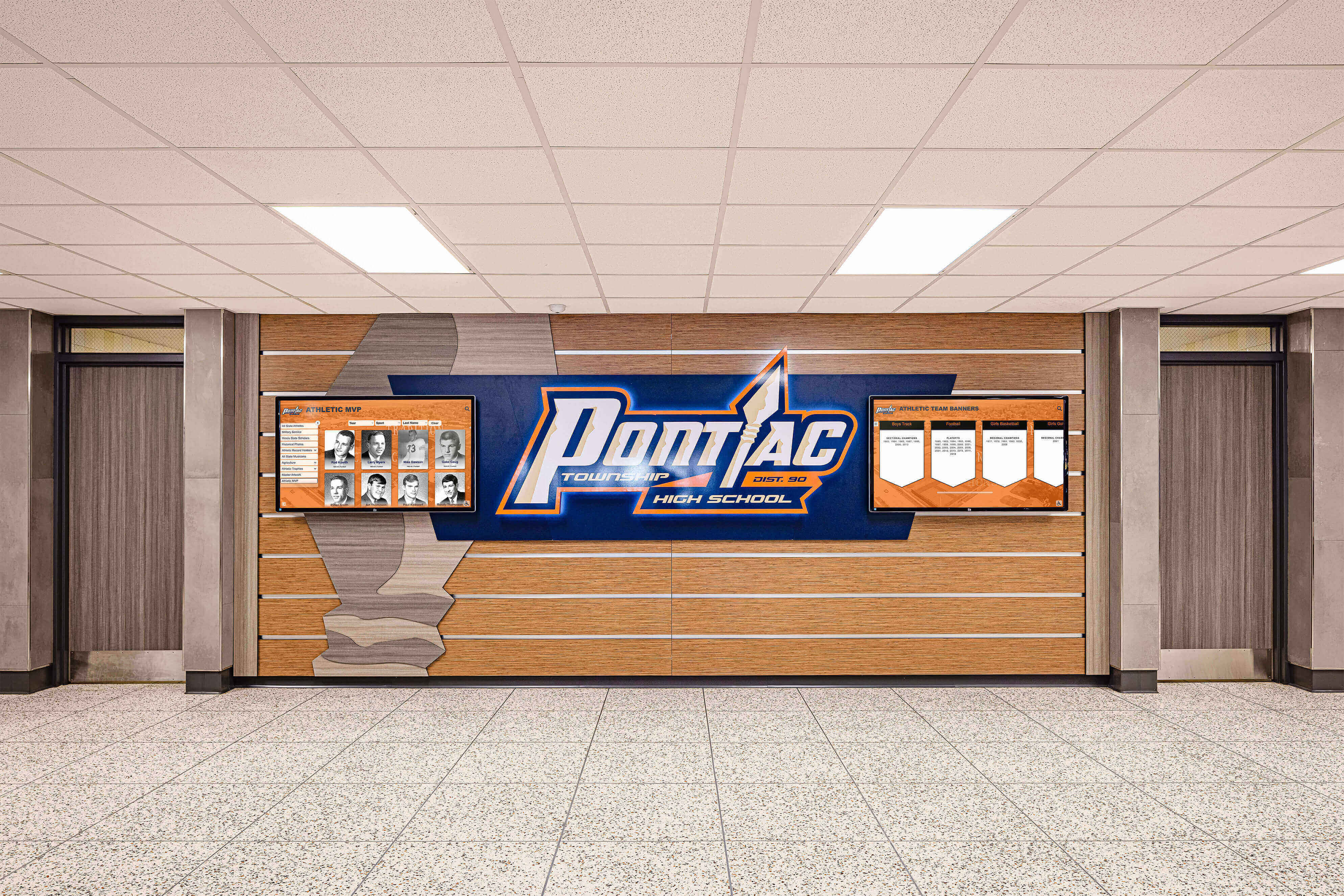
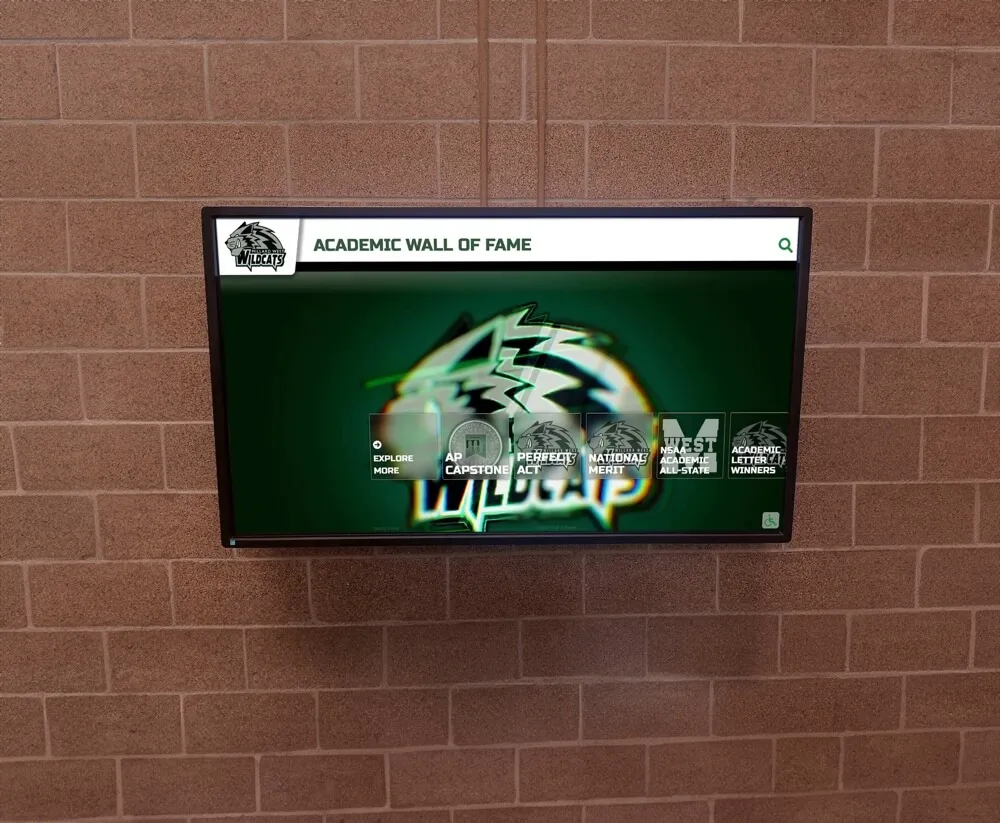
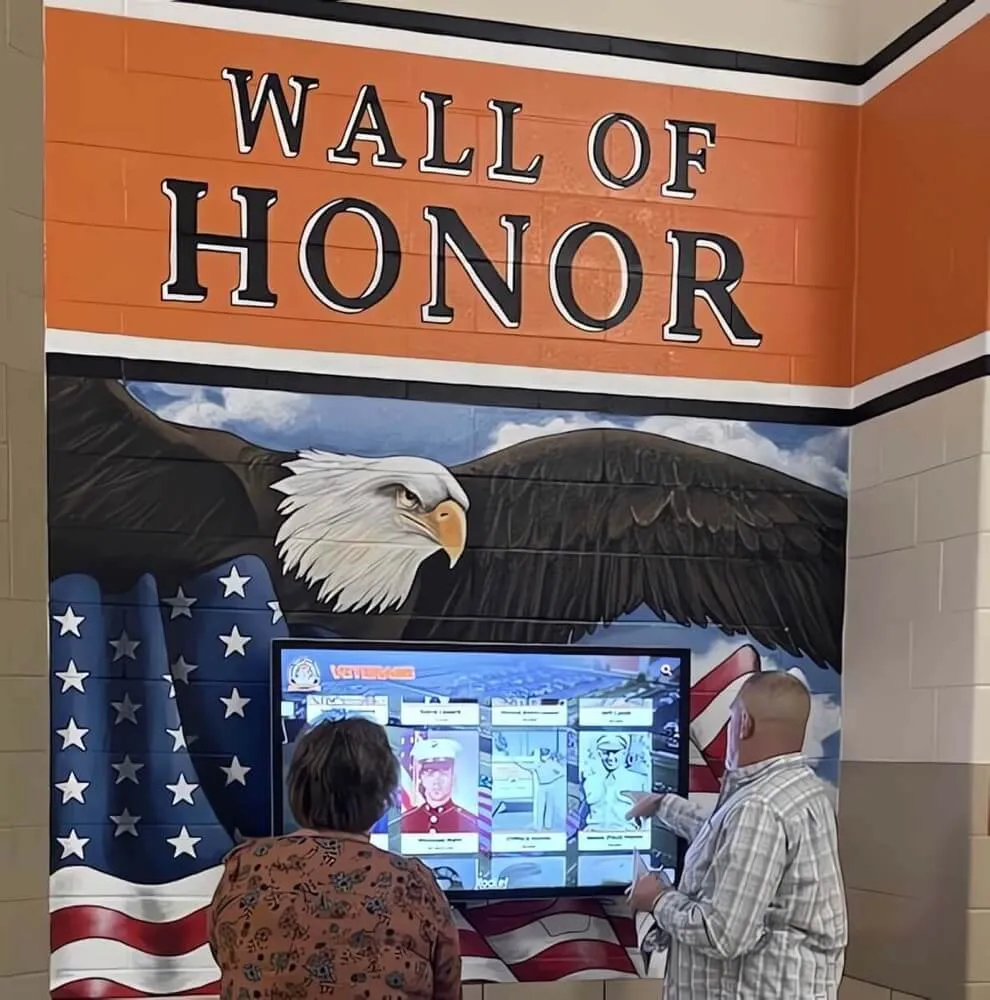
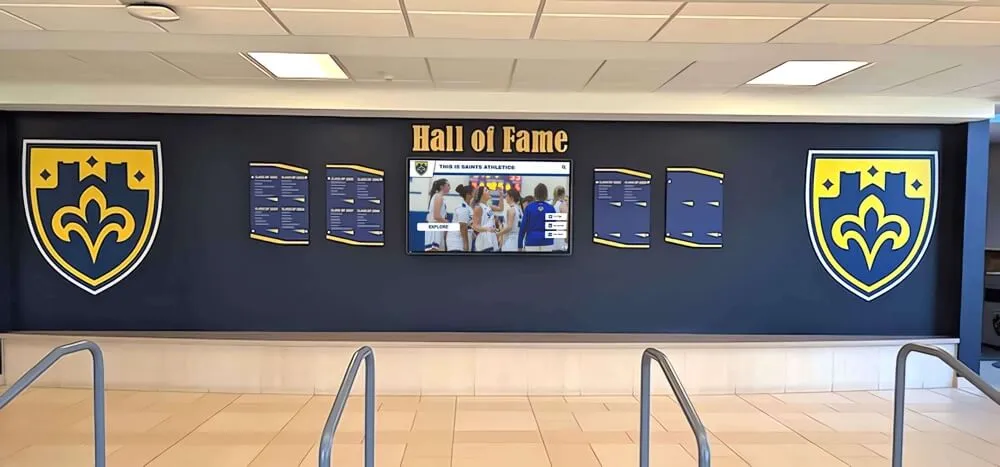
Athletic honor boards presenting school records and team history are only as complete as the source documents behind them — microfilm blemish inspection ensures that award lists and newspaper records are digitized with a documented condition assessment, so any gaps in image legibility are identified and noted rather than discovered after scanning is complete
Who This Inspection Workflow Serves
| Role | Primary Concern | How Redox Blemish Inspection Helps |
|---|---|---|
| Athletic Director | Completeness of the school’s athletic honor record | Identifies which microfilm rolls can be digitized immediately to secure clean records, and which carry blemishes that may have affected the legibility of award lists or championship documentation |
| Recognition Program Owner | Display-ready, accurate content for athlete recognition programs | Ensures that names, award years, and achievement records on award lists are digitized from rolls in known condition — blemished frames are documented rather than silently included in the digital archive |
| IT / Data Staff | Efficient digitization workflow without unexpected quality failures | Provides a classified roll inventory that sequences scanning priorities and routes problem rolls to specialists before scanning resources are committed |
| Librarian / Archivist | Collection-level condition documentation and long-term preservation planning | Produces a roll-level and frame-level condition record that supports both immediate digitization decisions and long-term collection care |
| Scanner Operator | Accurate information about each roll before scanning begins | Receives condition notes that identify blemish presence, extent, and relationship to image content — so rolls are handled with appropriate scanner settings and operator attention |
| School Administrator | Institutional record completeness and documented preservation practice | Establishes that the school assessed its microfilm collection condition systematically before digitizing, and documented any findings that affect the completeness of the digital record |
Schools also benefit from reviewing comprehensive hall of fame program tools for athletics, donors, arts, and history programs to understand the range of options for connecting a digitized athletic archive to an ongoing recognition program — because the decision about how to use the digitized files should ideally inform how the digitization project is scoped and documented, not follow it as an afterthought.

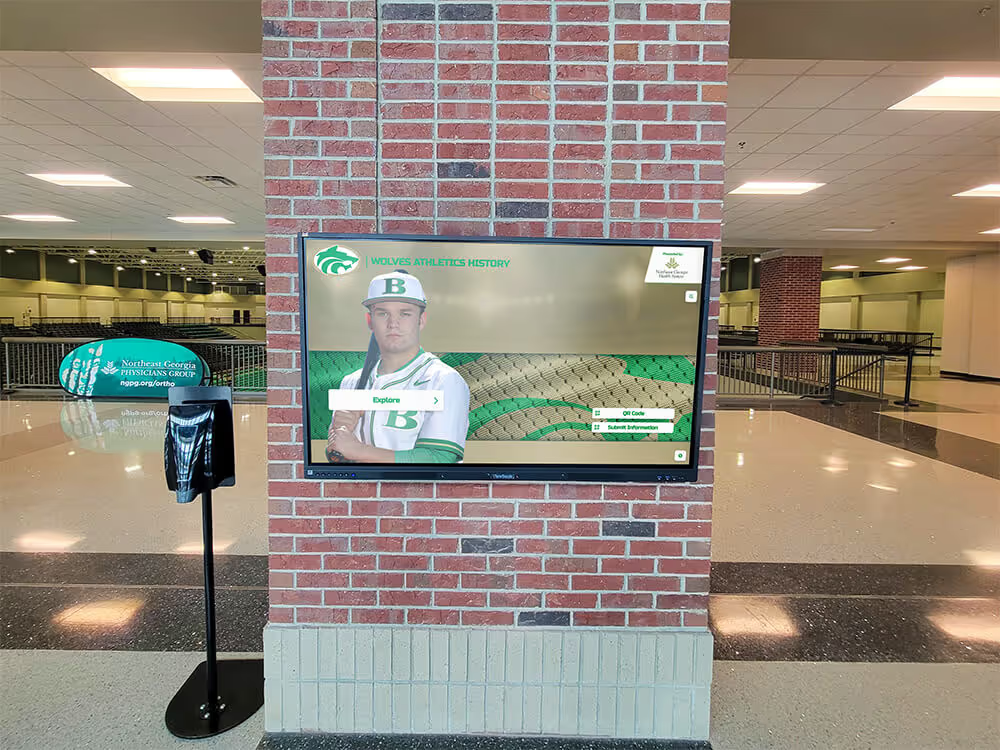
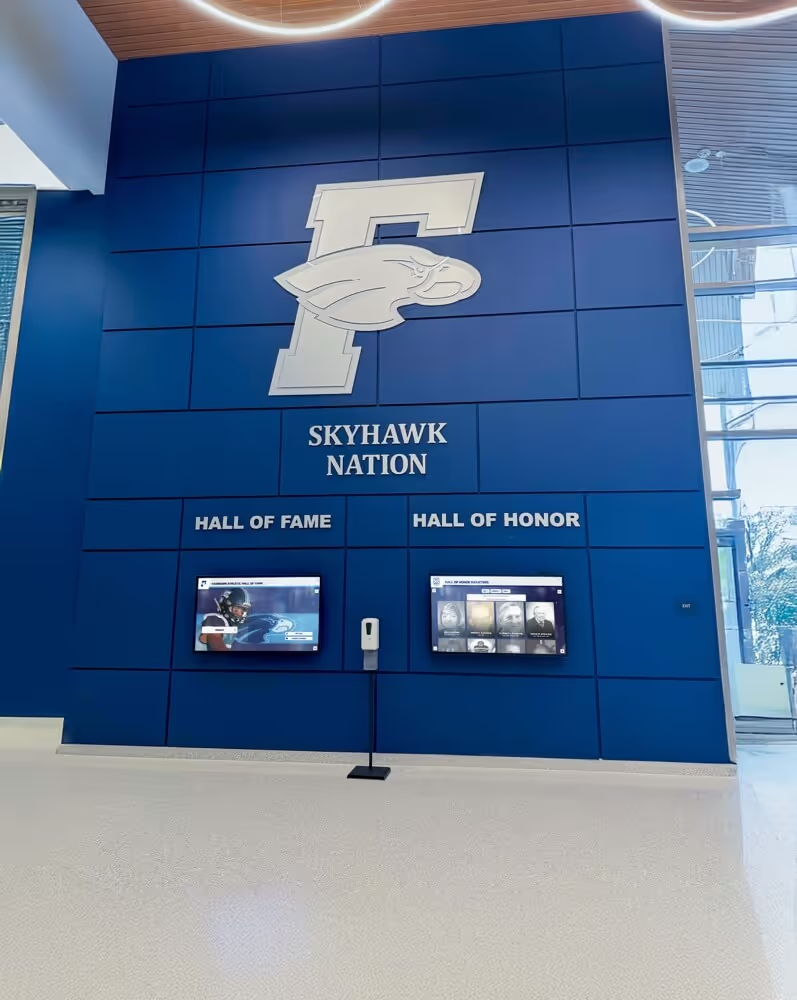
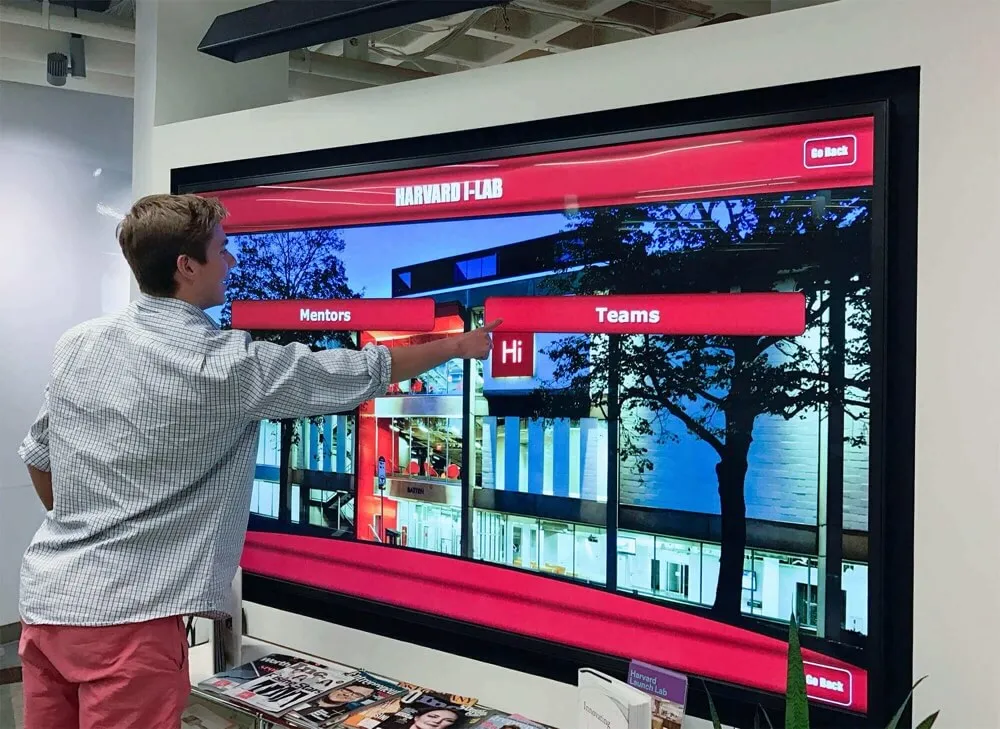
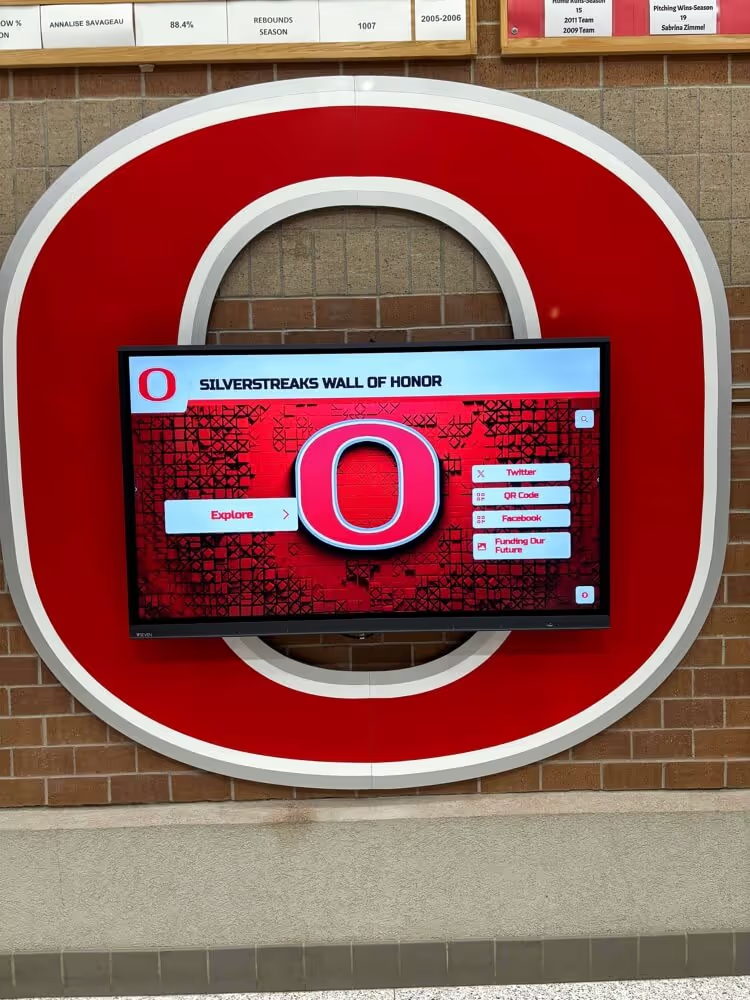
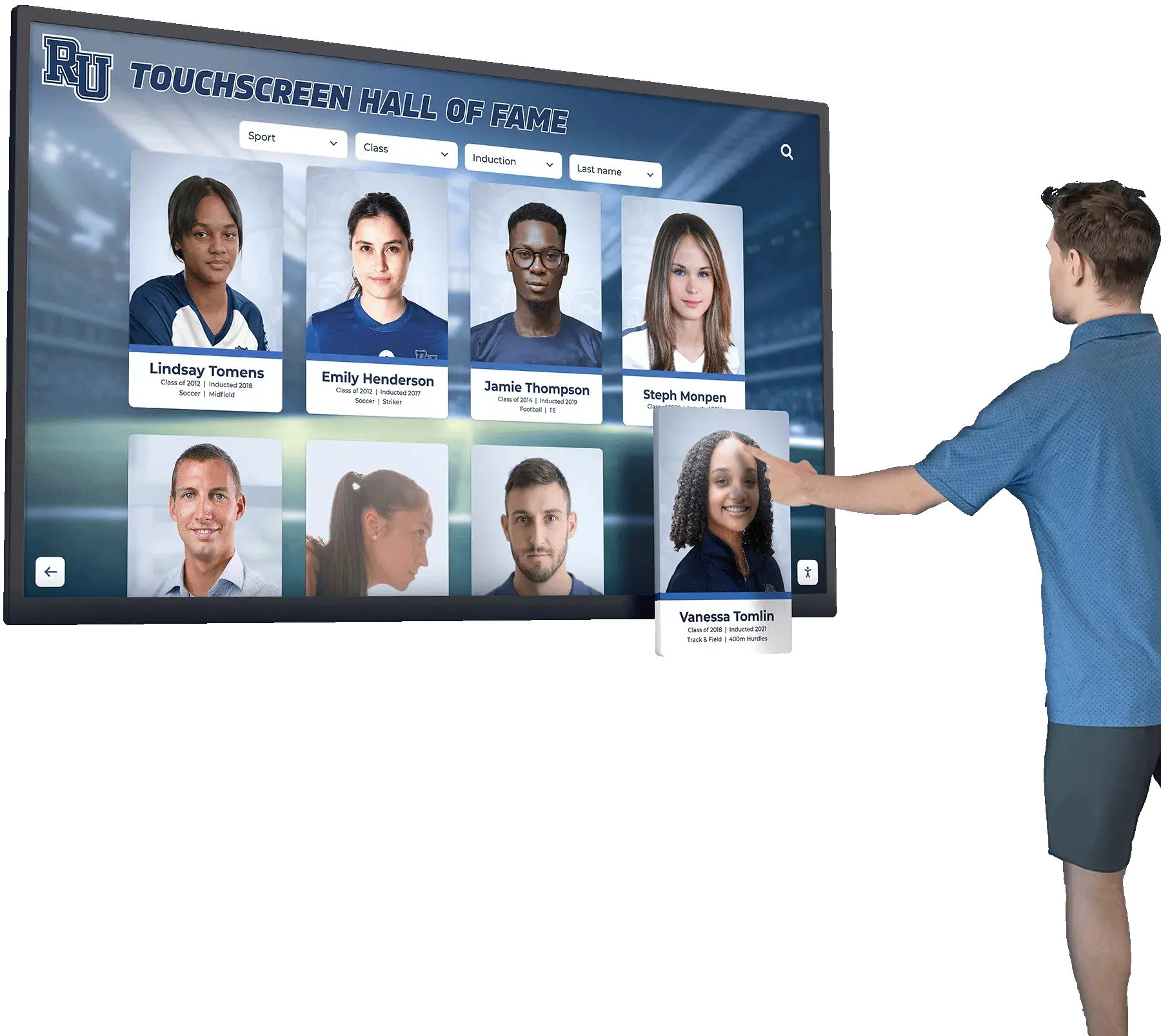
Hall-of-fame touchscreen displays in school hallways depend on accurate, complete athletic records recovered from source documents — when those records survive on silver-gelatin microfilm, pre-digitization blemish inspection is what determines which rolls contribute reliable content and which need specialist assessment before their frames enter the digital archive
Frequently Asked Questions
What do redox blemishes on microfilm actually look like, and how do I tell them from ordinary dust?
Redox blemishes on silver-gelatin microfilm appear as discrete colored areas — red, orange, or golden-yellow — that are in or at the gelatin layer of the film rather than loose on the surface. The color distinguishes them from dust or debris, which is typically gray or dark-colored and which should shift or dislodge when the film is gently advanced or examined under oblique light from a different angle. A colored area that does not shift position under oblique illumination from multiple angles, and that appears to be within or bonded to the film material rather than resting on it, is more likely to be a blemish than surface contamination — but definitive identification requires specialist examination. The practical rule for in-house inspection is: document what you observe, route ambiguous findings for specialist evaluation, and never attempt to clean, rub, or remove a colored area from the film surface.
If a redox blemish covers part of a frame, can better scanning or image processing recover the text or names underneath?
Generally, no. A redox blemish represents an alteration or displacement of the image silver that originally formed the text or image in that area. The image information in an affected area may be partially obscured, entirely lost, or present at reduced contrast depending on the severity and character of the blemish. Standard digitization captures the current state of the film — it does not restore silver that has chemically changed form or migrated. Some specialists in photographic materials conservation can advise on scanning approaches (illumination geometry, exposure parameters) that may improve image visibility at the margins of blemished areas, but this is a specialist assessment for specific materials, not a general claim that blemished content is recoverable. The most honest and useful thing a school can do is document which frames show blemish overlap with image content, note this in the digital record for those files, and consult a specialist about whether any recovery-informed approaches are appropriate before committing digitization resources.
Should rolls with redox blemishes be stored differently from the rest of the microfilm collection?
Improving the storage environment for blemished rolls — lower relative humidity, cooler temperature, archival-quality housings that pass photographic activity testing — is the primary action available in a school archive setting to slow further blemish development. The National Archives guidance on film-based holdings preservation describes the storage conditions that minimize ongoing deterioration. What a school should not do is apply any chemical treatment to blemished microfilm in an attempt to address the blemish in-house. Improving storage conditions for the entire microfilm collection (not just blemished rolls) is the appropriate in-house preservation response. Specialist evaluation is required before any other intervention.
How is this inspection different from what a digitization service will do when they scan the rolls?
A digitization service scans the film at the settings and resolution specified for the project. Standard digitization contracts do not typically include pre-digitization condition assessment, specialist referral routing, or frame-level blemish documentation of the type this inspection workflow produces. Without pre-digitization inspection, a digitization service will scan the rolls it receives — including rolls with Grade 3 or Grade 4 blemish presence — and deliver the resulting digital files, which will reflect whatever image loss is present in the source film. Pre-digitization inspection by the school or archive gives the institution control over which rolls enter the digitization queue, what condition notes accompany them, and which rolls are routed to specialist evaluation before scanning resources are committed. That control is not typically available after digitization is complete.
What should be included when sending a blemished roll to a preservation specialist?
Send the specialist the roll in an archival canister or polyester sleeve — not a rubber-banded stack or original kraft paper envelope. Include the complete condition record from Step 4: the documentation photographs (roll identification, transmitted-light frame image, oblique-light surface image, content-relationship image), the written condition record fields (classification, color observed, extent, relationship to image content, associated observations), and any known storage history for the roll. Include the rolls accession number and what content the roll contains — which sports newspaper run, which award list years, what athletic programs are documented on this roll. The more context the specialist has about what the roll contains and what the school’s digitization goals are, the more specifically they can assess whether any recovery-informed approaches are feasible and appropriate for that material.
Systematic redox blemish inspection converts an unknown-risk microfilm collection into a documented, classified inventory where every roll has a known condition grade, a condition record with supporting photographs, and a confirmed routing path — before any scanning decision is made, and before any name on an award list or championship result in a sports newspaper is lost to an undocumented digitization of a roll that deserved specialist evaluation first.
Ready to connect your inspected and digitized athletic archive to a recognition program that makes school history visible for athletes, alumni, and the community?
Request a Rocket Alumni Solutions demo and see how schools are turning documented, well-organized digitized athletic records into touchscreen hall-of-fame displays, searchable award archives, and digital yearbook programs that bring decades of athletic history to life.