School history, shared
Athletic Archive Film-Shrinkage Measurement Workflow for Historic Game Reels

Athletic archive film shrinkage measurement workflow is the set of steps archivists, athletic directors, and facilities staff follow to quantify dimensional change in historic game reels — before those reels are placed on a projector, cleaned, or sent to a digitization vendor. When 16mm or 8mm film manufactured before the 1990s loses moisture and plasticizer over decades of storage, the film base contracts. That contraction reduces the distance between sprocket perforations — a measurement called perforation pitch — by a fraction of a millimeter. At low shrinkage levels the film is still projectable. At moderate levels it requires a flatbed scanner rather than a projector. At high shrinkage levels the film is brittle, and any mechanical handling risks shattering the base or tearing perforations, permanently destroying irreplaceable footage of championship games, senior nights, and athlete recognition ceremonies.
This guide delivers a direct definition of film shrinkage and its causes, a numbered measurement workflow schools can follow with low-cost gauges, a reference table of shrinkage thresholds by risk level, and a stop-work and escalation guide for films that exceed safe handling limits. It is written for school administrators, athletic directors, archivists, and facilities staff managing reels of historic game footage, coach profiles, senior-night ceremonies, and year-end awards events captured on 16mm and 8mm film between the 1950s and early 1980s.

Every reel of historic game footage represents a moment in school athletic history that exists nowhere else — measuring shrinkage before handling prevents the mechanical damage that destroys brittle film irreversibly
What Film Shrinkage Is and Why Athletic Game Reels Are at Risk
Film shrinkage is the dimensional reduction of a motion picture film strip caused by the loss of moisture and plasticizer from the film base over time. The film base — the transparent layer that carries the photographic emulsion — is made from cellulose acetate (commonly called “safety film”) in nearly all film manufactured after the 1950s. Cellulose acetate is hygroscopic: it absorbs and releases moisture in response to the humidity of its storage environment. When a reel is stored in conditions that are too dry, or simply aged over decades with fluctuating humidity, the acetate base loses moisture and contracts.
Shrinkage is measured as a percentage reduction relative to a standard reference pitch — the designed distance from the center of one perforation to the center of the next along the film strip. On 16mm film, the standard pitch is 7.605 mm. On 35mm film, the standard pitch is 4.750 mm. On Regular 8mm film (also called Double-8mm before splitting), the pitch is 3.81 mm. As the film shrinks, the actual pitch decreases below the standard value. The percentage difference between the measured pitch and the standard pitch is the shrinkage percentage.
Film shrinkage is distinct from — and more mechanically dangerous than — other film conditions like:
- Vinegar syndrome (acetic acid off-gassing from advanced acetate degradation) — detectable by smell, not necessarily correlated with high shrinkage
- Color dye fading — photochemical degradation affecting image quality but not dimensional stability
- Emulsion delamination — separation of the photographic layer from the base
- Edge buckling or warping — a film geometry problem caused by uneven shrinkage across the film width
Shrinkage matters most when film must pass through a mechanism — a projector, a cleaning machine, or a flat-gate scanner. All of these devices grip or engage the film at the sprocket perforations. When a shrunken film’s perforations no longer match the teeth spacing of the sprocket drive, the mechanism either skips perforations, tears them, or applies asymmetric tension that cracks a brittle base. A single transport pass through a mismatched gate can ruin a reel that survived 60 years of storage undamaged.
Why School Athletic Film Archives Face Elevated Risk
Most school athletic film collections date from an era — roughly the 1950s through the early 1980s — when 16mm film was the standard format for school events, game footage, coach analysis reels, and athletic recognition programs. This era corresponds almost exactly to the window of maximum cellulose acetate vulnerability: the film was manufactured when acetate was the industry standard, stored in facilities that were not designed for archival climate control, and rarely inspected in the intervening decades.
Common storage situations that accelerate shrinkage in school collections include:
- Uncontrolled gymnasium or boiler room storage — hot, dry summers followed by cold, humid winters cycle the film base through repeated moisture loss and partial recovery, producing cumulative dimensional stress
- Metal canisters sealed without desiccant — sealed canisters trap off-gassing acetic acid, accelerating the degradation cycle that increases shrinkage rate
- Athletic department closets and storage rooms — temperatures that routinely exceed 70°F (21°C) significantly accelerate both acetic acid production and moisture loss
- Original projection reels rewound under tension — high-tension rewinding compresses the reel pack unevenly, which can mechanically deform the outer layers as the inner layers shrink
Schools frequently discover these reels when preparing for milestone events: a 50th-anniversary program celebration, a senior night in sports tribute screening, a hall-of-fame induction weekend featuring footage of early inductees, or a team bio archive project designed to populate a digital recognition display. At that point, measurement before handling is the only way to know whether projection will destroy the footage it is meant to celebrate.
Athletic Archive Film Shrinkage Measurement Workflow: A 10-Step Method
This numbered workflow applies to 16mm, Regular 8mm, and Super 8mm film reels — the formats most common in K-12 and small college athletic archives from the 1950s through the early 1980s.
Step 1: Gather Measurement Tools
Accurate shrinkage measurement requires a film shrinkage gauge — a precision device that measures the perforation pitch of a sample strip of film directly, without electricity or software. Two widely used options for school archivists are:
| Tool | Format Compatibility | Approximate Cost | Notes |
|---|---|---|---|
| Film-Tech or equivalent plastic film gauge | 16mm, 35mm | $20–$50 | Inexpensive; adequate for initial triage |
| Precision metal film pitch gauge | 16mm, 8mm, 35mm | $150–$400 | More durable; recommended for high-volume collections |
| Micrometer with perforation template | Any | $40–$120 | General-purpose; requires a reference template for each format |
| Densitometer with pitch attachment (institutional) | Any | $800+ | Used by professional film archives; unnecessary for school triage |
If your school does not own a gauge, contact your state’s film archive or library preservation office — many loan gauges to institutions without charge for collection surveys. Alternatively, a reputable film digitization vendor can measure shrinkage as part of a pre-treatment inspection before you commit to a digitization engagement.
Step 2: Prepare a Measurement Log
Before touching any reels, create a log sheet or spreadsheet that captures the following fields for each reel in the collection:
| Field | Example Value | Notes |
|---|---|---|
| Reel ID or label | FOOTBALL-1967-REEL-03 | Use the existing label or assign a unique ID |
| Film format | 16mm | 16mm, Regular 8mm, or Super 8mm |
| Approximate year | 1967 | From label, leader inscription, or context |
| Storage canister condition | Metal, rust on rim | Document before opening |
| Odor on opening | Mild vinegar | Indicates acetate degradation stage |
| Measured pitch (mm) | 7.521 mm | Record to three decimal places |
| Standard pitch (mm) | 7.605 mm | Fixed by format (see table below) |
| Calculated shrinkage (%) | 1.10% | ((Standard − Measured) / Standard) × 100 |
| Risk level | Moderate | Assigned from threshold table in Step 7 |
| Recommended action | Flatbed scan only; do not project | From escalation table |
| Measurement date | 2026-09-07 | Date of inspection |
Completing this log for every reel before any handling decision ensures that no reel is projected, cleaned, or shipped to a vendor without a known shrinkage level on record.
Step 3: Identify the Film Format and Standard Pitch
Before measuring, confirm the format of each reel. The format determines the standard pitch — the reference value against which you will calculate the shrinkage percentage.
| Film Format | Standard Pitch | Perforation Type | Era in School Athletics |
|---|---|---|---|
| 35mm (film print) | 4.750 mm (positive, 4-perf) | Edison or Bell & Howell | Very rare; some school documentary presentations |
| 16mm (standard) | 7.605 mm | Single-perf or double-perf | Primary format for school athletics 1950s–1980s |
| Regular 8mm (Double-8) | 3.810 mm | Double-perf (before splitting) | Consumer home movie format; some early school use |
| Super 8mm | 4.234 mm | Single-perf, reduced-size perforations | Common for school athletics from mid-1960s onward |
16mm is by far the most common format in school athletic archives. It was the professional-grade instructional and documentary format adopted by school athletic programs for game analysis, highlight reels, and institutional records from the 1950s through the introduction of VHS in the late 1970s. If a reel is labeled only with a sport name and year, assume 16mm unless the reel diameter (50-foot, 100-foot, or 400-foot spools) indicates a different format.
Step 4: Inspect the Canister Before Opening
Before measuring or handling the film itself, inspect and document the storage canister:
- Metal canisters with rust or corrosion on the rim — proceed carefully; rust particles can damage the emulsion edge of the outermost wound layer
- Stuck or sealed canisters — if resistance is felt when opening, stop and allow the canister to acclimate at 60°F (15°C) and 30–35% relative humidity for 24 hours before re-attempting. Forcing a seal on an extremely brittle reel can shatter the outer layers
- Strong vinegar odor — acetic acid off-gassing indicates advanced acetate degradation. Note the intensity of the smell; strong vinegar odor does not automatically mean the film is unmeasurable or unwatchable, but it signals that degradation is ongoing and the window for digitization may be limited
- White crystalline deposits on the film leader or canister interior — these may be plasticizer bloom (crystallized plasticizer that has migrated to the surface) or acetic acid crystals; photograph and note before proceeding
Step 5: Handle the Film Leader Only for Initial Measurement
When the canister is open, do not unwind the reel. The leader — the non-image portion of film at the beginning of the reel — is available without rewinding and provides a representative measurement sample. Most 16mm reels have a leader of several feet at the head; Super 8 and Regular 8mm reels typically have shorter leaders.
Cut or isolate a segment of three to five perforations on the leader for gauge placement. If the leader is absent or has been spliced away, measure from the first several frames of image area. Avoid measuring from the tail of the reel (the last frames before the end) without rewinding, as the tail condition may differ from the body of the reel.
Handling precautions for all film during measurement:
- Use clean, lint-free gloves — cotton or nitrile are both appropriate
- Support the reel from below; do not grip only the hub, as asymmetric pressure can crack brittle base material
- Do not apply any cleaning solution or lubricant before measuring; the measured condition should reflect the film’s actual current state
- Work on a clean, flat surface; avoid any surface that could scratch the emulsion (which faces inward on properly wound reels)
Step 6: Measure the Perforation Pitch
Place the film strip into the film gauge so that the perforations engage the gauge’s registration pins. A properly calibrated film gauge will give a direct reading in millimeters from the distance between two perforation centers. On a plastic triage gauge, the reading is typically a positional indicator on a labeled scale; on a precision metal gauge, it is a vernier or digital readout in millimeters.
Take three measurements at different points along the leader sample — the measurements should agree within 0.01 mm. If they do not, the gauge may not be calibrated or the film may have uneven shrinkage along its length (common on reels that were stored wound under high tension). Record all three values and average them for the log.
What correct measurement looks like:
A fresh, unshrunk 16mm reel measures at or very close to 7.605 mm. A reel with moderate shrinkage measures, for example, at 7.521 mm. Subtracting: 7.605 − 7.521 = 0.084 mm of linear reduction. Dividing by the standard pitch: 0.084 / 7.605 = 0.011, or 1.1% shrinkage. This single percentage is the key number for all subsequent decisions.
Step 7: Interpret Shrinkage Against the Risk Threshold Table
The film preservation community has established widely referenced shrinkage thresholds that correspond to specific handling risks. The table below applies these thresholds to the school athletic archive context:
| Shrinkage Level | Measured Pitch (16mm) | Risk Category | Handling Status |
|---|---|---|---|
| 0.0% – 0.5% | 7.567 mm – 7.605 mm | Minimal | Safe for projection, cleaning, and scanning with standard equipment |
| 0.5% – 0.8% | 7.544 mm – 7.567 mm | Low | Projectable with inspection; verify gate tolerance before threading |
| 0.8% – 1.5% | 7.491 mm – 7.544 mm | Moderate | Do not project; flatbed or stepper-transport scanner only |
| 1.5% – 2.0% | 7.453 mm – 7.491 mm | High | Do not project or use mechanical cleaning machine; hand inspection only; specialist vendor required |
| >2.0% | Below 7.453 mm | Critical | Stop work; risk of breakage on any mechanical handling; escalate to professional film preservation facility immediately |
Note that these thresholds are for 16mm film. Measurements for Super 8mm use the standard pitch of 4.234 mm, and the same percentage thresholds apply. For Regular 8mm (Double-8 format), use 3.810 mm as the standard pitch.
Step 8: Apply the Stop-Work and Escalation Rules
For every reel, the shrinkage percentage from Step 6 determines a mandatory handling rule. These rules are not advisory — a school administrator or athletic director who overrides a stop-work designation risks destroying footage that cannot be recovered once broken.
Stop-Work and Escalation Table for School Athletic Film Reels
| Shrinkage | Stop-Work Trigger | What to Do Next |
|---|---|---|
| <0.8% | None | Standard digitization or inspection workflow; proceed normally |
| ≥0.8% | Do not use a film projector | Re-route to flatbed scanner or a vendor with pin-registered, transport-controlled scanning equipment |
| ≥1.0% | Do not use automated cleaning machine | Hand-clean the leader only if necessary; contact vendor for humidification-and-cleaning consultation |
| ≥1.5% | Do not ship without specialist packing | Consult a film preservation vendor before any shipping; fragile reels may require custom packaging and climate-controlled transport |
| ≥2.0% | Full stop-work; no mechanical handling | Contact a professional film preservation organization or a vendor with ultrasonic or wet-gate scanning capability immediately; document reel condition and deterioration rate |
| Any level + active vinegar odor | Isolate from other reels | Move to a sealed, separately ventilated area; acetic acid off-gassing from one reel accelerates degradation in adjacent stored reels |
| Any level + visible brittleness | Do not unwind | Place reel in a sealed bag with silica gel; contact specialist before attempting any handling or measurement beyond the leader |
The most important practical rule for school athletic archives is this: shrinkage at or above 0.8% means the film must not pass through a projector under any circumstances. The projector’s sprocket mechanism will attempt to advance the film at the standard pitch, and when the shrunken perforations do not match, the result is torn perforations or a snapped film base. Either outcome is permanent. A reel of 1967 state-championship game footage does not have a second chance.
Step 9: Assign Priority for Digitization Based on Risk Level and Content Significance
Once every reel in the collection has a measured shrinkage level, prioritize them for digitization based on a combination of risk level and content significance. Films deteriorate over time — a reel at 1.4% shrinkage today may be at 2.0% in five to ten years if storage conditions are not improved. Films at the highest risk levels, with the most significant content, should be digitized first.
| Priority | Criteria | Rationale |
|---|---|---|
| Priority 1 (Immediate) | Shrinkage ≥1.5% AND content includes championship, hall-of-fame, or senior recognition events | Highest risk of loss; highest institutional significance |
| Priority 2 (Within 12 months) | Shrinkage 0.8%–1.5% OR unique content with no other surviving copy | Moderate risk; standard scanner workflow available |
| Priority 3 (Within 3 years) | Shrinkage <0.8% AND content is typical game footage with other surviving records | Low immediate risk; can be scheduled in normal workflow rotation |
| Deferred | Shrinkage <0.5% AND duplicate coverage from video or other sources | Minimal risk; allocate resources to higher-priority reels first |
Content significance factors for school athletic archives include: championship games, individual sport season-ending competitions, hall-of-fame induction ceremonies, athletic record board highlights that can only be verified from game footage, and events involving athletes who later achieved regional or national recognition.
Step 10: Document Findings and Update the Collection-Level Survey
After completing measurements for all reels in a survey session, compile the individual reel logs into a collection-level summary. This document serves multiple purposes: it informs digitization budget requests, provides evidence for grant applications supporting film preservation, and gives any digitization vendor a complete picture of the collection before they price or schedule a project.
The collection summary should include:
| Summary Field | Example |
|---|---|
| Total reels surveyed | 48 |
| Format breakdown | 42 × 16mm, 6 × Super 8mm |
| Shrinkage distribution | 12 reels <0.8%; 22 reels 0.8%–1.5%; 10 reels 1.5%–2.0%; 4 reels >2.0% |
| Priority 1 reels | 7 (include reel IDs and content descriptions) |
| Reels with active vinegar odor | 9 |
| Reels with visible brittleness | 4 |
| Recommended storage action | Transfer all reels to acid-free cans; move to climate-controlled space at 55°F / 40% RH |
| Estimated digitization budget range | [Requires vendor quotes based on Priority 1 and 2 reel count] |
| Survey date and staff | 2026-09-07; Athletic Records Coordinator |
Film Shrinkage and the Problem of Acetate Degradation (Vinegar Syndrome)
Film shrinkage and vinegar syndrome are related but not identical. Understanding the relationship helps school staff prioritize correctly.
Vinegar syndrome is caused by the hydrolysis of cellulose acetate — a chemical reaction that produces acetic acid (the smell of vinegar) as a byproduct. The reaction is autocatalytic, meaning that the acetic acid produced by the reaction further accelerates the reaction rate. A reel in early-stage vinegar syndrome produces a faint vinegar smell; a reel in advanced-stage syndrome produces a strong, persistent smell and typically shows significant physical symptoms including shrinkage, warping, and brittleness.
The acetic acid produced by vinegar syndrome also attacks adjacent reels stored in the same space. This is why isolation is a stop-work trigger — a reel with strong vinegar odor should be separated from the rest of the collection immediately, stored in a sealed, individually vented container, and scheduled for priority digitization before its degradation accelerates further or spreads to neighboring reels.
Key relationships:
- High shrinkage does not always mean strong vinegar odor. Film can shrink significantly from storage in dry conditions without producing heavy vinegar syndrome symptoms.
- Strong vinegar odor does not always mean high shrinkage. Early-stage vinegar syndrome produces acetic acid before the physical dimensional change becomes severe.
- Both can coexist and reinforce each other. The most at-risk reels typically show elevated shrinkage and vinegar syndrome simultaneously — these are Priority 1 for professional intervention.
For a broader view of the software and workflow tools athletic administrators use to manage collections like this, your state’s digital preservation program or a regional film archive can provide recommendations aligned with institutional scale.
Storage Improvements That Slow Future Shrinkage
Measuring shrinkage identifies what has already happened. Improving storage conditions limits how much additional shrinkage occurs before digitization is complete.
| Storage Factor | Problematic Condition | Target Condition | Effect on Shrinkage Rate |
|---|---|---|---|
| Temperature | >70°F (>21°C) | 55°F (13°C) or below | High temperature dramatically accelerates acetate degradation |
| Relative humidity | <30% or >60% | 40% RH (±5%) | Low humidity dries the base; high humidity risks mold and dimensional cycling |
| Canister type | Sealed metal with no ventilation | Vented metal or acid-free plastic with silica gel | Allows acetic acid to escape rather than accumulating inside the can |
| Storage orientation | Stacked flat under weight | Stored on edge (vertically) | Reduces pressure deformation on outer reel layers |
| Colocation with active vinegar reels | All reels stored together | Segregate active vinegar reels | Prevents cross-contamination of off-gassing |
Even moving film from an uncontrolled closet to a cooler, humidity-stable storage area — such as a climate-controlled server room that is already maintained for equipment — can meaningfully slow deterioration in the months between identification and professional digitization.
How Digitized Athletic Film Connects to Recognition Programs
The goal of measuring shrinkage before handling is not only to protect the reels during digitization — it is to ensure that the content on those reels survives into the digital archive that powers the school’s ongoing recognition programs. A reel of 1971 championship game footage, successfully digitized and preserved, becomes a source asset for athletic hall of fame touchscreen displays, senior night tributes featuring footage of honored athletes, and lobby recognition kiosks that bring school athletic history to life for current students and visiting families.
Schools that have completed film shrinkage surveys and digitization projects often find that the resulting digital archive is their most complete, highest-fidelity record of early athletic program history. Connecting that archive to a modern recognition platform — a digital hall-of-fame display, an interactive touchscreen kiosk, or a lobby recognition wall — transforms preservation work into a living celebration of athletic history.
See how Rocket Alumni Solutions turns verified athletic archives into recognition experiences →
Once digitized, film footage can be integrated into team bio and athlete profile systems that display career highlights alongside player records on modern lobby touchscreens. It supports athletic recognition display boards with verified historical footage that no printed display can replicate. Recognition programs built on a digitized film archive carry an authenticity — actual footage of actual athletes at actual games — that makes them uniquely compelling for reunion events, anniversary celebrations, and annual banquet programs honoring a program’s history.
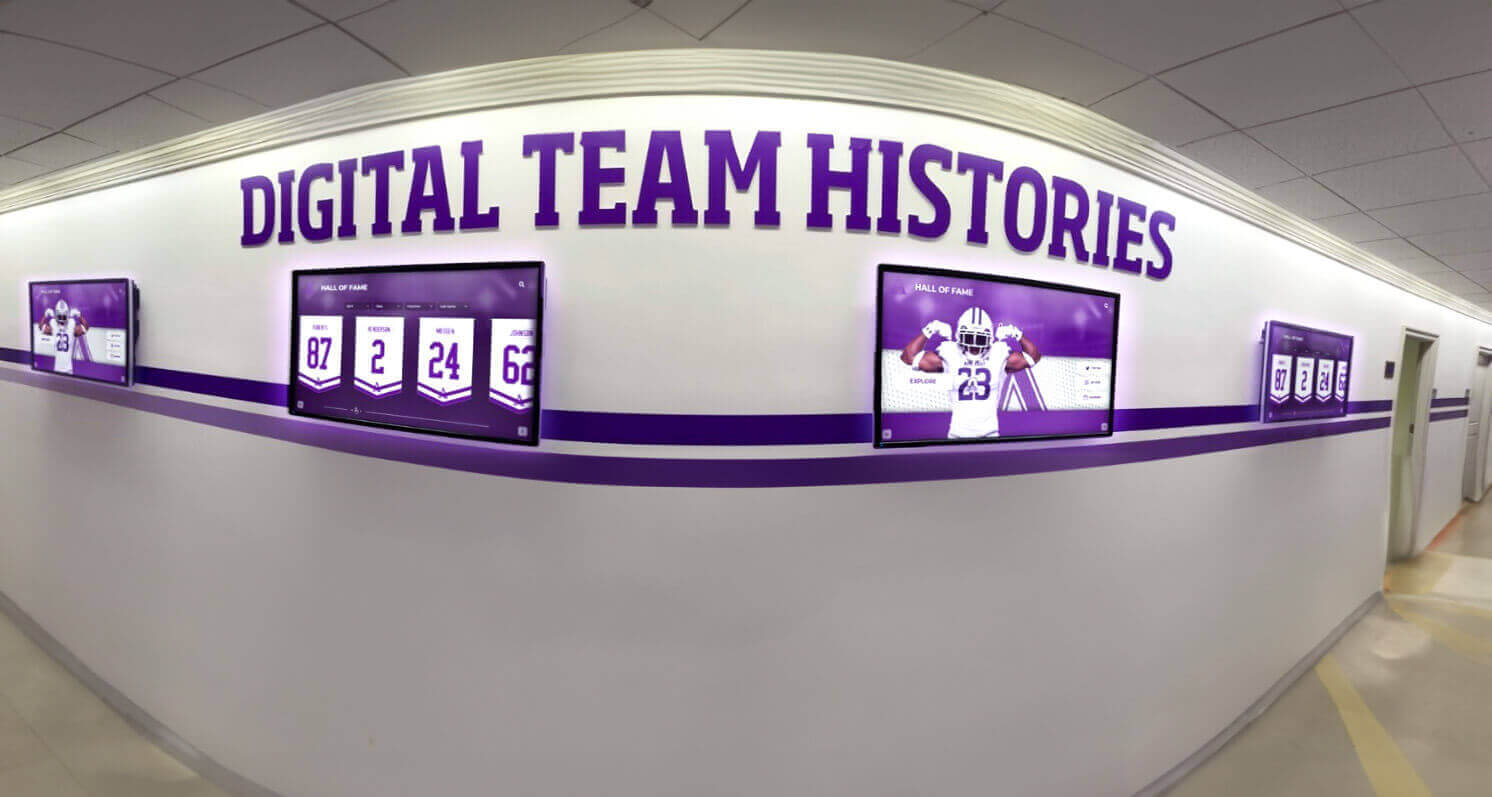
When film shrinkage measurement identifies reels that can be safely digitized, the resulting footage supports recognition displays that make athletic history visible to students, families, and visitors in ways static trophies and photographs cannot
Frequently Asked Questions About Film Shrinkage Measurement in School Athletic Archives
Can a school staff member measure film shrinkage without professional training?
Yes, for triage purposes. A basic plastic film gauge and the threshold table in this guide are sufficient for a first-pass survey to identify which reels are in the safe, caution, or stop-work range. Precise measurement for professional digitization decisions may benefit from a calibrated metal gauge, and any reel showing brittleness or advanced vinegar syndrome symptoms should be assessed by a specialist before further handling.
What if the reel has no leader — can we still measure shrinkage?
Yes, but with additional caution. Measure from the first few frames of image area. Handle as little of the film as possible, working from the outermost layer only. If the film is too shrunken or brittle to unwind safely even a few frames, treat the reel as Priority 1 and contact a professional vendor without further manual inspection.
Does digital storage eliminate the need to preserve the physical reel after digitization?
Professional digitization at full resolution (typically 2K or 4K for 16mm) produces a high-fidelity digital master. However, many preservation professionals recommend retaining the physical reel even after digitization, provided storage resources allow, because digitization technology continues to improve and a reel that was scanned at 2K today could potentially be rescanned at higher resolution in the future. If storage space is the constraint, prioritize retaining the original reels of the highest-significance content.
How often should school archives repeat shrinkage measurements?
For reels in storage awaiting digitization, an annual remeasurement of reels in the Moderate or High risk categories helps track how rapidly shrinkage is progressing. Reels that advance from one threshold category to the next between annual surveys are accelerating in deterioration and should be reprioritized for immediate digitization.
What does a senior-night recognition program need from a film archive?
Typically still images or short video clips of athletes from the relevant era. Even a few seconds of clear, undamaged footage from a reel showing a specific athlete or team provides enough material for a recognition screen or lobby display. Shrinkage measurement ensures that the reel can be safely digitized to extract that content before the induction or ceremony date.
Quick Reference: Film Shrinkage Measurement Checklist
Use this checklist before handling any historic game reel in a school athletic archive:
Before Measurement
- Measurement log created with fields for each reel
- Film gauge obtained and calibrated (or loaned from state archive)
- Clean gloves (cotton or nitrile) on hand
- Work surface clean and flat
- Storage canister inspected before opening
During Measurement
- Film format confirmed (16mm, Super 8mm, Regular 8mm)
- Standard pitch identified for the format
- Canister odor noted on log
- Leader located without full reel unwind
- Three pitch measurements taken and averaged
- Shrinkage percentage calculated: ((Standard − Measured) / Standard) × 100
- Risk level assigned from threshold table
After Measurement
- Stop-work rule applied if shrinkage ≥0.8%
- Isolation protocol applied if active vinegar odor detected
- Priority level assigned (1–4 or Deferred)
- Collection-level survey updated
- Digitization vendor contacted for Priority 1 reels before any further handling
Connecting Film Preservation to School Athletic Memory
A film shrinkage measurement workflow protects film reels at their most vulnerable moment — the moment before any mechanical device touches them for the first time in decades. For school athletic archives, that protection is the difference between a digitization project that recovers 60 years of game footage and one that discovers, mid-transport, that a reel of championship footage has shattered in its canister.
The schools with the most compelling recognition programs — lobby displays showing footage from the 1965 state championship team, hall-of-fame installations with actual game clips of early inductees, digital recognition boards that animate athletic history for every visitor — are the schools that completed the preservation work first. Measuring shrinkage before handling is step one of that work.
For the schools that have completed digitization and are ready to connect their verified film archive to modern recognition infrastructure, tools exist to make that footage a central feature of how the school tells its athletic story — on touchscreen kiosks, lobby displays, hall-of-fame installations, and digital platforms that current students, alumni, and community members can access and celebrate.

A school's athletic history is only as accessible as its archive is intact — film shrinkage measurement determines which reels can safely enter the digitization workflow that powers these recognition displays
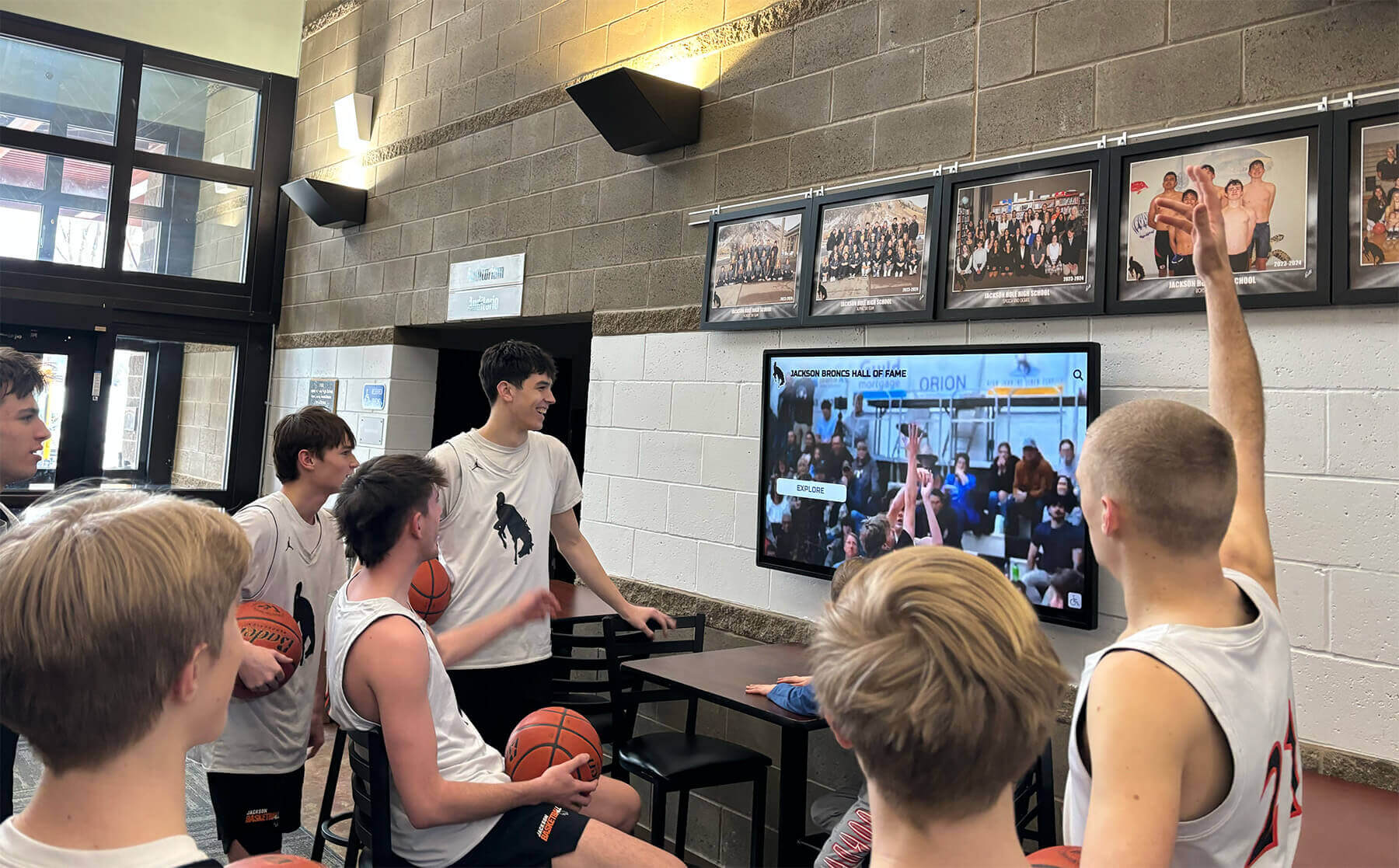
Current students engaging with historic game footage on a lobby display — the footage reaching that screen was preserved because someone measured the source reel's shrinkage before threading it through a projector
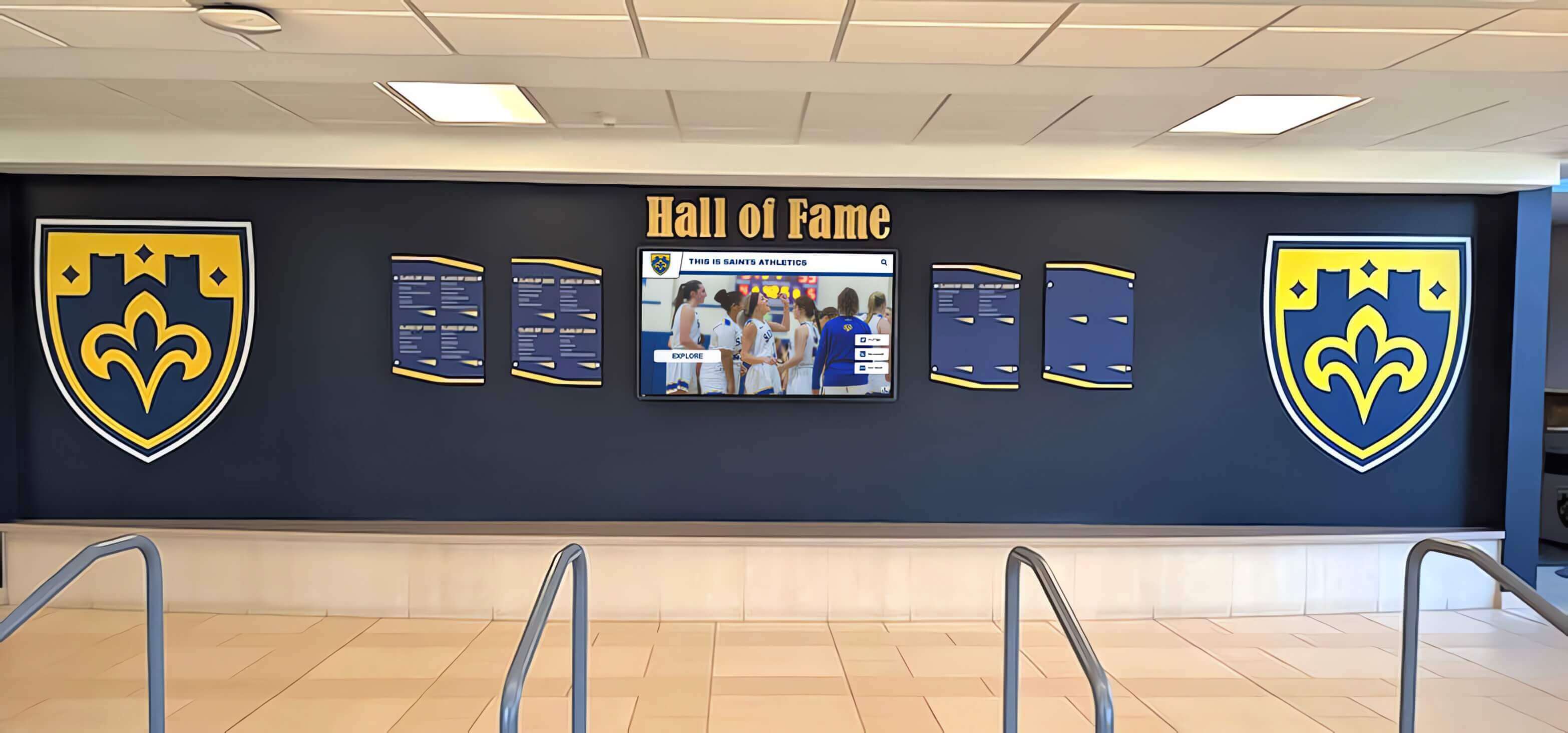
A school hall of fame lobby wall combining physical trophy displays with a digital recognition screen — every piece of historic footage appearing on that screen survived because it was measured, handled correctly, and digitized before deterioration made it unrecoverable
Ready to connect your digitized athletic film archive to recognition displays that bring it to life?
Rocket Alumni Solutions builds digital hall-of-fame displays, touchscreen kiosks, and interactive recognition platforms specifically for schools — designed to surface the decades of athletic history that a successful film preservation project recovers.
Ready to see this for your school?
Picture your collection in a custom mockup
Start with your yearbook collection and digitization goals, then request a custom digital mockup for your school.