Athletic archive chromogenic color print fading intake is the pre-digitization assessment process that provisionally identifies color team photographs as likely chromogenic prints, documents visible dye fading and color shifts in each print’s current state, records prior storage conditions that bear on fading severity, and separates an unchanged preservation capture from any labeled, color-corrected display derivative produced afterward. Color team photographs from the mid-1960s onward — the team portraits, individual athlete images, and candid photographs that document school athletic seasons across five or more decades — are in most cases chromogenic prints: photographs whose color is formed by organic dyes synthesized during development. Those dyes fade through chemical reactions driven by heat, humidity, and light. Fading is irreversible. The Canadian Conservation Institute’s guidance on care of colour photographic materials notes that colour photograph dyes appear to be among the only materials in a visual art medium to fade appreciably even in dark storage, where heat and high relative humidity drive dye destruction. The fading already present in a school’s color team photographs is documented at intake — not corrected before digitization and not treated in-house — so the preservation record reflects the actual condition of each print and any downstream display copies can be accurately labeled.
This guide gives school athletic directors, recognition-program coordinators, IT staff, and archive or facilities partners a focused intake framework for historic color team photographs that may be chromogenic prints: how to provisionally recognize chromogenic material without certainty, what fading and color shift observations to record, how to document prior storage conditions, how to separate a preservation capture from a display derivative in any digitization workflow, and when to route a print to a photographic conservator before proceeding.
Color team photographs from a school athletic archive — the annual team portraits, coach photographs, and action images that document seasons from the 1960s through the early 2000s — are among the most actively deteriorating photographic materials in school collections and among the most used sources for recognition programs, digital yearbooks, and hall-of-fame displays. Unlike glass negatives or paper prints from the nineteenth century, they are familiar objects. That familiarity can make their preservation needs less visible. Dye fading in a chromogenic print does not announce itself dramatically. It shows up gradually as a general lightening, a warm color cast in areas that should be neutral, or a shift in overall tone that becomes perceptible when the current print is compared to documentation from when it was made — if that documentation exists. Without systematic intake documentation, fading that has already occurred may not be recorded before digitization produces a scan that inherits those color shifts without any label explaining what they represent.
What Chromogenic Color Prints Are and Why Their Fading Matters at Intake
Chromogenic development, as described in the Canadian Conservation Institute’s guidance on colour photographic materials, is the process by which colour photograph dyes are chemically synthesized during development from colourless precursors present initially in the film layers. The resulting prints contain no residual silver or silver salts — the final image is composed entirely of organic dyes embedded in gelatin layers on the print base. The CCI guidance identifies chromogenic development as by far the most common colour photographic process in use, covering the majority of colour prints, negatives, and slides produced since the process became dominant from the mid-twentieth century onward. Since the mid-1970s, most colour prints have been produced on a resin-coated (RC) base — a paper core laminated between polyethylene layers — giving the prints their characteristic smooth, slightly plastic feel on the reverse.
For a school athletic archive, the practical implication is this: if the archive holds color team photographs produced from roughly the mid-1960s onward, those photographs are in most cases chromogenic prints whose color is held entirely in organic dyes and is therefore subject to the fading processes the CCI guidance describes. Fading is driven by two distinct conditions.
Dark storage fading occurs in the absence of light. The CCI guidance notes that the dyes in colour photographs appear to be among the only materials in a visual art medium to fade appreciably in dark storage, driven primarily by heat and high relative humidity. Team photographs stored in boxes, file drawers, or cabinets in unconditioned spaces have experienced dark-storage dye fading over their storage lives. Staining can also accumulate: the CCI guidance notes that white areas in a colour photograph may change to yellow in dark storage as part of this deterioration process.
Light fading occurs when prints are displayed or exposed to light. Pre-1985 colour prints, per the CCI guidance, are notably less stable under display conditions than prints manufactured after that date: older prints should be displayed at light levels below 50 lux and for limited periods, and exposure to ultraviolet radiation from fluorescent lamps should be avoided.
Both fading modes are irreversible. The CCI guidance is explicit that faded colour photographs cannot be chemically restored. Intake documentation of the fading already present in a school’s color team photographs is therefore a one-time opportunity to record the prints’ current state accurately — before further deterioration occurs, and before a digitization process is applied to materials whose condition was never assessed.

Digital hallway displays that surface team histories across multiple decades draw on a photographic archive where condition has been assessed — chromogenic color print fading intake documents what fading has already occurred in each print before any scanning approach is selected
Provisionally Recognizing Chromogenic Color Prints in a School Athletic Archive
Definitive process identification of a color photograph requires specialist examination and cannot be reliably made from appearance alone. Chromogenic prints share visual characteristics with other color print processes, and condition deterioration can alter appearance. The goal of provisional identification at intake is to recognize characteristics consistent with chromogenic prints — the most common color print format in school athletic archives from the mid-1960s onward — so that the handling and documentation approach appropriate to dye-fading materials is applied.
Characteristics consistent with a chromogenic color print:
- A full photographic color image in which colors appear across a continuous tonal range, not a hand-colored black-and-white print or a limited-palette graphic
- A smooth, slightly lustrous surface, often with a semi-gloss or gloss finish; since the mid-1970s, most prints have been on a resin-coated (RC) base that gives a slightly plastic or water-resistant feel to the print back
- Production apparent from context — team photographs, individual portraits, and action photographs from school athletic seasons broadly spanning the mid-1960s through the early 2000s — in standard commercial photographic print formats and sizes, possibly with a commercial lab imprint on the reverse
- Signs of color fading: a warm yellowish-orange cast in areas that should be white or neutral, a general lightening or dulling of the color range, or an overall color shift that differs from what would be expected for the depicted colors
Important limitations of provisional identification:
Chromogenic is not the only color print process, and not all color photographs from the mid-twentieth century onward are chromogenic. Dye transfer prints, dye destruction prints (such as Cibachrome/Ilfochrome), and other processes were used commercially. Each has different fading characteristics. If the process of a specific print matters for a preservation or treatment decision, a photographic conservator can identify the process through methods not available at a school intake station. Provisional identification at intake supports the handling and documentation approach, not a treatment decision.
When a color team photograph cannot be provisionally identified with reasonable confidence, or when its fading condition is severe enough to warrant conservation assessment before any further handling, route that print to a photographic conservator before any digitization is attempted.
Fading Observations and Routing: A Decision Table
The table below is a proposed school intake reference for routing color team photographs based on fading observations made during intake examination. It is a school workflow guide, not an official conservation grading standard, and it does not substitute for specialist assessment.
| What You Observe | What It May Indicate | Proposed Intake Routing | Digitization Approach |
|---|---|---|---|
| Colors appear consistent with expected depiction; highlight areas appear white or neutral | Fading is not visually apparent at this stage | Document condition; proceed to digitization with condition noted | Non-contact or careful flatbed; record condition in scan log |
| General lightening or reduced saturation across the color range | Possible moderate dark-storage or light fading | Document specific observations; proceed to non-contact digitization; note fading in preservation capture metadata | Non-contact preferred; label preservation capture as reflecting actual print state |
| Warm yellow or orange-yellow cast in areas that should be white or neutral | Color staining and fading characteristic of stored colour photographs, per CCI guidance | Document cast and extent; record prior storage conditions; proceed to non-contact digitization | Non-contact digitization; preservation capture reflects actual state; any corrected display derivative labeled separately |
| Significant color shift across the image; color components appear strongly shifted or partially absent | Substantial dye fading; color record may be significantly degraded | Document thoroughly; consult photographic conservator before digitization approach is finalized | Defer digitization until conservator has assessed |
| Physical deterioration: surface cracking, scratching, delamination, or structural damage visible | Physical condition may complicate digitization and handling | Document as found; route to conservator before any further handling | No digitization without conservator assessment |
| Format uncertain or fading characteristics do not clearly fit expected chromogenic pattern | Process may differ from chromogenic; different fading behavior possible | Treat as fragile; route to photographic conservator for identification | No digitization without identification and condition assessment |
Athletic Archive Chromogenic Color Print Fading Intake: A 5-Step Workflow
Step 1: Prepare the Intake Area
Establish a clean, organized intake space before any color team photographs are removed from their current housing.
Required at the intake station:
- Clean lintless nylon or cotton gloves worn throughout all handling — the CCI guidance on colour photograph handling specifies lintless nylon or cotton gloves as standard, noting that colour prints are susceptible to fingerprints and surface contact damage
- A clean, padded flat work surface — archival blotter or foam board, not a hard surface
- A camera or smartphone for condition photography, with a color reference card if available
- Consistent diffuse overhead illumination for examining prints; avoid strong direct spotlighting that adds heat or UV exposure during intake
- Archival enclosures for re-housing after intake: acid-free folders or polyester sleeves — the CCI guidance identifies uncoated polyethylene and polyester (polyethylene terephthalate) as acceptable enclosure materials for colour photographs, and specifies that polyvinyl chloride (PVC) and other chlorinated or nitrated plastics must not be used
- An intake log for recording print-level observations
Exclude from the intake station: any liquid, solvent, cleaning material, or chemical. The CCI guidance specifies that chemical treatments in aqueous solutions should never be attempted on colour photographs, and that washing photographs in water is only appropriate when gelatin layer stability has been confirmed — neither condition applies at a school intake station.
Step 2: Document the Physical Object and Provenance
Before examining the print surface for fading, record the physical description of each object and all available provenance information.
Physical documentation:
- Format and size: Standard commercial print size? Mounted on card or board? In a protective sleeve or folder?
- Base type: Does the print back feel smooth and slightly plastic-like, suggesting a resin-coated (RC) base consistent with chromogenic prints from the mid-1970s onward? Or does the back feel more like paper, suggesting a fiber-based support?
- Provisional identification basis: Record what characteristics support provisional identification as a chromogenic print (or note that identification is uncertain).
Provenance and inscription documentation:
- Transcribe all inscriptions and imprints on the print back verbatim — commercial lab imprints, date stamps, team or school identifications, handwritten names, season identifications
- Record all labels, notes, or markings on enclosures and housing exactly as written — envelope labels, folder annotations, box contents lists — as these are part of the provenance record even when the print itself carries no inscription
- Note any accompanying documentation: donation letters, clippings, or other materials that describe where the photographs came from, when they were made, or who is depicted
Athlete names, team designations, and seasonal records from provenance documentation should be flagged for independent verification before they enter any recognition database. Donor-supplied identifications may be accurate, but they require confirmation from primary sources before display in a public recognition context.
Step 3: Document Fading and Color Shifts
With the print face-up under consistent diffuse light, examine the image surface and record fading observations specifically at the print level.
Observations to record:
- Highlight and neutral areas: Examine areas that should be white or near-white — jersey numbers against a white ground, walls behind team portraits, sky in outdoor photographs. Are those areas white and neutral, or do they show a warm yellowish or orange-yellow cast? The CCI guidance identifies yellow staining in white areas as a deterioration characteristic that can develop in stored colour photographs.
- Overall saturation and color balance: Do the colors appear fully saturated and consistent with expected color rendering, or does the overall image appear dulled, lighter, or shifted? Is the shift warm (toward yellow or orange), cool (toward blue), or another direction?
- Shadow and dark areas: Are shadow areas and dark tones fully rendered, or do they appear lighter or less differentiated than expected?
- Local fading: Are there areas where fading appears more pronounced — edges, areas that may have been exposed to light differently from the rest of the print, or areas adjacent to printing artifacts?
- Discrete staining: Are there yellow, orange, or other-colored stains separate from the overall image tone?
Record each observation specifically and descriptively. “Highlight areas show a warm yellow-orange cast throughout; overall saturation appears reduced; shadow areas remain differentiated” is a useful intake record. “Print is faded” is not.
Recognition displays presenting decades of athletic achievement draw on a digitized photograph archive where each print's current condition was documented before scanning — fading observations recorded at intake become part of the metadata accompanying every digital file produced from the original
Step 4: Record Prior Storage Conditions
Fading in chromogenic color prints is driven by the conditions in which the prints have been stored. Storage history belongs in the condition record alongside the visual fading observations.
Storage condition documentation:
- Location and container type: Where have these photographs been stored — which part of the school building, in what type of container (boxes, drawers, filing cabinets, shelves)? Is the storage space conditioned, unconditioned, or subject to temperature and humidity fluctuation (attic, basement, equipment room, gymnasium storage)?
- Known storage duration: If known, how long have the photographs been in their current location? When were they last accessed or moved?
- Known environmental conditions: If the storage location has experienced extremes — summer heat, seasonal humidity, flooding, or proximity to heating equipment — record those conditions as described by the staff member or donor familiar with the storage history.
- Previous display history: Have any of the photographs been displayed on a wall, in a trophy case, or in a lobby setting? Display exposure accelerates light fading. The CCI guidance notes that pre-1985 colour prints are particularly susceptible; if a photograph has been displayed for an extended period, that history belongs in the condition record.
- Prior enclosure material: Were the photographs stored in PVC sleeves, paper envelopes, polyester sleeves, or other enclosures? The CCI guidance identifies PVC and chlorinated plastics as materials that should not be used with colour photographs; if photographs have been stored in such enclosures, that information is relevant to condition assessment.
Document storage conditions as reported, not as measured determinations. “Donor reports storage in a gymnasium storage room for approximately 15 years; room experiences significant heat in summer and is not climate-controlled” is a provenance statement, not an environmental assessment.
Step 5: Separate the Preservation Capture from Any Display Derivative
The critical fork in any digitization workflow for faded color team photographs is between the preservation capture and the display derivative. These serve two different purposes, and conflating them — producing a corrected version as if it were the unaltered original — misrepresents the condition of the source print.
Preservation capture:
The preservation capture is a digital image of the print in its actual current state: whatever fading, color shift, and overall condition the print shows at the time of digitization, without correction or enhancement. It is the archival baseline — the digital equivalent of the print as found. Every digitization session for a color team photograph should produce a preservation capture.
Preservation capture metadata should include the accession number of the source print, the date of digitization, a description of the fading and color condition documented at intake (transferred from the intake record), and a clear label: “Preservation capture — reflects actual print condition at time of digitization; no color correction applied.”
Display derivative:
A display derivative is a separate file in which color correction, density adjustment, or other image processing has been applied to produce a more visually accessible image for use in recognition systems, lobby displays, or digital yearbook programs. A display derivative is a legitimate and useful product of a digitization workflow. It is not the preservation record. It must be stored and labeled separately, with its metadata including the accession number of the source print, a label identifying it as a display derivative, and a note that color correction was applied.
For a school building a recognition archive on any custom database system — a spreadsheet, a dedicated collections management application, or a school-maintained database — the separation can be implemented as a two-record approach linking a source print accession number to one preservation capture file and one display derivative file, each with its own descriptive metadata fields. The specific implementation depends entirely on the system in use; the principle applies regardless of the technical platform. This is a generic example for illustrative purposes; any school-owned or custom system should be configured according to its own structure and the guidance of the staff who manage it.
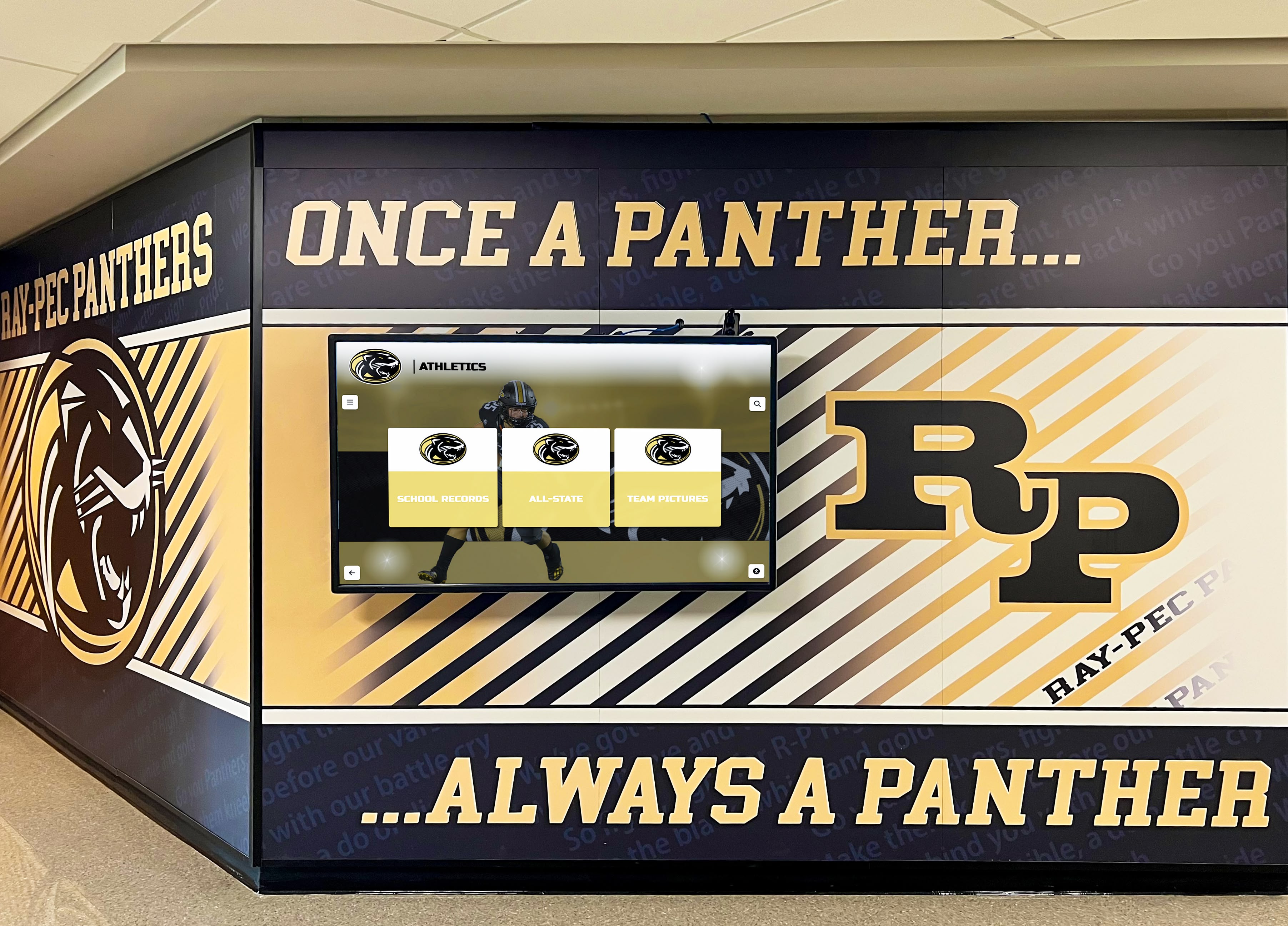
Athletic recognition displays in school hallways present visually accessible color photographs — those display images are correctly labeled display derivatives produced from documented preservation captures, not corrected originals presented as if unaltered
Chromogenic Color Print Fading Intake Checklist
Before intake handling:
- Lintless nylon or cotton gloves on; worn throughout all handling
- Clean padded work surface prepared
- Camera and color reference card ready for condition photography
- Archival enclosures prepared — polyester or polyethylene; no PVC
- Intake log ready for print-level observations
Physical documentation (each print):
- Format and size recorded
- Base type noted (RC-type back or fiber-based feel)
- All inscriptions and imprints on print back transcribed verbatim
- Enclosure and housing inscriptions and labels recorded verbatim
- Provisional process identification basis recorded; uncertainty noted if applicable
Fading and color shift observations (each print):
- Highlight and neutral areas examined: white, neutral, or yellow-orange cast described specifically
- Overall saturation and color balance described (not just “faded”)
- Color shift direction recorded if present: warm, cool, or another direction
- Shadow and dark area rendering noted
- Local fading or discrete staining recorded if present
- Condition photograph taken under consistent diffuse light
Prior storage conditions:
- Storage location and container type recorded as reported
- Known temperature and humidity conditions noted as reported
- Known display or exhibition history noted if applicable
- Prior enclosure material noted (including PVC if applicable)
Routing and re-housing:
- Condition classification and routing decision entered in intake log
- Prints requiring conservator consultation flagged before further handling
- Each print re-housed individually in acid-free folder or polyester sleeve
- Accession number recorded on enclosure exterior; nothing written on print surface
Digitization preparation:
- Non-contact digitization approach confirmed for prints with physical instability or surface concerns
- Preservation capture vs. display derivative distinction confirmed with digitization operator before any scanning begins
- Preservation capture metadata fields prepared: accession number, fading description, “no color correction” label
- Display derivative metadata fields prepared: accession number, correction applied label, date
Planning Non-Contact Digitization for Color Team Photographs
For color team photographs routed to digitization after the intake workflow above, the digitization setup should reflect any physical condition concerns noted at intake and the requirement to produce an unaltered preservation capture.
Non-contact vs. flatbed digitization:
Flatbed scanning — placing the print face-down on scanner glass — is a common approach for stable, undamaged prints. For prints with surface scratches, delaminating emulsion, or any physical instability observed at intake, flatbed contact introduces risk. An overhead camera setup — print face-up on a stable surface, camera mounted above — eliminates surface contact and allows visual monitoring throughout the capture process. The approach selected should be noted in the intake record and confirmed with any contracted digitization service before materials are transported.
Lighting for the preservation capture:
The preservation capture should be made under diffuse, consistent illumination that records the print’s actual colors and tones without introducing casts from the light source. Fluorescent and LED sources with uneven spectral output can introduce tonal shifts into scans of color photographs. The CCI guidance recommends tungsten light sources for displaying colour prints; the same principle of a neutral, consistent light source applies to digitization intended to produce an accurate preservation capture.
Specifying requirements to contracted services:
When digitization is contracted to an outside service, the intake condition record for each print should accompany the print to the scanning facility. Confirm with the operator:
- That the preservation capture must be produced without color correction
- That any color-corrected version must be a separate file, labeled as a display derivative
- That prints with surface instability noted in the condition record must be flagged before handling in the scanning facility
- That prints with uncertain condition should be returned unscanned rather than handled without assessment
Condition assessment as a broader discipline:
The same documentation-first intake approach that governs color team photograph intake applies to other physical materials in a school’s athletic recognition collection. A systematic championship banner condition assessment checklist applies analogous intake logic to banners — examining condition before any repair, replacement, or digitization decision is made. For materials assessed on a recurring schedule rather than at one-time intake, a structured championship banner inspection checklist covers the annual review logic for banners in gyms and hallways. Both reflect the same principle that condition is documented before action is taken.

Athletic recognition spaces that combine physical trophy displays with school identity murals often hold color team photographs whose condition should be documented at intake before any digitization or display plan is finalized
Connecting Color Print Intake to Athletic Recognition Programs
The practical goal of chromogenic color print fading intake is a digitized archive of school team photographs that is complete, accurately documented, and usable for the recognition programs through which athletes, alumni, and the school community encounter those images.
Color team photographs from the mid-1960s onward document school athletic history across the decades when most current alumni were athletes, coaches, or students. A school’s collection of color team photographs may include the first championship seasons, the teams that produced current coaches and athletic directors, and the athletes whose names appear on existing trophy bases and honor boards. Digitized and accurately documented — with preservation captures reflecting actual condition and display derivatives labeled as corrected — those photographs can enter a digital hall of fame, a touchscreen recognition installation, or a digital yearbook program in a form that is both accessible and archivally honest.
For schools that display physical athletic recognition materials alongside digital content, the guidelines for safely mounting objects in a trophy case address how to display jerseys, trophies, and memorabilia — the physical recognition objects that often share display or storage proximity with historic color team photographs.
For schools navigating the range of condition-reporting tools and review checklists available for athletic recognition materials, a championship banner seam slippage report checklist for school buyers illustrates the kind of structured condition reporting that vendors and schools review together — comparable, in its documentation logic, to the intake checklists a school develops for photographic materials it manages directly.
Once digitized and documented, color team photographs enter the same recognition infrastructure as championship titles, individual athlete profiles, and award records. That infrastructure is most useful when its underlying data is consistently structured — with clear definitions of how names, team designations, awards, and media file types relate to each other. A hall of fame profile data dictionary provides a framework for standardizing those definitions, ensuring that digitized photographs can be found, displayed, and associated with the right athletes and seasons once they enter the system.

Touchscreen hall-of-fame displays presenting color photographs of school athletes across multiple decades depend on a digitized archive where each source print's condition was documented at intake — fading records accompany each file into the recognition system
Frequently Asked Questions
Can I identify a chromogenic color print from appearance alone at intake?
Provisional identification from appearance is possible and supports intake routing decisions. A full-color photographic image on a smooth, slightly lustrous surface with a resin-coated back that feels slightly plastic — produced in a standard commercial photographic print format from the mid-1960s onward — is consistent with a chromogenic print. However, chromogenic is not the only color print process from this period, and condition deterioration can alter appearance. Visual characteristics support provisional identification for handling and documentation purposes; they do not substitute for specialist examination when process identification would affect a treatment or conservation decision.
What specifically should I look for when documenting color shifts?
Examine highlight and neutral areas first: regions that should be white or near-white — jersey numbers on a white ground, background walls in team portraits, sky areas in outdoor photographs — are the most sensitive indicators of color staining and fading. A warm yellow or orange-yellow cast in those areas is a characteristic appearance associated with deterioration in stored colour photographs, as described in the CCI guidance. Then assess the overall image: does it appear fully saturated and balanced, or does it appear dulled, shifted toward warm or cool, or lacking in specific color ranges? Record observations specifically rather than as a single severity rating.
Should I correct fading in the scan before storing the digital file?
No. The preservation capture must reflect the actual current state of the print without color correction. Applying correction to the preservation capture produces a file that does not accurately represent the source print’s condition. Correction can be applied to produce a display derivative, but that derivative must be stored and labeled separately. The preservation capture is the archival baseline — and it cannot be retroactively created if an uncorrected scan was not saved first.
The photographs have been stored in a gymnasium storage room for decades. Does that affect how I interpret fading?
Storage conditions are part of the fading record. A gymnasium storage room that experiences significant summer heat and humidity fluctuation has subjected any color photographs stored there to the conditions the CCI guidance identifies as primary drivers of dark-storage fading: heat and high relative humidity. Document the storage location and conditions as reported, and include them as context for the degree of fading observed. This is a contextual observation; it does not produce a precise fading prediction. But it helps anyone reviewing the intake record understand why a print from that location may show more pronounced fading than one from a consistently conditioned space.
When should I route a color team photograph to a photographic conservator?
Route to a photographic conservator before further handling when: the print shows physical damage (surface cracking, delaminating emulsion, tears, or structural instability) that makes handling for digitization risky; the process cannot be provisionally identified and process matters for the handling decision; fading is so severe that the image is substantially degraded and a digitization approach requires specialist guidance; or any condition is present where in-house intake staff cannot determine whether further handling is safe. The American Institute for Conservation maintains a Find a Conservator directory at culturalheritage.org that allows filtering by specialty including photographic materials.
Does the CCI guidance recommend cold storage for school archive color photographs?
The CCI guidance identifies cold storage — at temperatures below 0°C with controlled relative humidity — as currently recognized as the most effective preservation measure for large collections of colour photographic materials, and notes that stable, moderate relative humidity is a primary factor controlling deterioration rate. The guidance also specifies that relative humidity must be maintained carefully and must never exceed 60%, and that fluctuating humidity must be avoided. Cold storage for photographic collections involves specific requirements for humidity control and gradual acclimatization that the CCI guidance details. Schools with questions about appropriate storage conditions for their specific collections should consult a photographic conservator or a regional archival institution rather than extrapolating a single environmental factor in isolation.
Color team photographs documenting school athletic history from the 1960s through the early 2000s hold the visual record of seasons, coaches, and athletes that alumni remember and that recognition programs present. A focused chromogenic color print fading intake, applied before any scanning session, documents the actual condition of each print, records the storage history that shaped its fading, and ensures that preservation captures and display derivatives enter the digital archive with accurate labels — giving the school a reliable, archivally honest record of its athletic history regardless of how recognition programs use those images downstream.
Ready to connect your documented, digitized color team photograph archive to a recognition program that presents school athletic history accurately and accessibly?
Request a custom Rocket Alumni Solutions demo and see how schools are bringing decades of digitized team photographs — from founding-era portraits to recent championship seasons — into touchscreen hall-of-fame displays, digital yearbooks, and lobby recognition installations that make athletic history visible to athletes, alumni, and your entire school community.