School history, shared
Athletic Archive Audio Crosstalk Correction Workflow for Historic Recordings
The athletic archive audio crosstalk correction workflow is the process of identifying, measuring, and eliminating the unwanted leakage of a signal from one audio channel into an adjacent channel in historic game broadcasts, coach interview recordings, and VHS stereo tracks — a defect that causes one side of a stereo mix to contaminate the other, or causes content recorded on one track of a multi-track tape to bleed audibly into a neighboring track at every playback and digitization of the affected recording. In multi-track and stereo analog tape formats, each audio channel occupies a physically distinct band of magnetic oxide on the tape surface. During playback, the head assembly must read each track in isolation. When the head geometry, magnetic field width, electronic isolation, or azimuth calibration allows signal from one track to reach the amplifier path of an adjacent track, the result is crosstalk — a ghost of the adjacent channel’s content that sits beneath the primary channel’s signal, coloring everything from sideline announcer commentary to coach pre-game remarks with an unwanted second voice or ambient sound layer.
Crosstalk is distinct from print-through echo, dropout, and azimuth misalignment, though all four can coexist in a single recording. Unlike print-through, which produces a time-offset ghost of the same channel’s content, crosstalk introduces content from a spatially different channel. Unlike dropout, which removes signal, crosstalk adds it. Unlike azimuth misalignment, which causes high-frequency attenuation without bleed, crosstalk allows the adjacent channel’s full signal — at a reduced level — to pass directly into the primary channel at every playback. The practical effect in a school athletic archive is that a mono interview recording captured on a two-track reel captures the adjacent track’s ambient room tone as a persistent undertone beneath the coach’s voice, or that a stereo game broadcast digitized from VHS carries a softened version of the right ambient microphone channel beneath the left commentator channel throughout the entire file.
This guide gives school administrators, athletic directors, AV coordinators, and IT staff a systematic workflow for identifying crosstalk in existing tape collections, measuring channel isolation, applying pre-digitization hardware corrections, using software tools to reduce bleed in captured audio, validating corrected files, and setting intake standards that control the problem in future acquisitions.

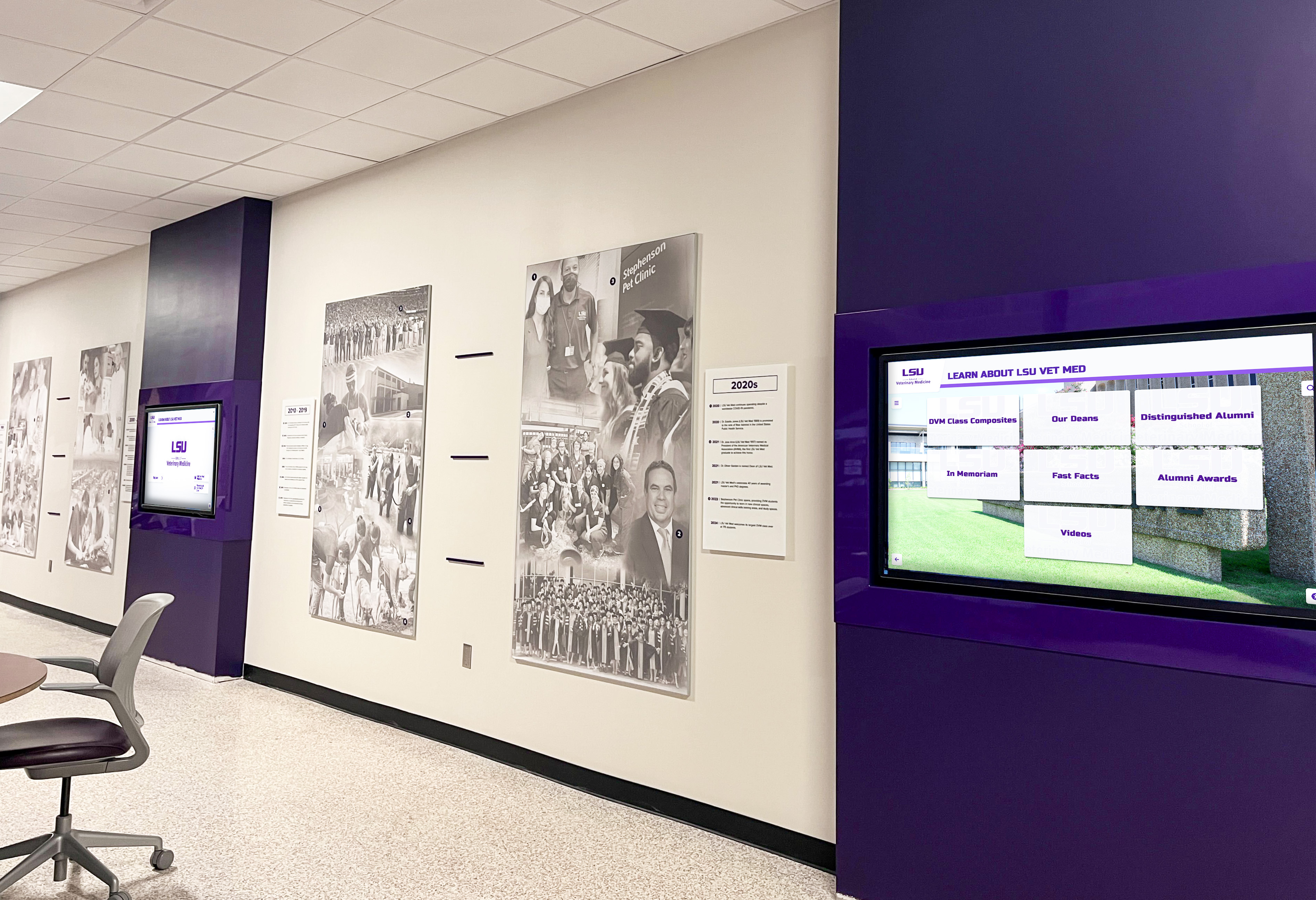
Hallway recognition systems and team history displays source their audio from the archived recordings a school has preserved — crosstalk correction performed before archive ingest determines whether historic game broadcasts and coach interviews play back cleanly or carry a persistent secondary channel undertone through every downstream display and presentation
What Audio Crosstalk Is and Why Athletic Archives Are Vulnerable
Audio crosstalk — also documented in the archival literature as channel bleed, inter-track leakage, or magnetic induction crosstalk — occurs when the magnetic field recorded in one track of a multi-track tape influences the readback amplifier path assigned to an adjacent track. The defect has two primary mechanisms that commonly appear together in tape-based athletic archives.
Magnetic crosstalk arises from the physical geometry of recorded tracks and playback heads. Each recorded track radiates a magnetic field with a fringe that extends slightly beyond the nominal track boundary. A playback head whose gap is slightly wider than the recorded track, or whose azimuth is angled even fractionally off the recorded track angle, reads that fringe as a signal contribution from the neighboring track. The result is a permanent addition of the adjacent channel’s content to the primary channel’s playback path — not a time-delayed echo, but a simultaneous bleed.
Electronic crosstalk arises in the analog amplifier chain downstream of the head assembly. In consumer and prosumer VHS decks, cassette players, and older open-reel machines, channel separation in the preamp and audio processing stages was often specified at 40 to 50 dB — adequate for fresh, high-level recordings, but sufficient for bleed to become audible when program levels on one channel differ substantially from the other, or when the playback head’s magnetic contribution compounds the electronic isolation weakness.
Why school athletic archives are particularly vulnerable:
- Multi-format recording history. School archives commonly include 1/4-inch open-reel recordings, compact cassette interviews, and VHS game footage — formats with substantially different track geometries and head specifications. When a playback machine’s head is slightly mismatched to the recorded track layout, magnetic crosstalk rises above the threshold of audibility.
- Consumer-grade VHS stereo. VHS Hi-Fi audio records both stereo channels simultaneously via helical-scan FM encoding, achieving high channel separation. The longitudinal (linear) stereo tracks at the tape edge — the tracks used in early-generation VHS recorders and in the linear monitor track on later decks — operate with far narrower track widths and lower separation, typically in the 30 to 40 dB range on a well-maintained deck and lower on a worn or misaligned one.
- Reversible cassette recording. Compact cassettes recorded in both play directions divide the tape width into four tracks — two per direction. When a cassette tape that recorded in only one direction is played back, the head sometimes partially reads the adjacent tracks intended for the reverse direction, introducing reverse-playback bleed beneath the forward program. In cassette tapes that were recorded on both sides, this bleed contains audible content from the other side’s recording played in reverse.
- Head wear and alignment drift. Playback heads in consumer and prosumer decks wear at the contact surface over thousands of hours of use. A worn head presents a gap geometry that differs from the manufacturer’s specification, effectively widening or angling the sensing window in ways that increase magnetic crosstalk. Heads that have not been professionally aligned for years introduce compounding azimuth and height errors that amplify track bleed beyond what magnetic geometry alone would produce.
- Open-reel multi-track recordings. Schools that recorded coach commentary, oral history interviews, or radio broadcast feeds on 4-track or 8-track open-reel machines in the 1960s through 1980s archived recordings where each track occupies a narrow band of a 1/4-inch or 1/2-inch tape. A playback machine not precisely matched to that track format will exhibit elevated crosstalk across the entire recording.
- Long-term playback head contamination. Oxide from degrading tapes deposits on the head surface and in the head gap over successive plays. Contamination raises the effective head-to-tape gap, reducing high-frequency response and reducing channel isolation simultaneously — two compounding effects that worsen both tonal quality and crosstalk level in the same playback session.
The practical consequence for school athletic archives is that recordings from the era covering most of a program’s historical identity — the 1960s through the late 1990s — are the formats and the storage conditions most likely to produce audible crosstalk during playback and digitization.
Crosstalk Susceptibility by Source Format
| Source Format | Era in School Archives | Crosstalk Risk | Primary Symptom | Correction Approach |
|---|---|---|---|---|
| Open-reel 4-track (1/4") | 1950s–1980s | Very high | Adjacent-track voice or music faintly audible beneath primary channel throughout recording | Matched-format head; software channel isolation filter |
| Compact cassette (1-direction only) | 1965–2000s | High | Reverse-direction ghost beneath forward program in quiet passages | Head cleaning; reverse-direction bleed filter in software |
| Compact cassette (both directions recorded) | 1965–2000s | Very high | Audible reversed content from other side beneath primary channel | Same as above; more visible on level meters |
| VHS linear stereo | 1984–2000s | High | Right-channel ambient sound audible beneath left commentator channel; or vice versa | Proper deck alignment; software stereo crosstalk cancellation |
| VHS Hi-Fi stereo | 1984–2000s | Low to moderate | Slight channel bleed on head-worn decks; typically below audible threshold on maintained decks | Head cleaning and demagnetization; verify during capture |
| S-VHS linear audio | 1987–2005 | High | Same as VHS linear; narrower track width increases head-geometry sensitivity | Same as VHS linear; prioritize head inspection |
| S-VHS Hi-Fi audio | 1987–2005 | Low | Component separation is better than linear; minor bleed on worn heads | Verify at digitization; usually not correctable beyond head maintenance |
| 3/4" U-matic audio | 1970s–1990s | Moderate | Two-track format with dedicated audio heads; bleed requires significant head wear | Professional deck alignment recommended for correction |
| Betacam SP audio | 1986–2000s | Low | Component recording with discrete audio channels; separation typically adequate | Verify level only; electronic crosstalk occasionally present in aging decks |
| MiniDV / DVCAM audio | 1995–2010 | None | Digital encoding eliminates analog inter-track magnetic and electronic crosstalk | No crosstalk correction needed |
| DAT audio | 1990s–2000s | None | Digital recording; not applicable | Not applicable |
The format boundary relevant to audio crosstalk is the transition from analog magnetic recording to digital encoding. Any format where audio was stored as an analog magnetic signal occupying a physically defined track width — open-reel, cassette, VHS linear, or U-matic — carries the possibility of inter-track magnetic and electronic bleed during playback. Once audio is encoded digitally, the mechanism does not apply.
For most school athletic archives, the crosstalk correction workflow applies to the open-reel, cassette, and VHS linear audio recordings that represent the decades from the earliest systematic athletic recording programs through the late 1990s — precisely the formats that document the institutional memory most valuable to recognition displays, hall-of-fame installations, and alumni engagement programs.
Schools planning to use historic game broadcasts and coach interview recordings in recognition programs that extend beyond the athletic department — including high school spirit week traditions and community celebration installations — will find audio crosstalk is most noticeable to visitors who encounter the material through lobby speakers in quiet environments, making correction before archive ingest the most efficient path to quality control.
Step 1: Identify Crosstalk Symptoms in Existing Recordings
The first step in the workflow is determining which recordings in the collection actually contain audible crosstalk at a level that warrants correction. Not every cassette or VHS recording will exhibit the problem — a capture workflow using a properly maintained deck and matched head geometry may have minimized crosstalk below the audible threshold on many recordings.
What to listen for during playback review:
Open each candidate file in an audio editor with waveform visualization and individual channel metering — Audacity (free, cross-platform) or Adobe Audition both support the required tools — and monitor during:
- The opening seconds of the recording, before the primary channel speaker begins
- Quiet passages between announcer commentary or interview responses
- Passages where one channel contains a loud event and the other channel should be quiet
In a stereo game broadcast with left-channel commentary and right-channel ambient crowd sound, crosstalk from the right channel appears as a faint crowd presence beneath the left-channel commentator voice even during pauses in the crowd. In a mono coach interview recorded on Track 1, crosstalk from Track 2 (which may contain a second program, a different interview segment, or ambient room tone) appears as a continuous undertone beneath the primary voice throughout the entire recording.
Crosstalk versus other defects — distinguishing the source:
Several artifacts produce faint secondary sounds in historic recordings. Confirm the defect is crosstalk before committing to the correction workflow:
- Crosstalk: A consistent secondary signal present throughout the entire recording at a roughly stable level relative to the primary channel. The secondary content is the complete program from an adjacent channel — including its pauses and dynamics — not a discrete echo or a noise floor.
- Print-through echo: A single ghost event at a fixed time offset (100–300 ms) before or after transient events. It does not contain a complete second program; it contains a faint copy of the primary channel shifted in time.
- Room reverberation in the original recording: Natural spatial decay present uniformly in all loud events — not a separately identifiable program source.
- Azimuth misalignment: Causes progressive high-frequency loss across the frequency spectrum; does not introduce content from an adjacent track’s program.
- Dropout: A momentary signal absence — removes content rather than adding it.
If a faint but complete secondary program (voice, crowd sound, music) is audible throughout the recording at a consistent relationship to the primary channel, the defect is crosstalk. Correct identification before treatment prevents applying noise reduction designed for dropout or print-through to a problem that requires channel isolation tools.
Using metering to confirm crosstalk:
With the candidate file open in your audio editor:
- Solo the channel you believe carries crosstalk bleed — if the recording is stereo, isolate the left or right channel; for mono multi-track recordings, isolate each track individually.
- Identify a passage where the primary channel on that track should be silent — for example, a leader segment before the program begins, or a pause between interview questions where no one is speaking on that track.
- In that passage, observe the level meter and listen in headphones. A noise floor with an irregular spectral shape that moves in response to loud events on the adjacent channel — rather than maintaining a flat, random noise characteristic — confirms crosstalk. If the secondary content rises and falls in sync with the adjacent program rather than randomly, you are hearing bleed.
- Note the approximate level difference between the primary channel’s nominal program level and the crosstalk signal during quiet primary passages. This measurement — the channel separation figure — determines which correction approach is warranted.
Step 2: Measure Channel Separation and Classify Severity
Before selecting a correction method, measure the actual channel separation the recording exhibits. This measurement directs the workflow toward the correct tool tier and sets expectations for what correction can achieve.
Measuring channel separation in Audacity:
- Open the recorded file and locate a passage where the primary channel is at nominal program level.
- In that same time region, examine the waveform of the channel that should be silent or at ambient level.
- Use the Analyze > Amplify tool (without applying it) to read the peak level of the crosstalk channel; compare this to the peak level of the primary channel in the same region.
- The difference in dB between primary and crosstalk levels is the approximate channel separation for that recording.
Severity classification:
| Measured Channel Separation | Severity | Audibility | Recommended Approach |
|---|---|---|---|
| 50 dB or greater | Below threshold | Inaudible in most playback contexts | No correction required; document and proceed to archive |
| 40–49 dB | Borderline | Audible through headphones in silent passages; inaudible on typical lobby speakers | Hardware head cleaning may improve; monitor at archive ingest |
| 30–39 dB | Moderate | Audible on lobby speakers; noticeable to attentive listeners | Software crosstalk reduction recommended |
| 20–29 dB | Significant | Clearly audible on any playback system; affects intelligibility of quiet passages | Hardware correction before capture if possible; software correction required |
| Below 20 dB | Severe | Secondary program competes with primary; content may be unintelligible in both channels | Full hardware and software correction workflow; professional evaluation recommended |
A channel separation measurement below 40 dB in a recording that will be displayed in lobby kiosks, integrated into recognition wall audio feeds, or exported to digital yearbook highlight reels warrants correction before archive ingest. The correction performed at the intake stage is the only efficient point in the workflow: after a file is committed to the archive, every downstream use — every display, every export, every highlight reel — inherits the bleed.
Step 3: Hardware Correction Before Digitization
Hardware approaches to crosstalk reduction apply before the analog signal is converted to digital. They address the physical causes of bleed at the playback head and electronics stage, and their corrections benefit the entire recorded signal uniformly — unlike software approaches, which operate on the already-captured digital waveform.
Head cleaning:
Oxide accumulation on the playback head gap degrades channel separation by reducing the effective gap depth and contaminating the magnetic sensing geometry. Clean the head before each tape playback session using a cotton swab or foam-tipped applicator moistened with isopropyl alcohol at 91% or higher concentration. For VHS decks, use tape-path head cleaning cassettes only if alcohol-solvent cleaning is not feasible — most professional archivists prefer direct solvent cleaning because wet-cleaning cassettes introduce abrasion.
After cleaning, allow the head to dry completely (30 seconds minimum) before threading a tape. A head cleaned before each session and demagnetized monthly maintains the closest possible conformance to the manufacturer’s separation specification.
Head demagnetization:
Playback heads accumulate residual magnetism from repeated tape contact. A magnetized head reduces the signal-to-noise ratio of quiet-level tracks and reduces channel separation by introducing a bias field that couples between head elements. Demagnetize the transport head, erase head, and all metal guide posts using a handheld tape demagnetizer in a slow, arcing motion — approaching from a distance, sweeping across the head surface, then withdrawing slowly. Never allow a powered demagnetizer to contact the head directly or stop while near the head.
Matched playback format verification:
Confirm that the deck’s playback head geometry matches the track format of the tape being played. A 4-track compact cassette head reading a tape recorded as a 2-track mono instrument recording — a configuration common in oral history interview workflows of the 1960s and 1970s — will read adjacent tracks simultaneously, producing severe crosstalk that no software correction fully resolves. Verify the original recording format through documentation before selecting a playback deck.
For open-reel recordings, the track format (full-track, half-track, quarter-track) and tape width determine the head specification required. A half-track stereo head reading a full-track mono recording reads both halves of the tape simultaneously and cannot isolate the mono program without mechanical modification of the transport.
Adjusting playback levels:
Elevated crosstalk becomes more audible when one channel carries a significantly higher signal level than an adjacent channel. Where program content allows, reduce input gain on the primary channel to keep program levels at -12 to -6 dBFS during capture, rather than pushing levels to -3 or 0 dBFS. Lower primary levels reduce the signal strength available to drive magnetic fringe into adjacent tracks, and lower program levels also reduce the perceptual contrast between primary and crosstalk channels. This adjustment does not eliminate crosstalk but reduces its relative audibility at capture.
Using professional-grade decks with superior head geometry:
Consumer VHS decks and portable cassette players were manufactured to specifications that accepted channel separation in the 35 to 45 dB range. Professional-grade archival decks — the JVC BR-S800U for VHS, the Panasonic AG-1980P for S-VHS, the Sony TC-D5M for cassette, and Nagra open-reel decks for 1/4-inch recordings — were built to tighter tolerances, with head geometries and electronic channel isolation specifications in the 50 to 60 dB range on well-maintained units. Routing archival captures through professional decks provides an inherent improvement in channel separation before any software correction is applied.
Schools comparing options for digitizing their historic game broadcast and interview holdings will find that the equipment choice at the capture stage determines the ceiling for achievable channel separation in the archive master file. A professional capture at 55 dB separation requires only minor software refinement; a consumer capture at 30 dB separation requires substantial correction that cannot fully recover the lost isolation.

Lobby and hallway recognition displays that incorporate historic audio recordings — game broadcasts, coach interviews, or program highlights — expose the archive's audio quality to visitors and students; crosstalk correction before ingest ensures that quality reflects the program's history rather than the imperfections of tape playback
Step 4: Software Crosstalk Correction After Capture
When hardware approaches have been applied and channel separation in the captured file still measures below 40 dB, software correction addresses the residual bleed in the digital waveform. Software crosstalk correction operates on a fundamentally different mechanism than hardware correction: rather than preventing bleed at the source, it uses the phase and amplitude relationships between channels to mathematically reduce the secondary channel’s contribution to the primary.
Stereo crosstalk cancellation (Mid/Side matrix processing):
For stereo recordings — VHS linear stereo game broadcasts, stereo cassette interview recordings, and stereo open-reel program content — a Mid/Side matrix operation is the most effective first-pass software correction. The approach encodes the stereo signal into a sum (Mid) channel containing content common to both channels, and a difference (Side) channel containing content unique to each. Crosstalk — by definition the same content appearing in both channels simultaneously — appears in the Mid channel, while unique primary content appears in the Side channel.
In Audacity:
- Open the stereo file.
- From the track menu, select Split Stereo to Mono to create two separate mono tracks.
- Invert one of the mono tracks using Effect > Invert.
- Mix the two tracks. Crosstalk content that appears at equal amplitude in both channels will cancel; primary content unique to each channel will remain.
- Unmix and remix to stereo with appropriate gain adjustment.
The effectiveness of Mid/Side cancellation depends on how symmetrically the crosstalk appears in both channels. Where crosstalk in one channel differs from the other in phase or amplitude — as often occurs in recordings with asymmetric head wear — a secondary manual correction pass addresses the residual.
Spectral subtraction and noise reduction for crosstalk bleed:
For moderate-severity bleed where the crosstalk signal is at 30 to 40 dB below the primary, Audacity’s Noise Reduction tool (Effect > Noise Reduction) can reduce bleed if the adjacent channel’s content is relatively consistent in character and can be sampled in isolation. The tool works best when a short segment of the isolated bleed — found in a passage where the primary channel is silent — can be used as a noise profile. The profile is then subtracted from the full recording, reducing the contribution of that spectral pattern throughout the file.
This approach is effective when:
- The crosstalk bleed has a consistent spectral character (a constant adjacent-track program tone or ambient room sound)
- A clean sample of the bleed without primary content can be identified and isolated (a tape leader, a pre-program silence, or a gap between program segments)
The tool is less effective when the adjacent channel’s content varies significantly in level and spectral character throughout the recording — for example, a coach interview track with varied speech content bleeding into a commentary channel produces a constantly changing crosstalk profile that a single noise print cannot fully address.
Adobe Audition’s Stereo Channel Mixer for amplitude-based correction:
Adobe Audition provides a Stereo Channel Mixer effect (Effects > Stereo Imagery > Stereo Channel Mixer) that allows precise reduction of cross-channel contribution by percentage. If the measured crosstalk in the left channel from the right channel is approximately 10% of the right channel’s signal (corresponding to roughly 20 dB separation), setting the cross-channel contribution for the left channel to subtract 10% of the right channel’s content applies a targeted correction matched to the measured bleed level.
This method requires:
- A reliable measurement of the crosstalk percentage from Step 2
- A stereo or dual-mono recording where both channels are accessible as separate streams
- Careful gain compensation after cross-channel subtraction to prevent the corrected channel from becoming quieter than the original
Manual spectral editing for severe or isolated crosstalk events:
When bleed is concentrated in specific frequency ranges — a crowd-sound adjacent channel bleeding a narrow midrange band into a commentary channel — the Spectral Frequency Display in Adobe Audition or the Spectrogram view in Audacity allows visual identification and erasure of the bleed by frequency region. This approach is time-intensive but provides the highest precision for recordings where the crosstalk content occupies a distinctly different frequency profile than the primary program, such as instrumental music bleeding into a spoken interview.
Programs building comprehensive athletic archives that will connect to athletic awards database systems and recognition platforms should perform all software corrections on a working copy of the captured file, not the master. The original digital capture — even with crosstalk present — serves as the preservation master from which future correction passes can be attempted as tools improve. The corrected version becomes the access copy.
Step 5: Validate Corrected Files
Validation confirms that the correction achieved the targeted improvement, that the correction process did not introduce new artifacts, and that the corrected file meets the archive’s quality standards before it is committed to permanent storage.
Re-measure channel separation:
After applying hardware and software correction, re-measure channel separation in Audacity or Adobe Audition using the same method as Step 2. Compare the post-correction measurement to the pre-correction baseline. Document both figures in the processing record for the file. A successful correction pass should improve channel separation by at least 10 dB over the pre-correction measurement; a pass that achieves less than 5 dB improvement warrants a different correction approach or a consultation with a professional audio conservator.
Listen for introduced artifacts:
Software crosstalk reduction tools — particularly aggressive noise reduction passes — can introduce processing artifacts:
- Spectral holes: Portions of the frequency range that are attenuated more than intended, producing a hollow or underwater quality in voices
- Musical noise (birdies): A characteristic chirping or warbling artifact from overly aggressive spectral subtraction, most audible in quiet passages following loud events
- Phase smearing: A slight diffusion or blurring of transient events caused by aggressive phase-based processing
If introduced artifacts are audible at the corrected file’s intended playback volume and listener distance, reduce the correction pass intensity and re-process. A correction that reduces crosstalk from 30 dB separation to 37 dB without introducing artifacts is preferable to one that achieves 45 dB separation with audible musical noise.
Waveform comparison:
In Audacity, open the original digital capture and the corrected file side by side in two windows. Align a known reference point in both files (the beginning of program content, a distinct transient event) and compare the waveform amplitudes during a passage that contains the correction target. The corrected file should show a measurably reduced waveform amplitude in the crosstalk-affected channel during passages where the adjacent channel’s content drove the bleed.
Extended listening review:
Perform a full-duration listening review of the corrected file at the intended playback volume and speaker configuration — if the recording will be used in a lobby display, listen through a speaker representative of that environment. A correction that measures well in an audio editor may still be audible on specific speaker types or in specific acoustic environments. The target is perceptual transparency: a listener who encounters the corrected file in its intended display context should not notice the corrected defect.
Schools building collections of historic game broadcasts and coach interviews for display in recognition installations benefit from the same validation discipline applied to video defect correction. Programs that connect corrected audio archives to college football hall-of-fame level recognition programs — where the audio component of a historic broadcast carries institutional significance — require validation standards that reflect the display context, not just the measurement threshold.
Step 6: Document Correction Metadata and Update Intake Standards
Every corrected file should carry a processing record that documents what was found, what was applied, and what was achieved. This record serves two purposes: it prevents the same correction pass from being applied redundantly if the file is re-processed in the future, and it provides a quality history for every item in the collection.
Required processing record fields:
| Field | Content |
|---|---|
| File identifier | Archive accession number or unique file ID |
| Source format | VHS linear stereo, compact cassette 4-track, 1/4" open-reel half-track, etc. |
| Defect identified | Audio crosstalk (channel bleed) |
| Pre-correction channel separation | dB measurement from Step 2 |
| Hardware corrections applied | Head cleaning, demagnetization, deck model used |
| Software corrections applied | Tool name, version, settings applied |
| Post-correction channel separation | dB measurement from Step 5 |
| Artifacts introduced | None / describe if present |
| Processing operator | Name or initials of staff performing the correction |
| Date of correction | ISO 8601 format (YYYY-MM-DD) |
| Master file location | Path to uncorrected digital capture master |
| Access copy location | Path to corrected access file |
Store the processing record as an embedded metadata field in the corrected file’s XMP or BEXT chunk where the codec supports it (WAV, BWF), and as a sidecar text or CSV record alongside the file in the archive directory structure. Files that move between storage systems or archive platforms carry their processing history in the embedded field regardless of the sidecar file’s status.
Updating intake standards:
The crosstalk correction workflow is most valuable when applied as a systematic intake protocol to every new acquisition rather than as a retrospective remediation on already-archived files. Update the athletic archive’s intake standards to include:
- A mandatory crosstalk screening pass for every open-reel, cassette, or VHS linear audio recording entering the archive for the first time
- A minimum channel separation target of 40 dB for access copies before they are published to display systems
- A required note in the processing record if a corrected file still measures below 40 dB separation after maximum feasible correction
- A deck maintenance schedule that includes monthly head demagnetization and per-session head cleaning before any tape is threaded
Programs that have established systematic intake protocols across related preservation challenges — including the same kind of systematic approach applied to finding historic yearbook records across a school’s history — will find that the crosstalk screening step adds only a few minutes per tape but eliminates a defect class that is otherwise permanent in the archive.
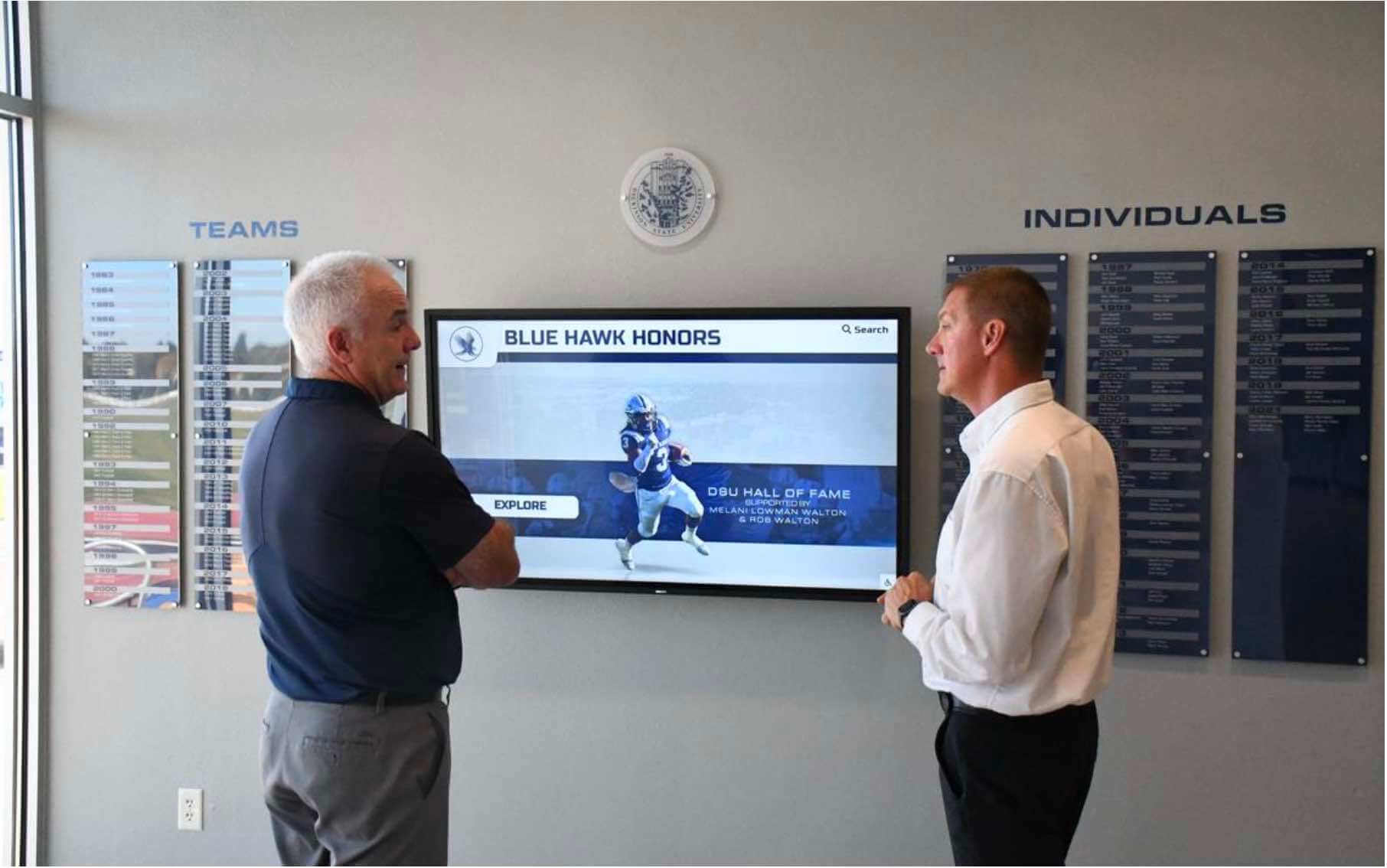
Hall-of-fame displays and athletic recognition installations draw on the full archive to tell a school's athletic story — audio crosstalk correction ensures that the historic broadcasts and coach interviews supporting those displays are heard as they were intended, without channel bleed competing with the primary program
Crosstalk Risk Factors by Recording Type
School athletic archives contain several distinct recording categories that carry different crosstalk profiles. Applying the workflow selectively based on recording type and estimated risk reduces the time required to process a large collection.
Game broadcast recordings on VHS linear stereo: The highest-volume category in most school archives from the 1984–2000 era. These recordings were commonly made by connecting a VHS deck’s linear audio inputs to two microphone sources — one for sideline commentary and one for ambient crowd sound. The linear stereo track’s inherent separation of 30–40 dB on a consumer deck, combined with years of head wear, makes this the category most likely to produce audible crosstalk. Screen all VHS linear stereo game recordings before archive ingest.
Coach interview and oral history recordings on compact cassette: The second highest-risk category. Many schools used consumer cassette recorders for post-game coach interviews, recruitment visits, and year-end program reviews. Cassettes recorded in both play directions carry the additional risk of reverse-side bleed. Prioritize cassette recordings for crosstalk screening, particularly those recorded in the C-90 or C-120 formats where thinner tape stock reduces both the magnetic layer separation and the effective track guard bands between adjacent tracks.
Radio broadcast recordings on open-reel 1/4" tape: The highest-risk category for the oldest recordings in the archive. Open-reel recordings from the 1960s and 1970s were often made on 4-track equipment in environments where the playback format was not precisely documented. Screen all 1/4-inch open-reel recordings and verify the track format against the deck specification before playback.
VHS Hi-Fi audio game recordings: Lower risk than linear stereo. The helical FM encoding used in VHS Hi-Fi achieves channel separation substantially higher than the linear tracks on a well-maintained deck. Screen Hi-Fi recordings only when the deck used for capture shows head wear or when playback produces audible secondary content — do not apply software correction routinely to Hi-Fi content that measures above 45 dB separation.
Digital format recordings (MiniDV, DVCAM, DAT): No crosstalk risk from the recording format itself. Apply no crosstalk correction to these recordings. If secondary audio is present on a digital recording, it originated in the original recording environment (ambient microphone bleed, room acoustics) rather than in the tape format — a different problem requiring different treatment.
Connecting Corrected Audio to Recognition Programs
The workflow’s value is fully realized when corrected archive recordings are connected to the recognition systems and school programs that benefit from clean source material. A coach interview recorded in 1978 with audible channel bleed, corrected to 45 dB separation before archive ingest, plays back cleanly through a lobby touchscreen kiosk without requiring visitors to work around the defect to understand the content. A stereo game broadcast from 1991 with right-channel crowd bleed removed from the left-channel commentary track provides a clear audio layer for a video highlight reel compiled for a graduating class recognition program.
Programs that incorporate corrected audio archives into recognition display systems that track certificate and program milestone histories benefit from the consistency that correct intake standards provide: every audio file in the archive meets the same channel separation floor, which means every downstream display system that draws from the archive produces a consistent listening experience.
Schools that preserve game broadcasts and coach interviews alongside program documents, statistical records, and photographic archives create the fullest available picture of an athletic program’s history. Finding missing pieces of that picture — locating a recorded broadcast or an interview that fills a gap in the program’s documented record — often resembles the detective work involved in locating historic school yearbook records. The crosstalk correction workflow is what ensures that, once found, those audio records are preserved at a quality level that allows them to be used.
Programs planning recognition events — graduation-year recognition programs, athletic banquet highlights, and alumni celebration content — that draw on historic game broadcasts benefit from archive-quality audio in every exported compilation. Corrected archive audio appears cleanly in graduation slideshow presentations and athletic celebration media without requiring post-production noise reduction that degrades the overall mix quality.
Frequently Asked Questions
Q: Can audio crosstalk correction recover content that is fully masked by the bleed — for example, a voice that is inaudible beneath a louder adjacent-channel signal?
No. Software crosstalk cancellation reduces the level of the bleed signal but cannot amplify the primary channel’s content that was masked by it. If the primary program signal level at a given moment is 10 dB below the bleed level — if the bleed is louder than the primary — cancellation may make the bleed audible at a reduced level without recovering intelligibility in the primary channel. The practical target of the correction workflow is content where the primary program is the dominant signal and the bleed appears as a secondary undertone. Recordings where the bleed competes with or exceeds the primary signal level may require professional audio forensics to extract primary content.
Q: Does head cleaning improve crosstalk in all cases, or only in specific circumstances?
Head cleaning improves crosstalk when oxide contamination in the head gap is the primary cause of reduced channel separation — a common condition in decks that have been used to play multiple tapes without cleaning. If the crosstalk is caused by a structural head geometry mismatch — the wrong head type for the recorded track format, or physical head wear that has changed the gap geometry permanently — cleaning will not restore separation. Cleaning is the correct first step because it is fast, non-destructive, and often effective; but it is not a universal remedy. If separation does not improve after a thorough cleaning, proceed to head demagnetization and then to equipment-level inspection before concluding that the deck’s geometry is the limiting factor.
Q: We have hundreds of tapes in the collection. How should we prioritize which recordings receive the full crosstalk correction workflow?
Prioritize by format and anticipated downstream use. Compact cassette and VHS linear stereo recordings from programs with documented broadcast histories represent the highest combined risk and value — screen these first. Open-reel recordings from the earliest decades of the collection are highest-risk by format but may be lower in volume; process these as a distinct cohort. For the full collection, a rapid triage pass — two to three minutes of monitored playback per tape during the head-cleaning step — provides enough information to classify severity and route each tape to the appropriate correction tier without committing the full workflow to every item before a severity measurement is available.
Q: Is the corrected access copy the version that should be committed to the archive, or should we keep the uncorrected master?
Both. The uncorrected digital capture is the preservation master — the highest-fidelity digital representation of the original tape that the archive holds. Future improvements in software correction tools may allow a better correction pass from the same master than what is achievable today. The corrected access copy is the version published to display systems, shared with alumni programs, and used for highlight reel production. Commit both to the archive storage system and document their relationship in the processing record. Do not discard the preservation master after producing the access copy.
Q: How does audio crosstalk differ from azimuth misalignment, and can we have both problems in the same recording?
Yes, both defects can coexist in the same recording, and they sometimes worsen each other. Azimuth misalignment occurs when the angle of the playback head’s gap does not match the angle at which the original recording head traversed the tape — the result is a progressive high-frequency attenuation that increases with frequency, producing a muffled, dull sound quality. Azimuth misalignment can increase crosstalk because a misaligned head reads a diagonal cross-section of the tape that includes portions of adjacent tracks. A recording exhibiting both high-frequency loss and audible channel bleed should be assessed for azimuth misalignment first, because correcting the alignment — by adjusting the playback head angle on decks that support it — often reduces crosstalk simultaneously. Software equalization applied to compensate for azimuth loss, without first correcting the alignment, will amplify the crosstalk proportionally alongside the boosted high-frequency content.
Building Audio Crosstalk Correction Into Your Archive Culture
The athletic archive audio crosstalk correction workflow delivers its greatest return when it becomes a standing intake protocol applied to every eligible tape rather than a reactive measure applied after a display quality complaint surfaces. Schools that have committed to systematic archive preservation understand that the window for digitizing analog tape collections is narrowing on two fronts: the physical tapes continue to degrade regardless of storage conditions, and the equipment capable of reading them — the professional decks with the head geometry and electronics required for accurate playback — is increasingly difficult to maintain and source.
The audio content in a school athletic archive is not replaceable from any other source. A game broadcast captured on VHS linear stereo in 1988 is the only recording of the voices, the crowd, and the commentary that accompanied that season. A coach interview recorded on cassette in 1974 is the only surviving audio record of a program’s founding era in that staff member’s own words. The crosstalk correction workflow is the step that determines whether that content enters the permanent archive at the quality level it deserves — clean enough to be displayed, shared, and heard by the students, alumni, and families who care about what the program has meant to their school.
Programs that connect their corrected audio archives to recognition display systems, hall-of-fame installations, and alumni engagement platforms — the programs that make historic content visible and meaningful to current and future school communities — are exactly the programs that benefit most from every step the intake workflow performs correctly. The athletes and coaches whose voices are in that archive deserve to be heard without the distortion that inadequate preservation produces.
Ready to connect your corrected athletic audio archive to a recognition display that honors your program’s full history?
Rocket Alumni Solutions designs digital hall-of-fame systems, lobby touchscreen kiosks, and athletic recognition walls for schools — built to present archive-quality audio and video from programs that preserved their history with care.
Ready to see this for your school?
Picture your collection in a custom mockup
Start with your yearbook collection and digitization goals, then request a custom digital mockup for your school.