Every school has student-athletes whose stories deserve to be told completely—not just a name on a roster, but the full picture of who they are, what they achieved, and why their contributions mattered. The challenge is consistency. Without a defined athlete spotlight template, athletic departments, yearbook advisers, and alumni offices end up reinventing the wheel for every profile they produce—leaving gaps in the archive and presenting recognition that looks different every time it appears.
A well-designed athlete spotlight template solves all of this. It ensures that every profile collected for the school yearbook, the athletic hall of fame, a lobby digital display, or a season-end banquet program captures the same core information in the same organized structure. This guide walks through exactly what schools should include, how to organize those fields for different contexts, and how the same underlying template can feed multiple recognition systems simultaneously.
Whether you are building recognition profiles for the current season’s standout performers or cataloguing alumni athletes for a school’s hall of fame archive, a consistent athlete spotlight template is the foundation that makes all downstream work faster, more professional, and more meaningful to the people being honored.

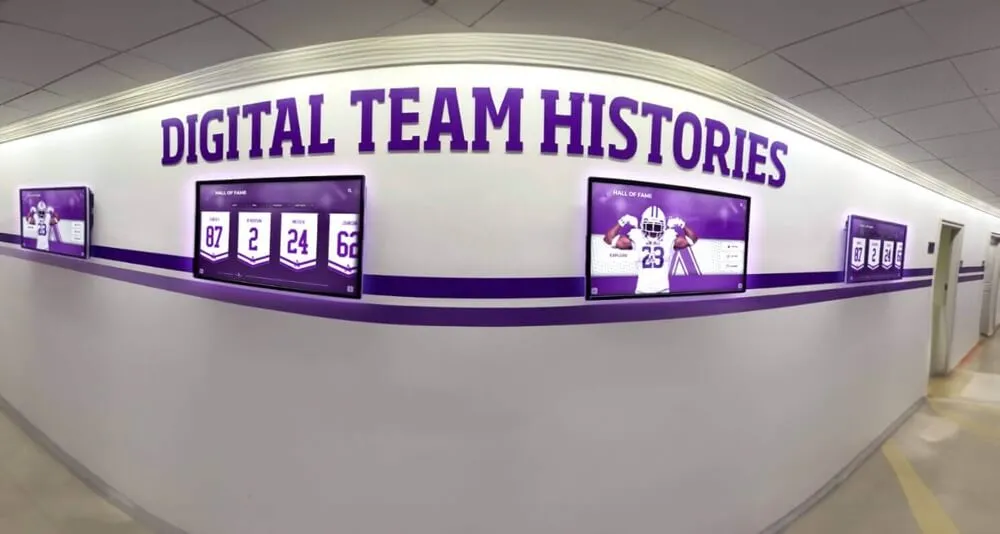
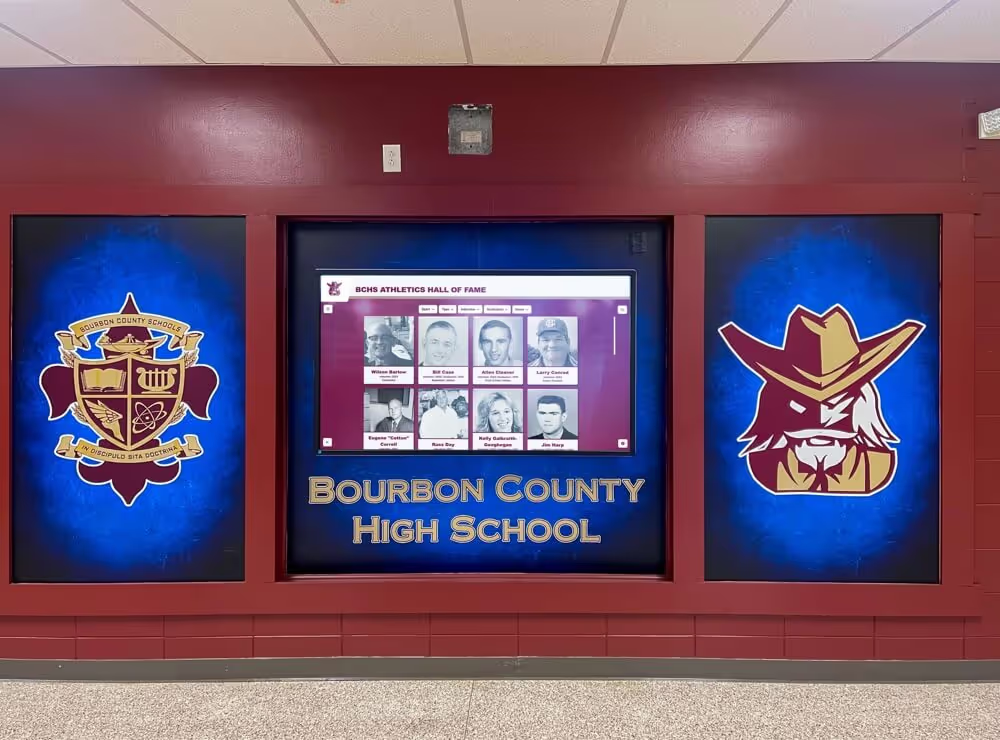
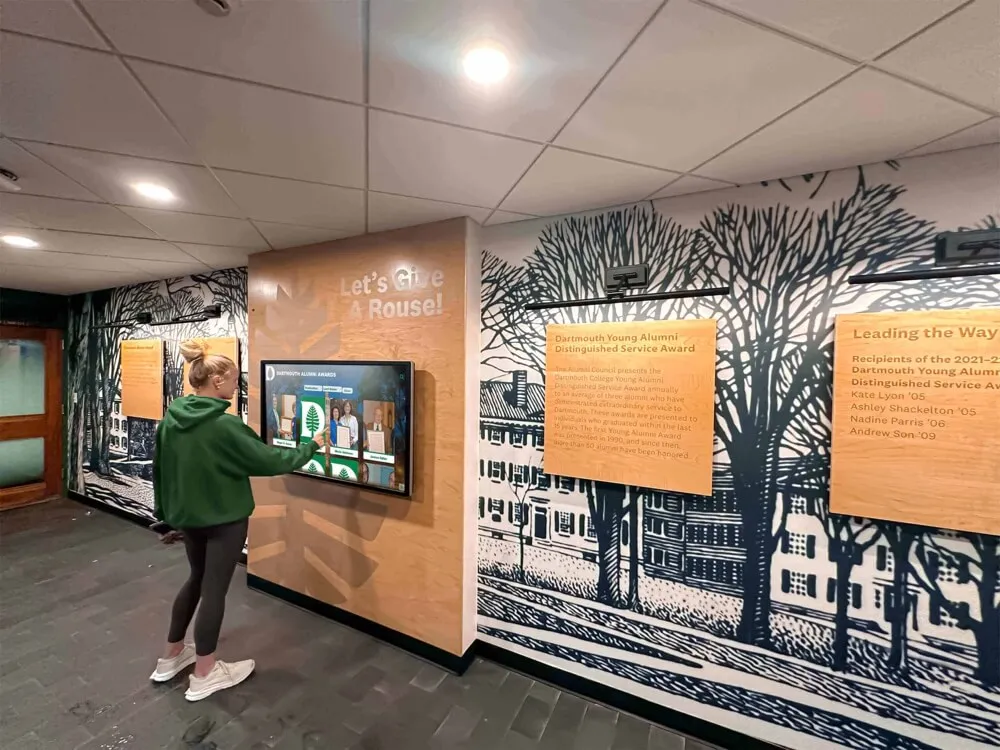
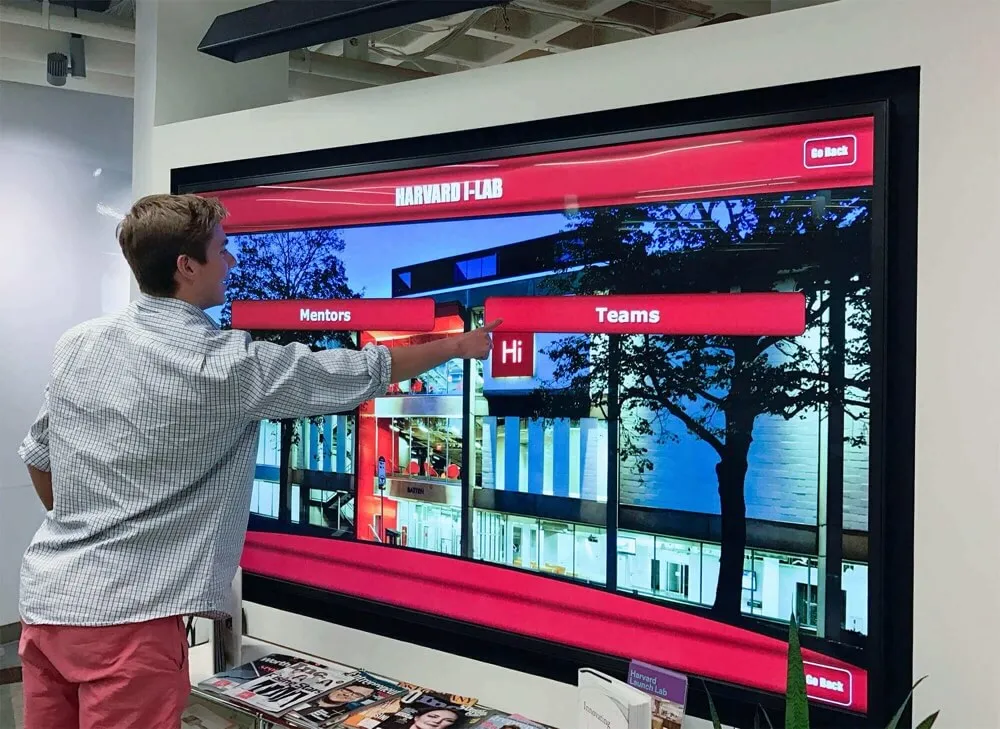
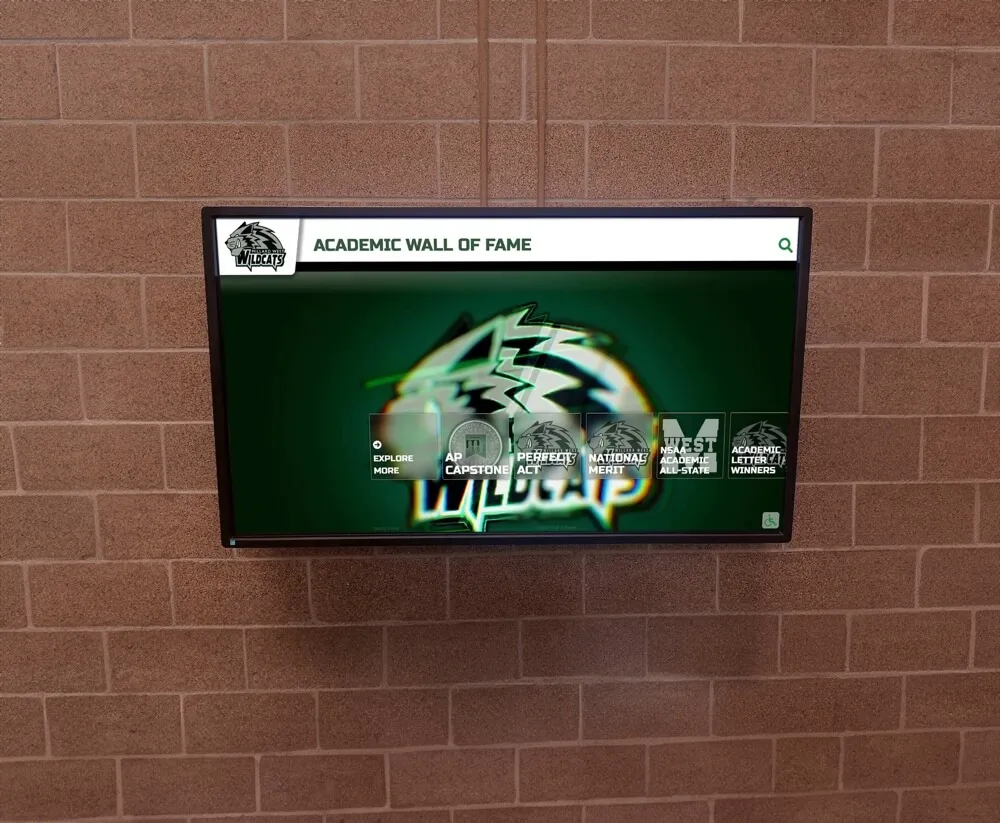
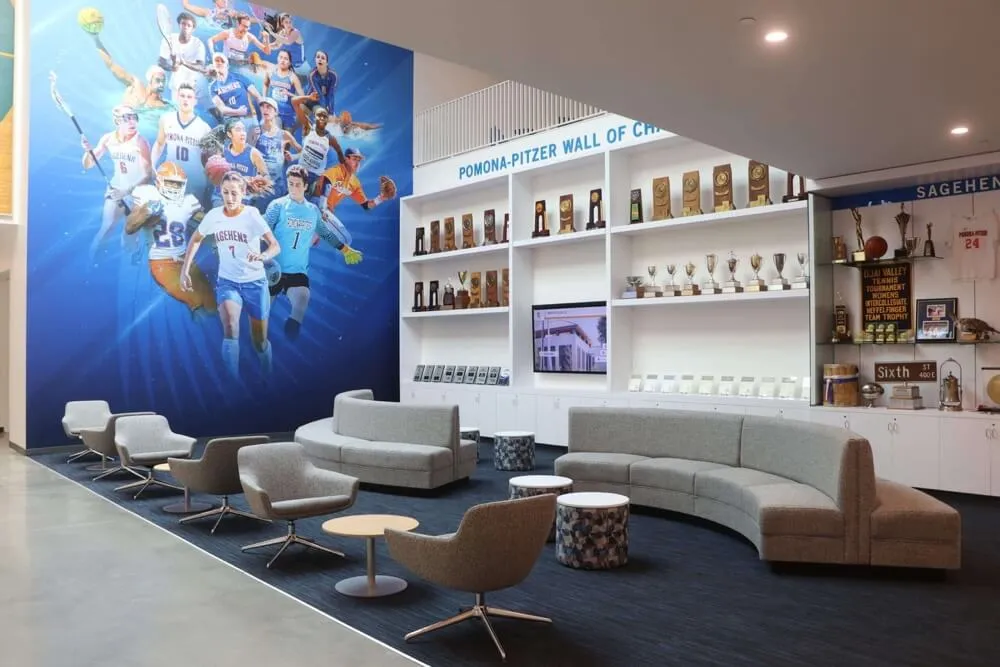
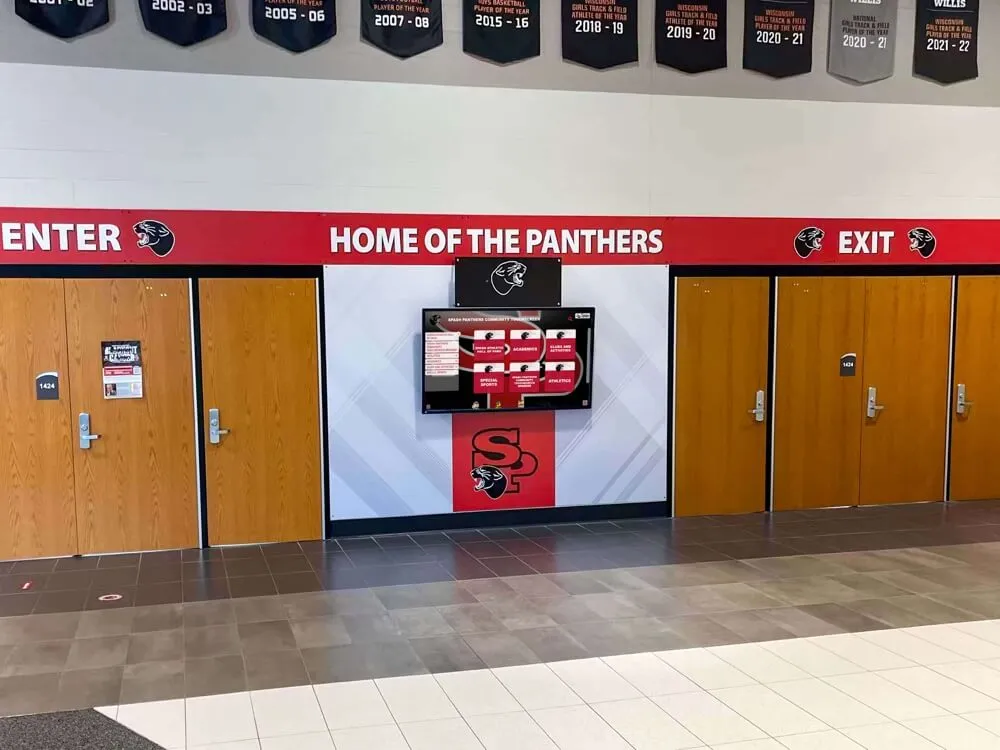
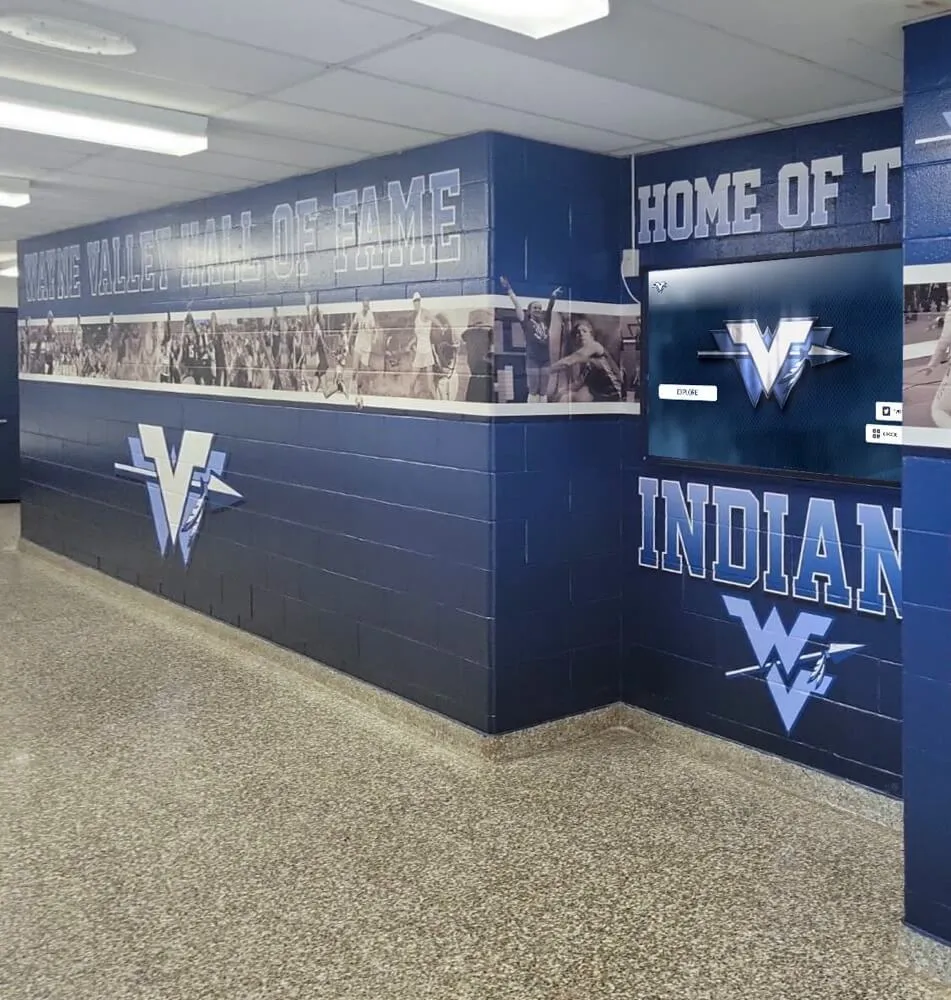
A consistent athlete spotlight template ensures every profile on a digital display captures the same quality of information, from current student-athletes to alumni honored in the hall of fame
Why a Standardized Athlete Spotlight Template Matters
Inconsistent profiles are more than an aesthetic problem. When some athlete spotlights include graduation year and others do not, when some include position and others only list sport, the gaps compound over time. A school trying to build a comprehensive hall of fame or athletic archive five years from now will find itself reverse-engineering information that should have been captured at the time.
Standardization also communicates respect. An athlete who receives a richly documented profile—complete photograph, statistics, personal story, coach’s comment—feels genuinely honored. An athlete who receives a name and a sport feels like an afterthought. Both took the same journey through your program. The template determines which experience they have.
Three Contexts That Share One Template
A well-designed athlete spotlight template should serve at least three contexts without major revision:
Season publications and yearbooks — Profiles produced for the annual yearbook, athletic program booklets, or end-of-season banquet slideshows. These profiles are produced quickly in bulk and need a consistent structure that staff and student editors can fill in reliably.
Ongoing digital recognition — Profiles displayed on hallway touchscreens, digital trophy cases, and school websites. These are browsed by current students, families, and campus visitors and need to be visually complete and descriptive enough to stand alone.
Long-term archives and hall of fame inductees — Profiles that outlast the season and become part of the school’s permanent athletic history. These require the richest documentation and the most careful source verification.
One template designed with all three contexts in mind will gather the right information the first time, avoiding costly follow-up work later.

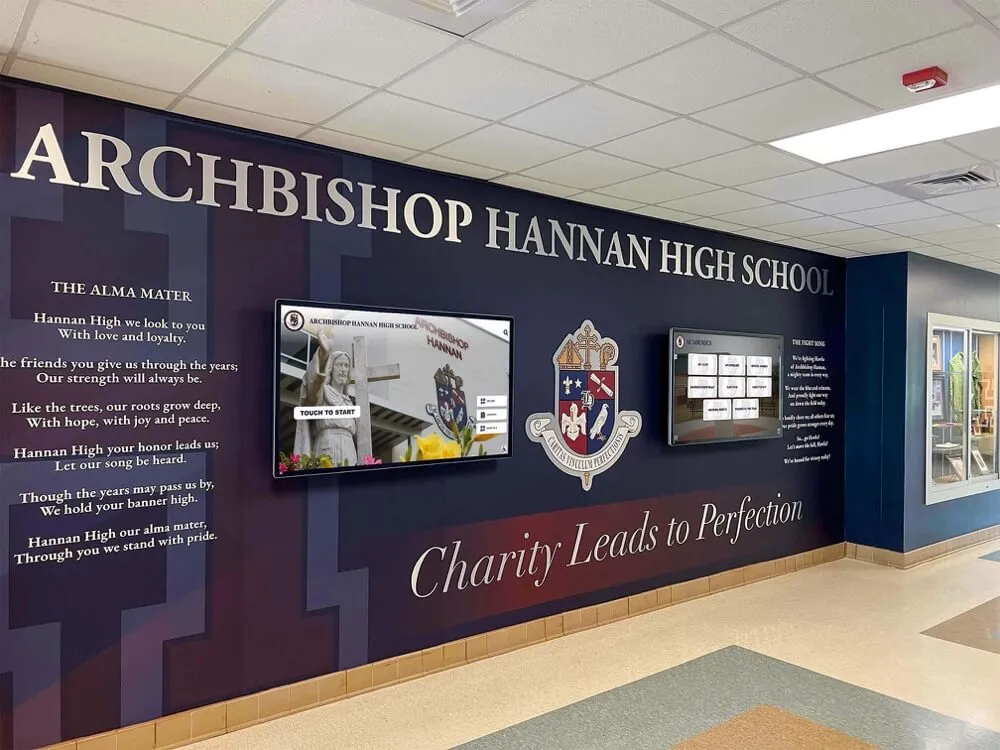
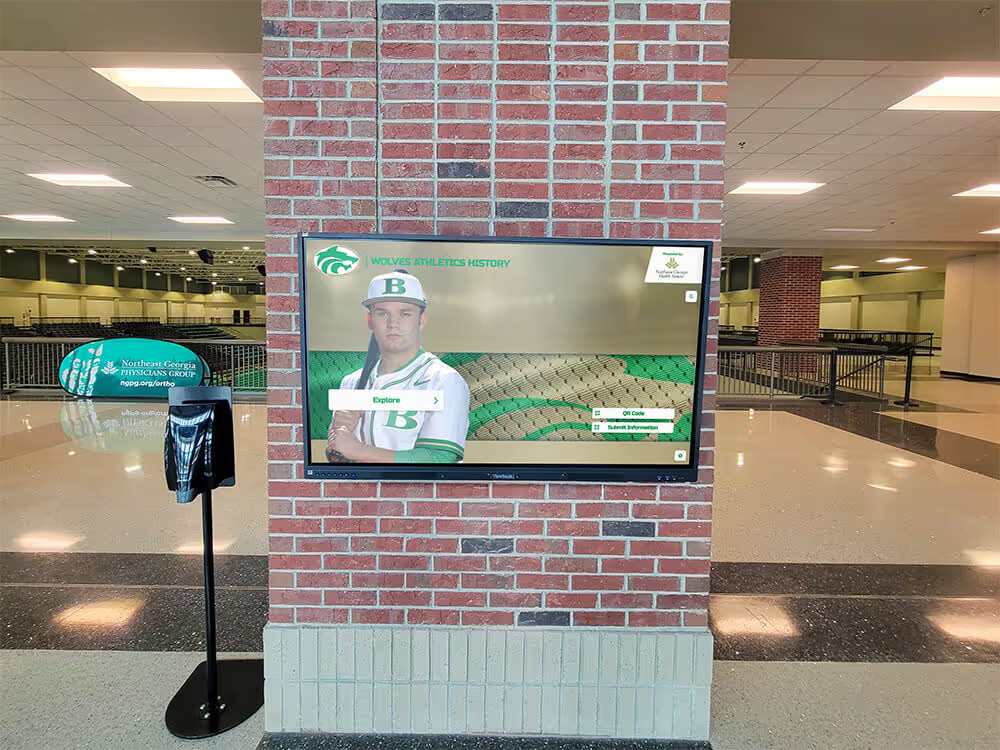
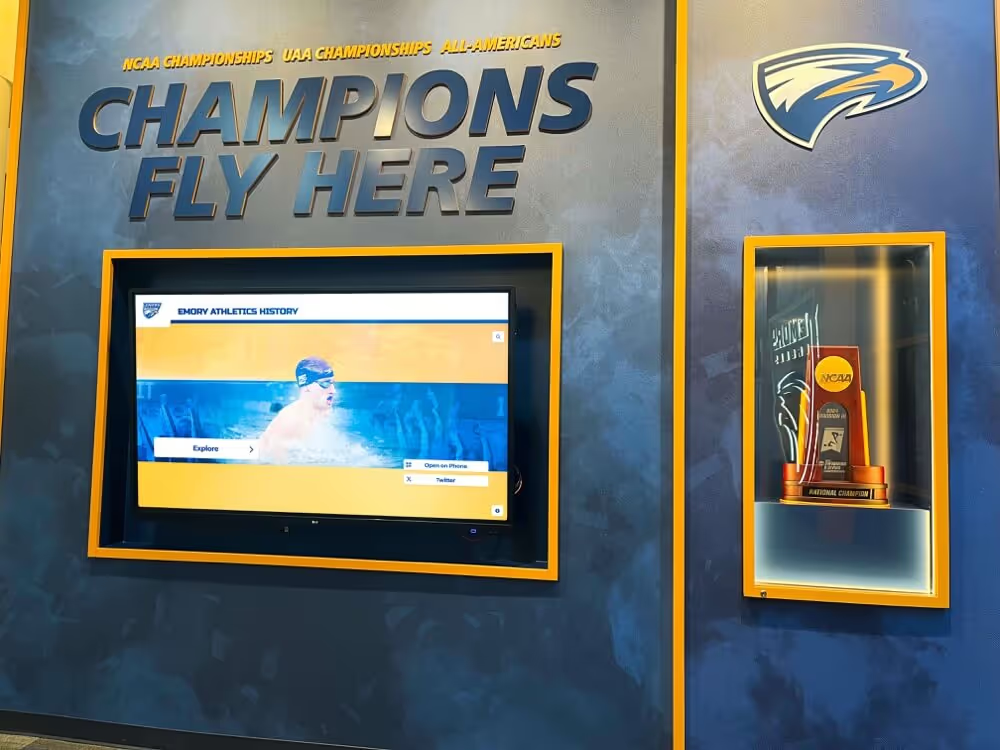
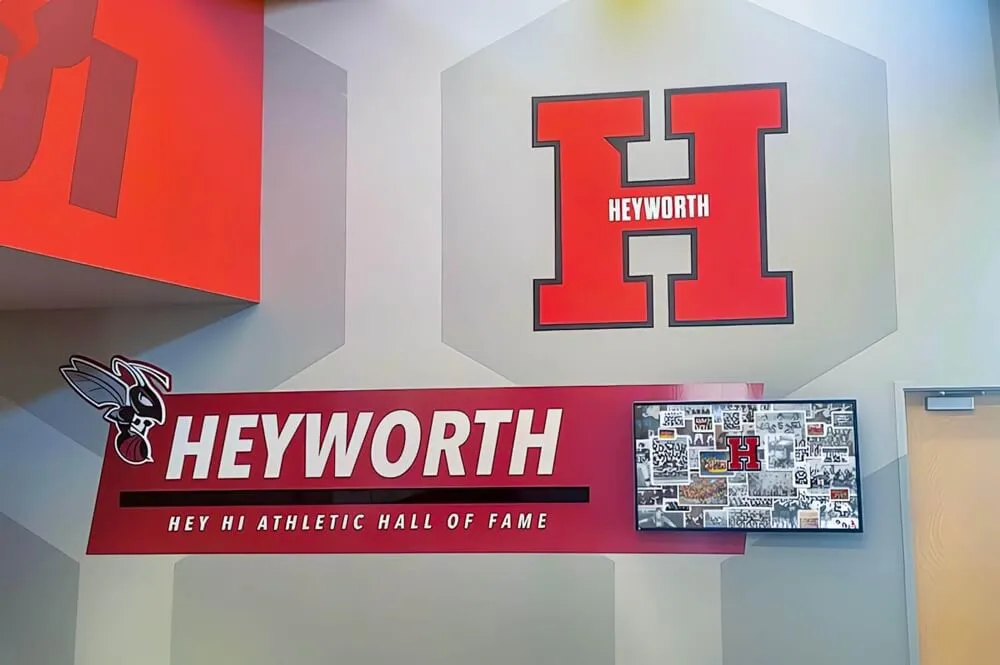
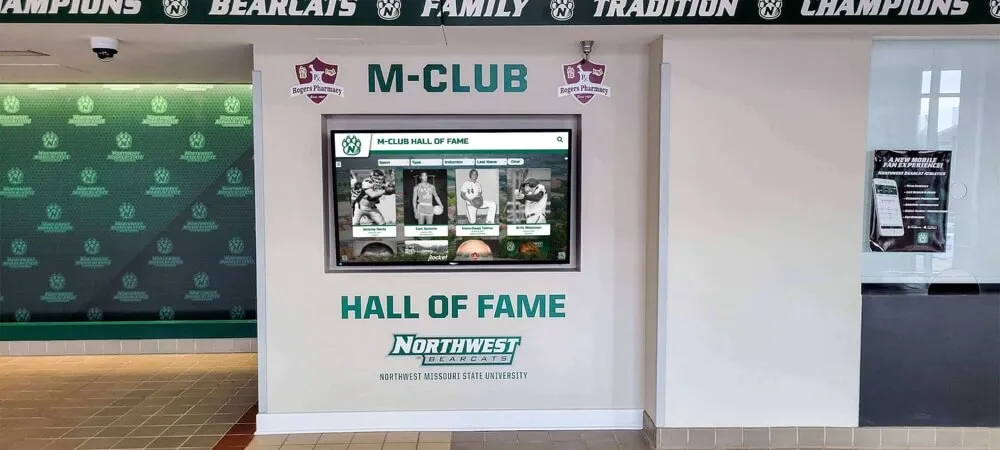
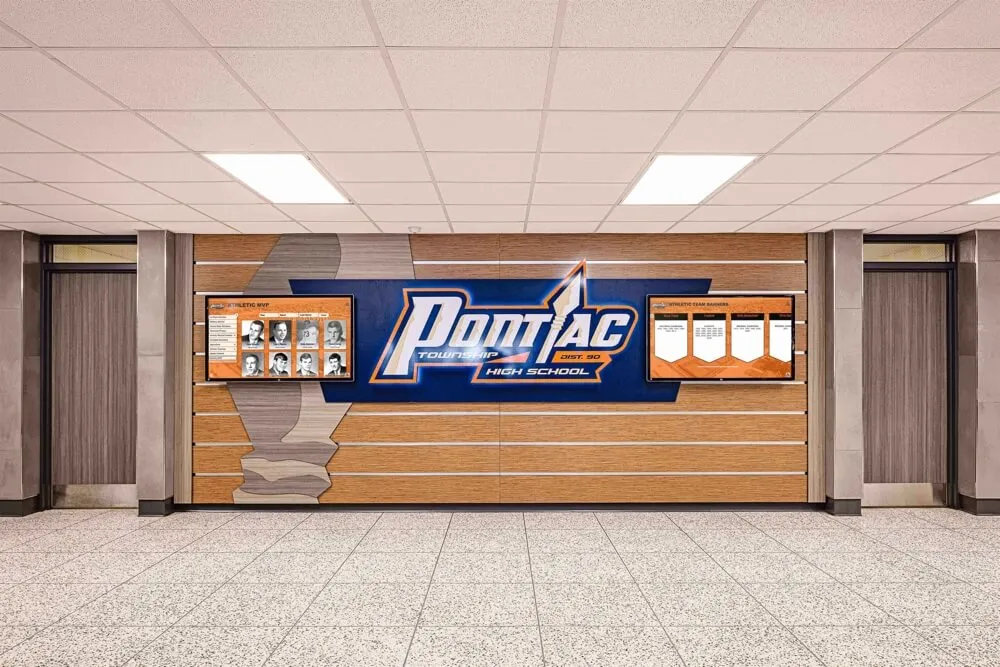
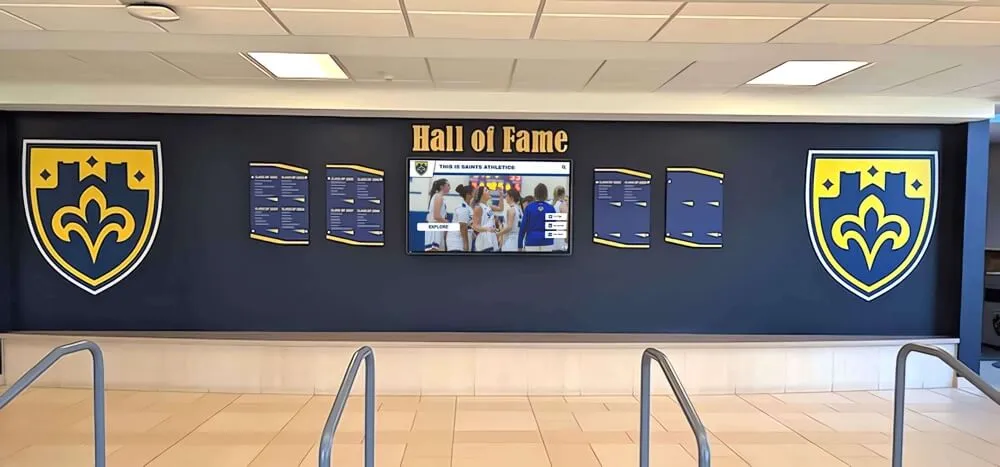
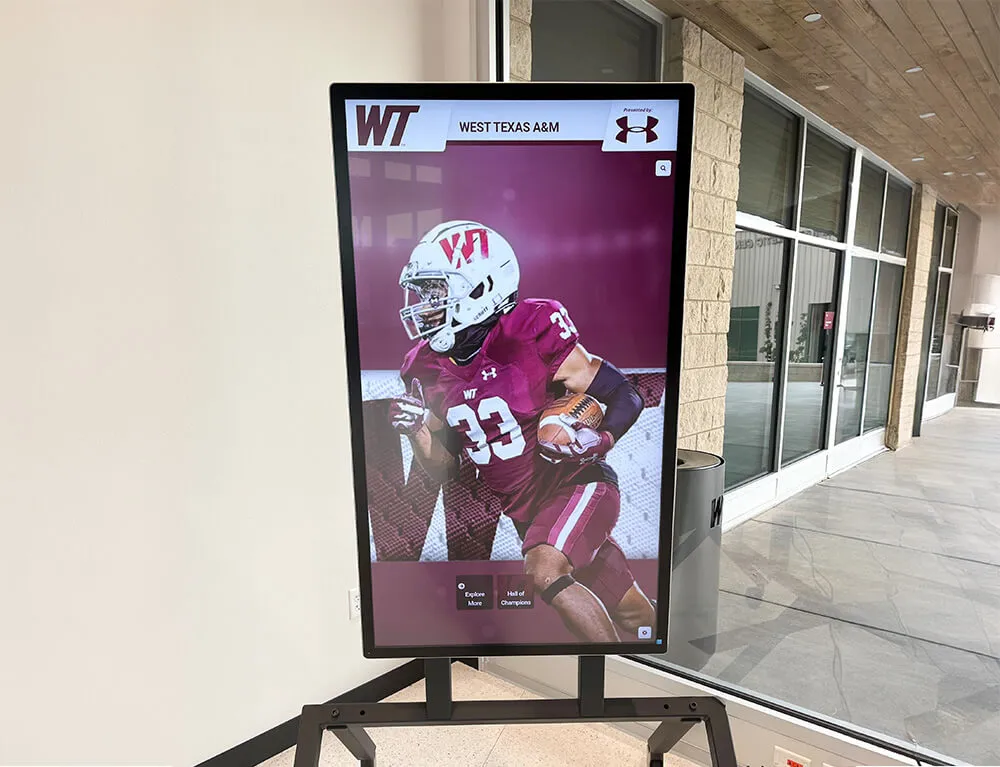
Interactive hall of fame kiosks display individual athlete spotlights, making it easy for visitors to browse profiles across sports, years, and achievement categories
The Core Athlete Spotlight Template: Every Field Schools Should Include
The following fields represent the complete athlete spotlight template. Not every field will appear in every publication context—some are essential for archival accuracy but unnecessary in a printed program—so each field is labeled with where it is most critical.
Section 1: Identity and Contact Information
These fields establish who the athlete is and when they were part of your program.
Full Legal Name Use the athlete’s full name exactly as it appears in school records. Include any preferred name or nickname in parentheses if the athlete uses one publicly. Consistent name formatting prevents duplicate records when the same athlete appears across different recognition contexts over the years.
Graduation Year (or Class Year) The single most important archival field. Graduation year anchors every other piece of information in time and is the primary filter users apply when searching historical records. Never omit it.
Sport(s) List every varsity sport the athlete participated in during their career, not just their primary sport. Multi-sport athletes are frequently under-documented because profiles default to a single sport.
Position / Event / Role For team sports, include the position played. For individual sports like track, swimming, or wrestling, include the specific event or weight class. For cross-country or golf, note any specialty (e.g., team captain, lead-off runner) if applicable.
Academic Department or Enrollment Details (archival, optional) Noting the athlete’s academic focus—honors, vocational track, or specific program—connects athletic achievement to the whole student and becomes valuable context in long-term archives.
Section 2: Athletic Achievement Records
These fields document what the athlete accomplished—the measurable record that makes the profile authoritative.
Career Statistics The most-referenced section of any athlete spotlight. Include season-by-season statistics for each year of varsity participation, not just the final season. For each season, record:
- Season record (team wins/losses or equivalent)
- Individual statistics relevant to the sport (points per game, batting average, goals, times, distances)
- Honors earned that season (all-conference, all-state, MVP, team captain)
Schools documenting career statistics accurately create the foundation for student athlete high honors recognition profiles that can be published across platforms without additional research.
School Records Held Note any all-time school records set or tied. Include the category, the record value, and the season it was set. These records deserve prominent display and should be tracked separately from season statistics. When a new athlete breaks an old record, the previous holder’s profile should note that their record stood for X years—this historical context adds depth to both profiles.
Team Championships List conference, district, regional, and state championship seasons in which the athlete participated. Include the team’s final record or placement. Championship participation is often the most emotionally resonant section of an archive profile.
All-State, All-American, and Special Recognition List every external honor the athlete received: all-conference, all-state, all-American, academic all-state, regional player of the year, or newspaper recognition. Include the conferring organization and the year for each award.
Section 3: The Athlete’s Story
Statistics tell what happened. This section tells why it mattered.
Coach’s Comment or Quote A brief statement from the head coach—or the coach who had the most significant relationship with this athlete—transforms a statistical profile into a human story. Even one sentence carries enormous weight. Collect these at season end while memories are fresh; retroactive coach quotes for alumni profiles often require more effort to gather but are worth pursuing.
Personal Statement or Athlete Quote (optional for current athletes, valuable for archives) A brief statement from the athlete themselves—what the sport meant to them, what they learned, what they’re proud of—becomes the most personal element of any profile. Current athletes can provide this at season end; alumni can be invited to contribute via email or social media outreach during hall of fame nomination processes.
Significant Moments or Milestones Note any specific game, meet, match, or event that defined the athlete’s career—a game-winning performance, a come-from-behind season, a record broken in the final event. These narrative anchors make the profile memorable and give readers a story to carry away.
Life After School (for alumni profiles) For hall of fame profiles and long-term archives, documenting what the athlete did after graduation adds dimension. College sport participation, professional careers, community service, and career achievements all reflect well on the program that produced them. Digital hall of fame inductee profiles increasingly include post-graduation achievements as standard sections because they demonstrate the lasting value of athletic participation.
Section 4: Photography and Visual Assets
A profile without a photograph is incomplete. Visual identity is what makes an athlete spotlight feel personal rather than bureaucratic.
Primary Portrait Photo A clear, high-resolution headshot or portrait in school athletic gear. Specifications to standardize across all profiles:
- Minimum resolution: 300 DPI for print; 72 DPI at display size for digital
- Consistent background (solid color, school backdrop, or playing surface)
- Consistent framing (head and shoulders, or three-quarter body)
- File format: JPEG or PNG saved at original resolution; do not crop at capture
Action Photo (recommended) One in-game or in-competition photograph showing the athlete in their element. Action photos are especially valuable for digital displays and touchscreen hall of fame profiles where users expect visual storytelling.
Team Photo Reference Note the year and context (varsity basketball 2024–25) so that team photos stored in the school archive can be linked to the individual profile. This cross-referencing becomes important in searchable digital systems.
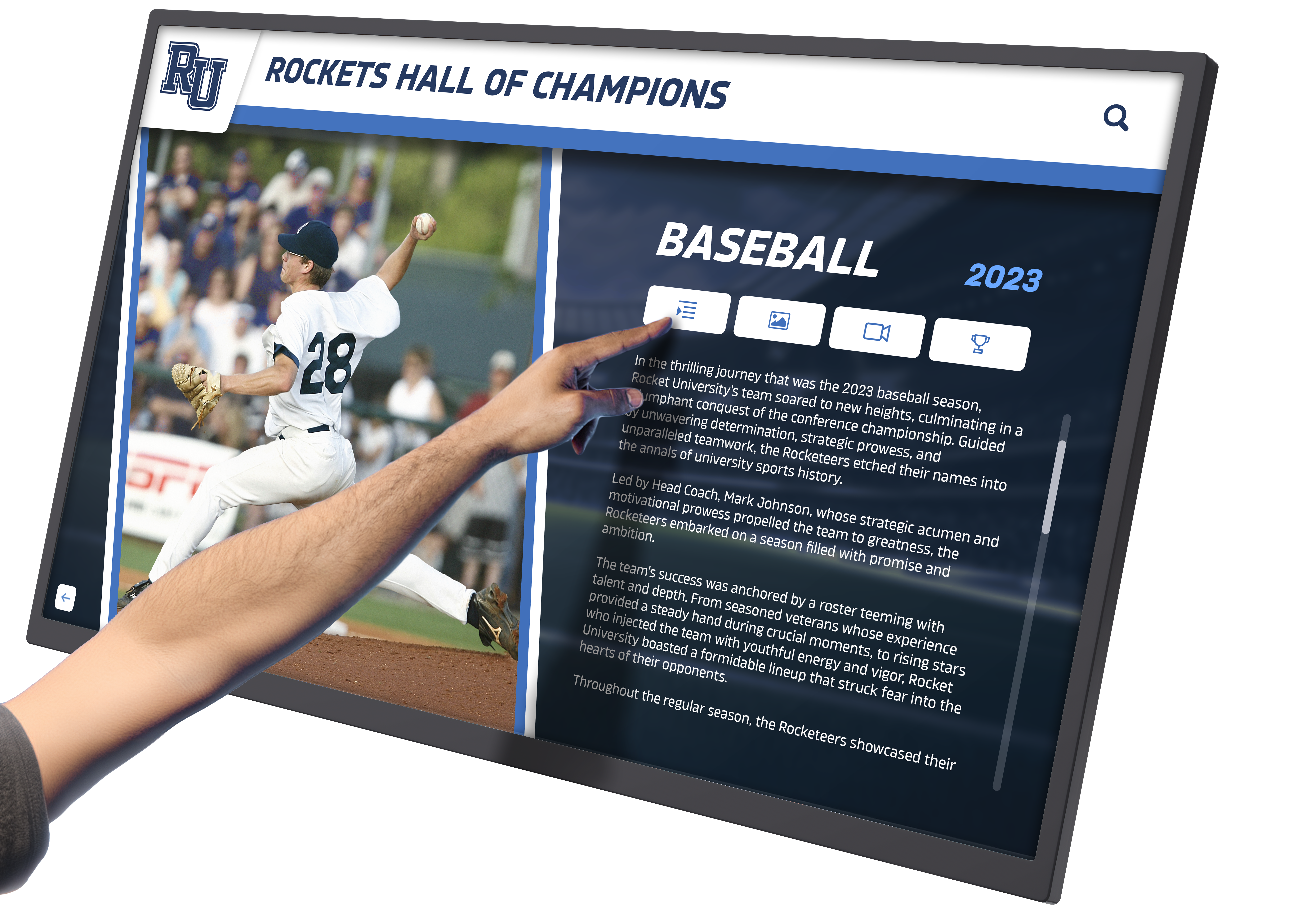
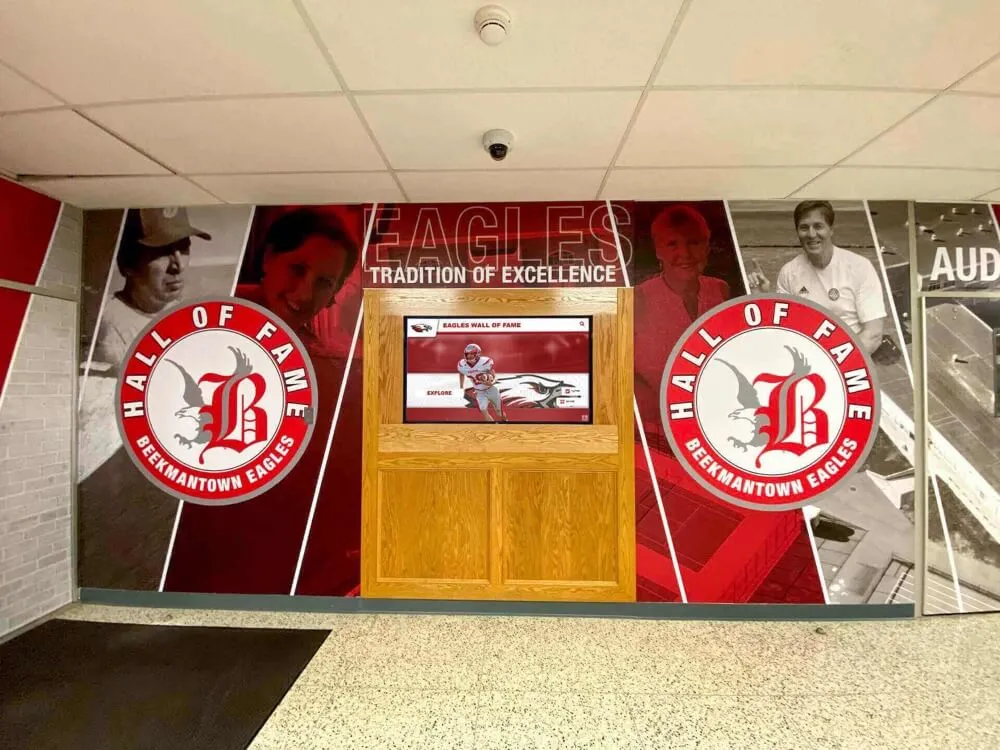
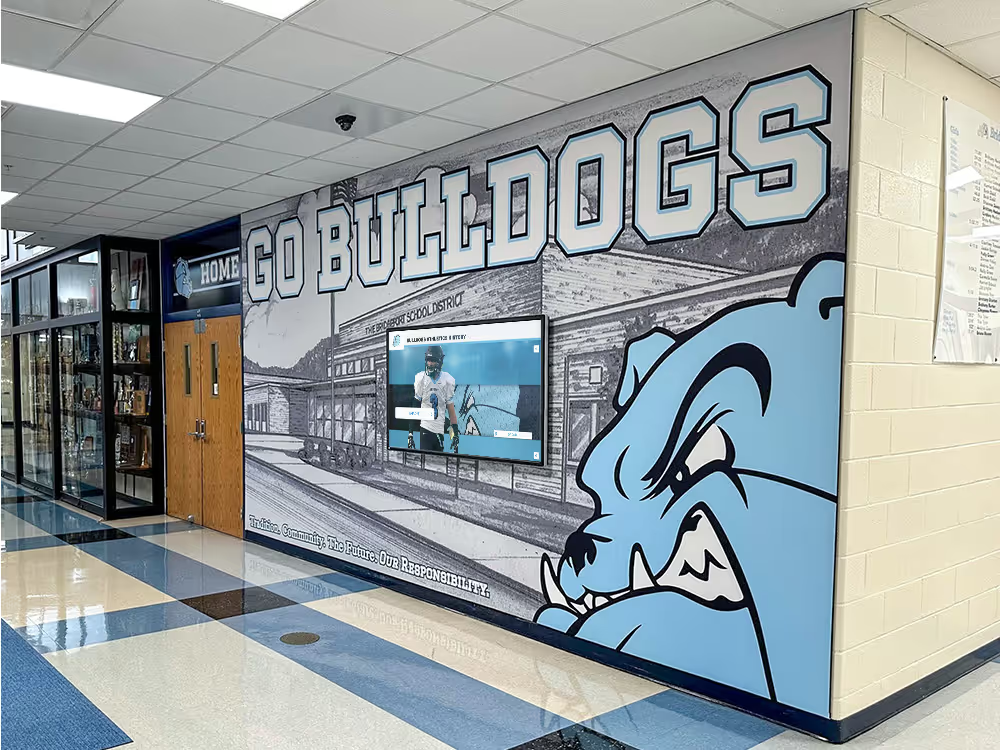
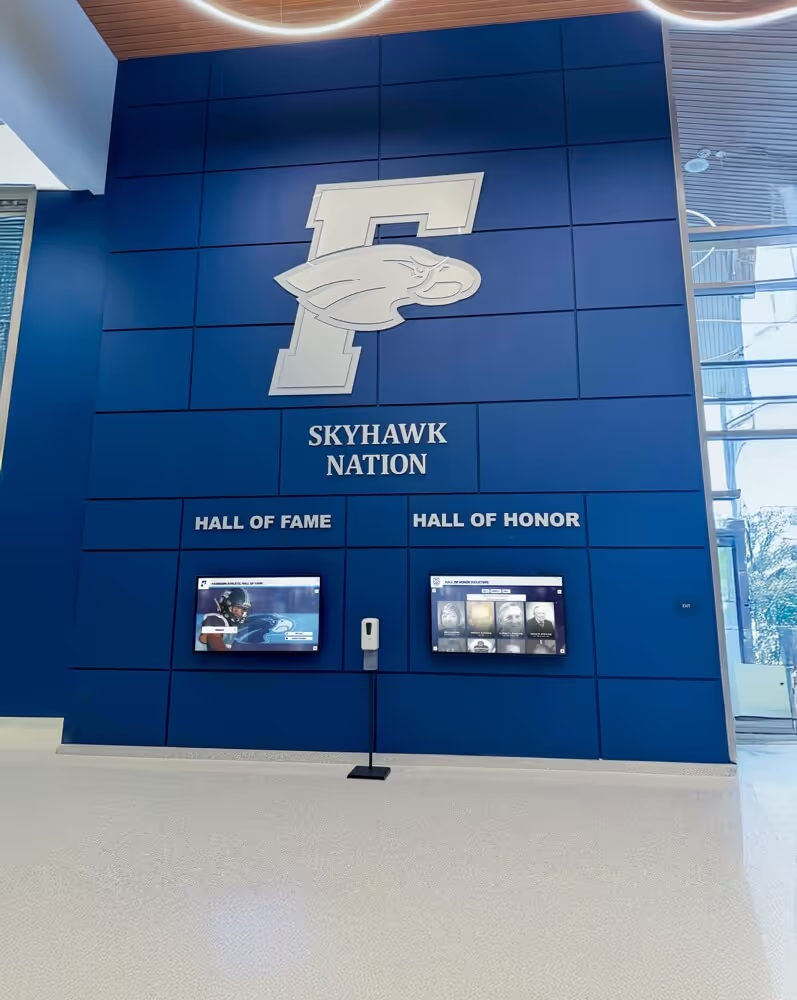
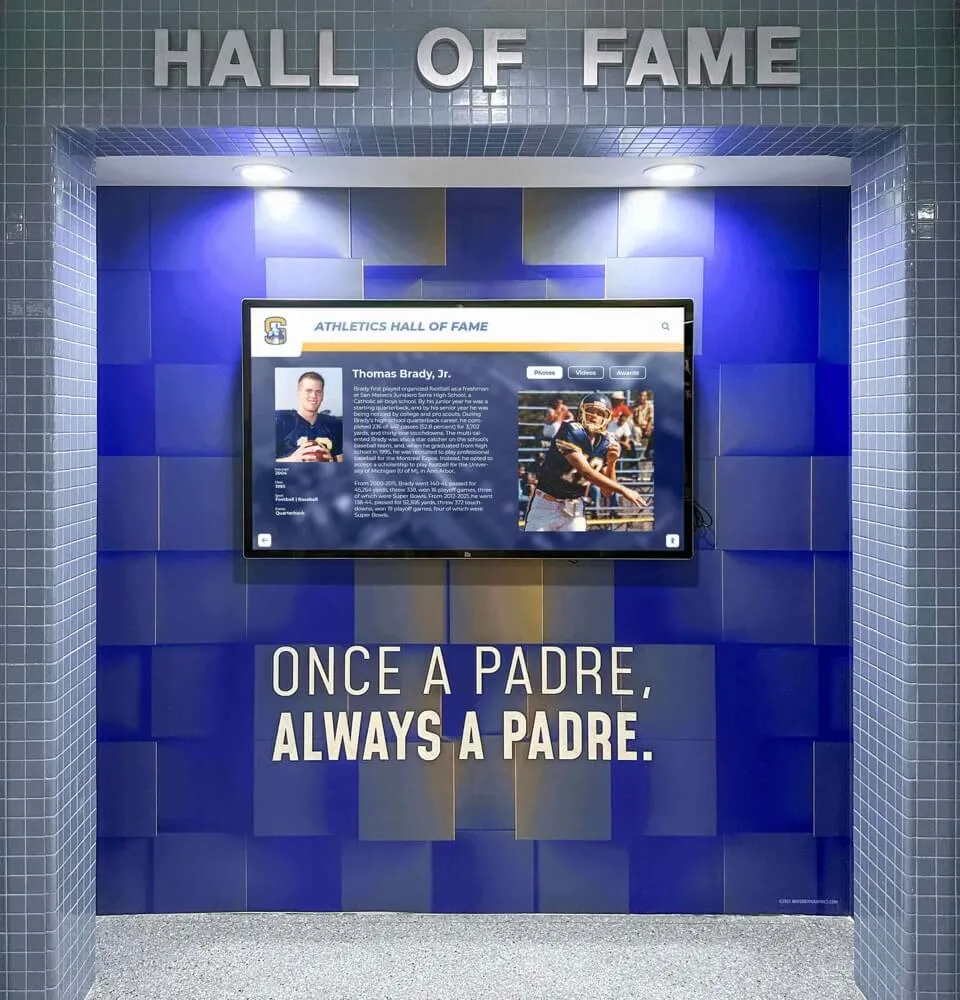
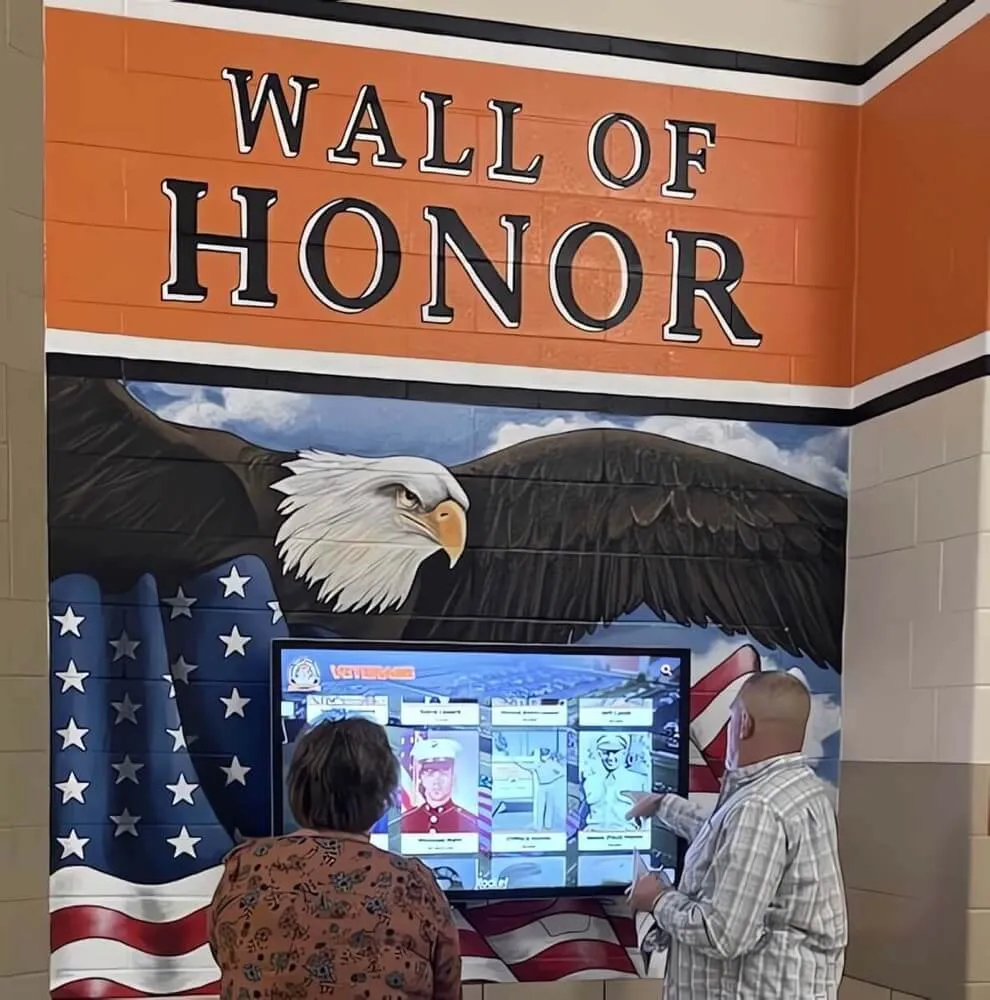
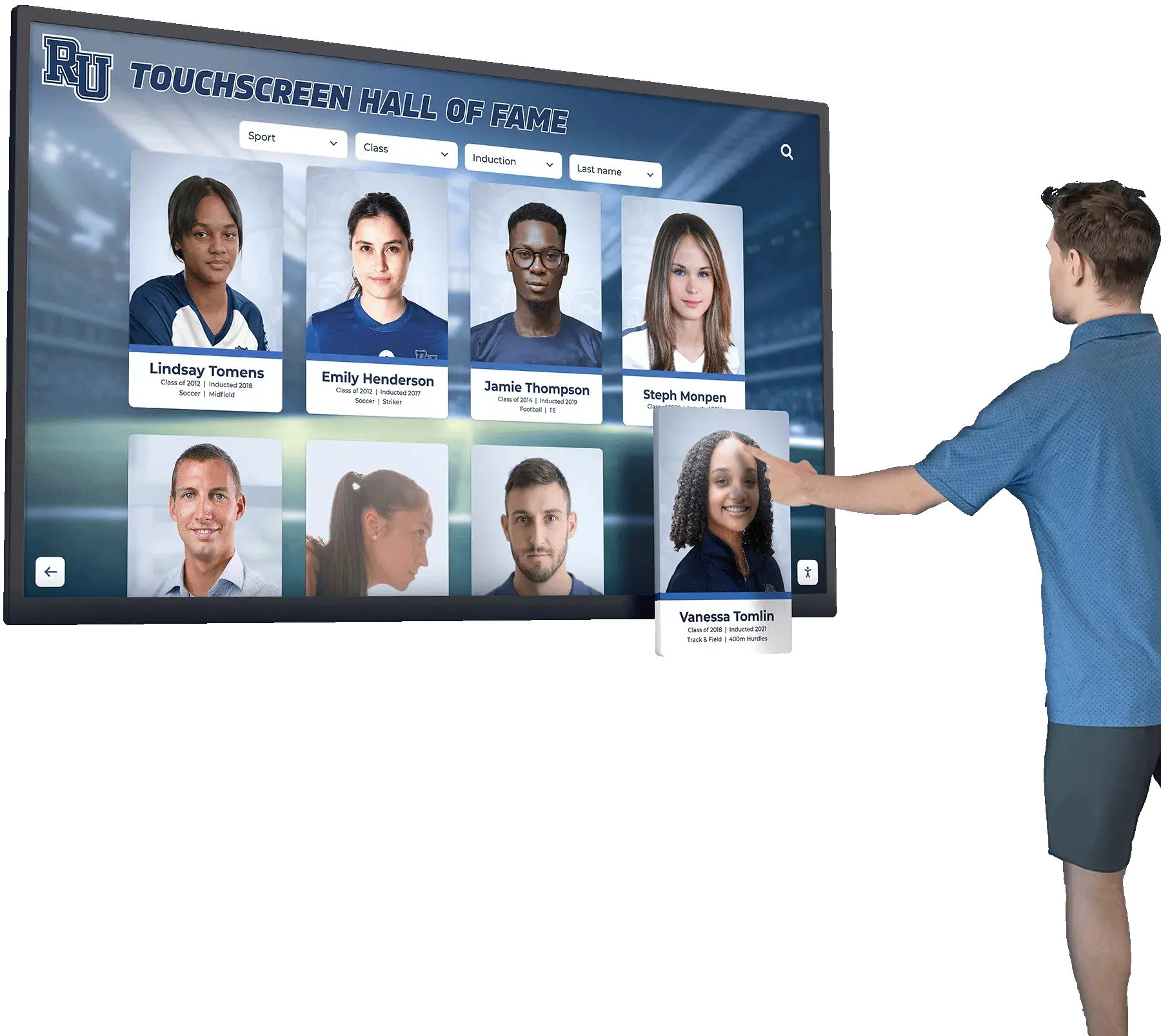
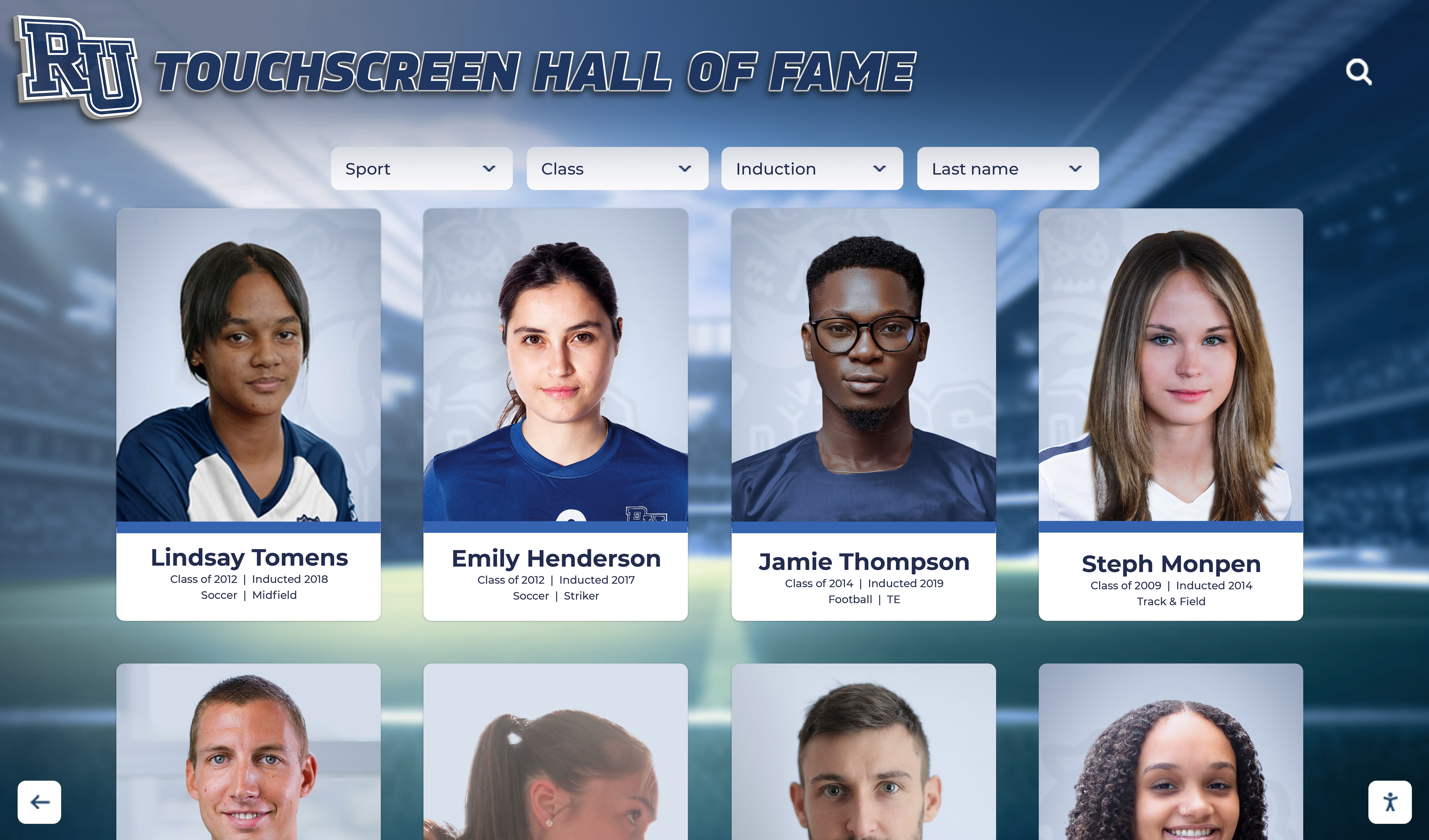
Rich athlete spotlight profiles on touchscreen displays combine portrait photography, career statistics, and coach commentary to create complete recognition experiences
A Note on Photo Rights and Privacy
For current student-athletes, photo release consent should be collected as part of the annual athletic paperwork process—not retroactively when a profile is being assembled. For alumni profiles, reaching out through alumni networks, social media, or direct contact to obtain or confirm photo permissions is standard practice.
Schools building long-term digital archives should store original high-resolution images in a dedicated archive folder separate from web-optimized versions. Archive copies preserve quality for future use cases—reprinting, display upgrades, anniversary publications—that current display needs do not require.
Section 5: Program and Archive Metadata
These fields serve the people managing the records rather than the people reading the profiles. They are invisible in public displays but essential for maintaining a usable archive.
Record Created Date When was this profile first entered? This helps identify records that may need refreshing and distinguishes original entries from retroactively added ones.
Last Updated Date Archives are living records. Post-graduation achievements, hall of fame inductions, and corrections should all be timestamped.
Source Verification Notes Where did the statistics come from? Coach-provided data, official state athletic association records, and yearbook entries are all valid sources—but knowing the source allows future staff to evaluate the reliability of the information and follow up if discrepancies appear.
Display Context Tags Tag each profile with where it appears: yearbook, hall of fame display, website, lobby touchscreen, banquet program. This metadata prevents confusion when profiles are updated—changes need to propagate to every context where the profile appears.
Adapting the Template for Different Recognition Contexts
The same underlying template feeds different outputs depending on how it is used. Understanding these adaptations helps schools design data collection that captures everything needed for all contexts at once.
Yearbook and Season Publication Profiles
For yearbook and printed program contexts, the athlete spotlight template typically reduces to:
- Name, sport, position, graduating class
- Season highlights and key statistics
- Portrait photo
- Coach quote (one to two sentences)
- One action photo
The brevity is intentional—print space is limited and readers scan rather than read in depth. The key is that the full template was collected and the condensed version was derived from it, not that the condensed version is all that was gathered.
Digital Display and Touchscreen Profiles
Digital displays can present far more information than print, and users interact with them by choice—every person browsing a touchscreen hall of fame profile is actively interested in what they are reading. For this context, include:
- Complete career statistics and season-by-season records
- All external honors and recognitions
- Multiple photographs (portrait plus action)
- Full coach commentary
- Personal statement or athlete quote
- Significant moments and milestones
All-state athlete recognition digital displays demonstrate how the richer profile format translates to more meaningful recognition when displayed on interactive screens in school lobbies and gymnasiums.
Hall of Fame Induction Profiles
Hall of fame profiles are the most complete expression of the athlete spotlight template. In addition to everything above, they typically add:
- Nomination committee citation or induction rationale
- Post-graduation career and life achievements
- Impact on the school’s athletic program
- Connections to other honorees (team members, coached by the same coach)
- Video content if available (highlight clips, induction ceremony remarks)
These profiles are designed to last indefinitely—a hall of fame inductee’s profile should remain meaningful and complete fifty years after induction. Invest in completeness at the time of induction rather than planning to add detail later.
Archive Profiles for Historical Athletes
Retroactive profiles for athletes who competed before systematic record-keeping existed require a modified approach. Complete career statistics may not be available. The template should note what is known, flag what is uncertain, and identify potential sources for future verification rather than leaving fields blank or filling them with guesses.
Common sources for historical athlete data include:
- School yearbooks (digitized or physical)
- Athletic department scrapbooks and program archives
- Local newspaper archives
- Booster club records and banquet programs
- Alumni self-reporting through outreach campaigns
School picture wall ideas and digital archives include guidance on converting physical historical records into the kind of digital profiles that can be displayed and searched alongside current-season data.
Building a Collection System Around the Template
A template is only useful if the data actually gets collected. Most athletic departments struggle not with knowing what to include but with having a reliable process for gathering information from coaches, athletes, and families at the right time.
The Season-End Collection Window
The optimal time to collect athlete spotlight information is immediately after the competitive season ends—when memories are fresh, coaches are reflecting on the season, and athletes are emotionally engaged with what they just accomplished. Waiting until the following fall for yearbook production, or until a hall of fame nomination years later, means relying on memories that have faded and records that may have been misplaced.
Build a season-end collection form that coaches and athletes can complete within two weeks of the final competition. The form should map directly to the athlete spotlight template fields so data entry is a straightforward transfer rather than a translation exercise.
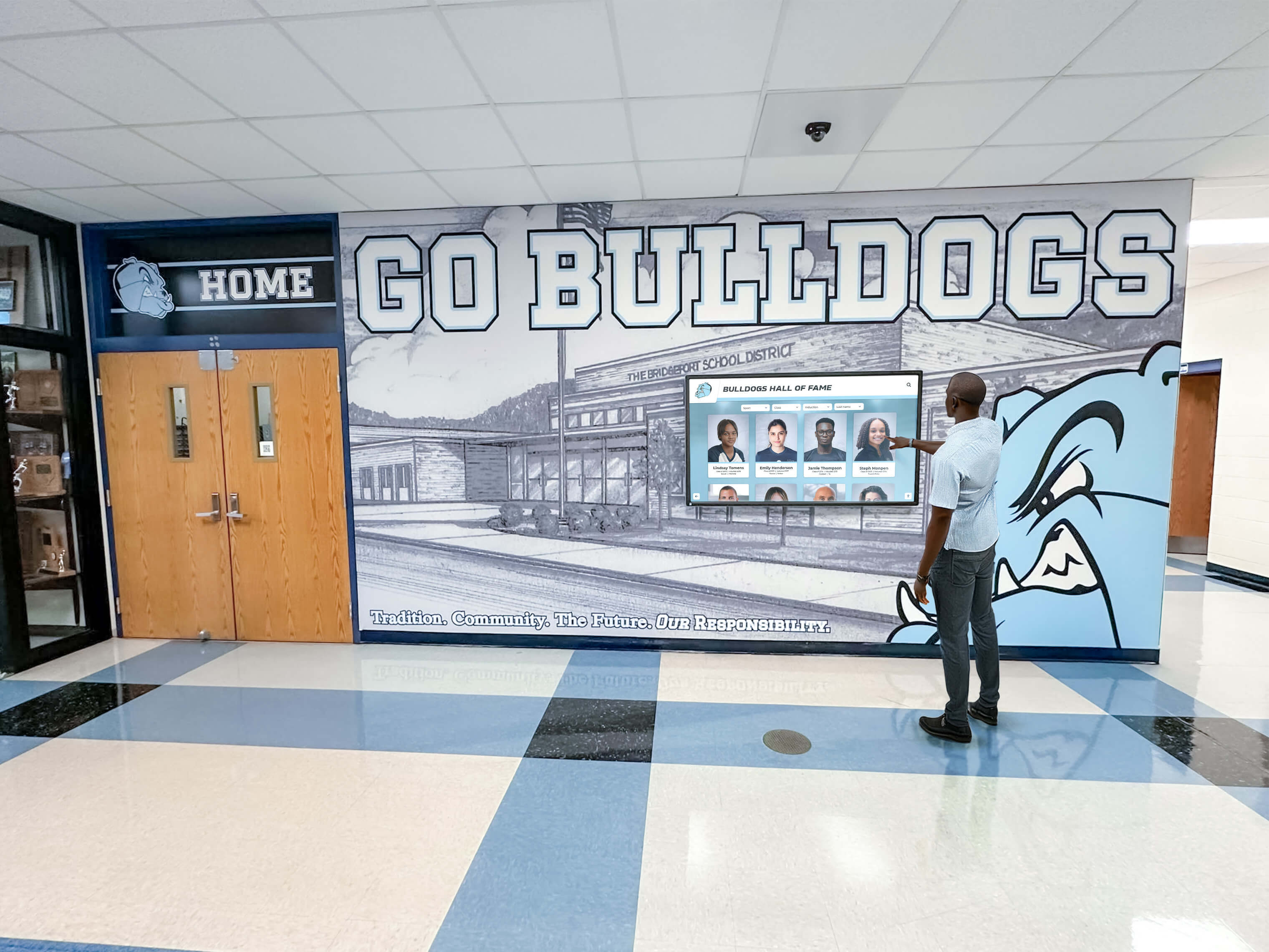
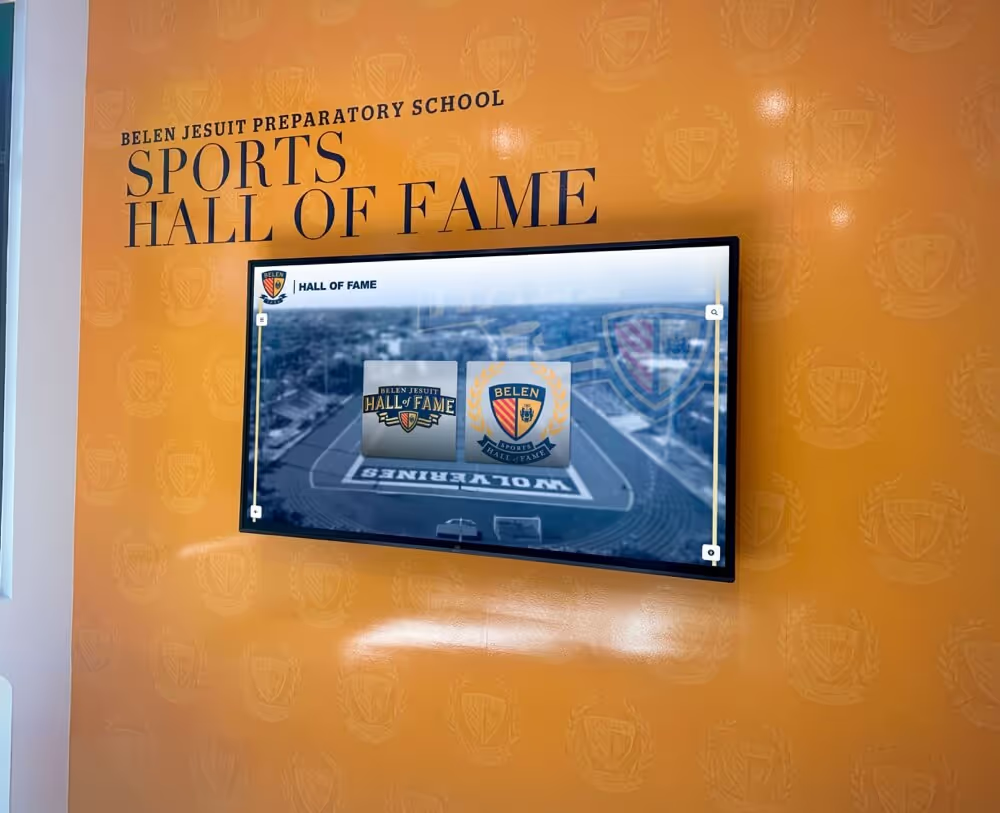
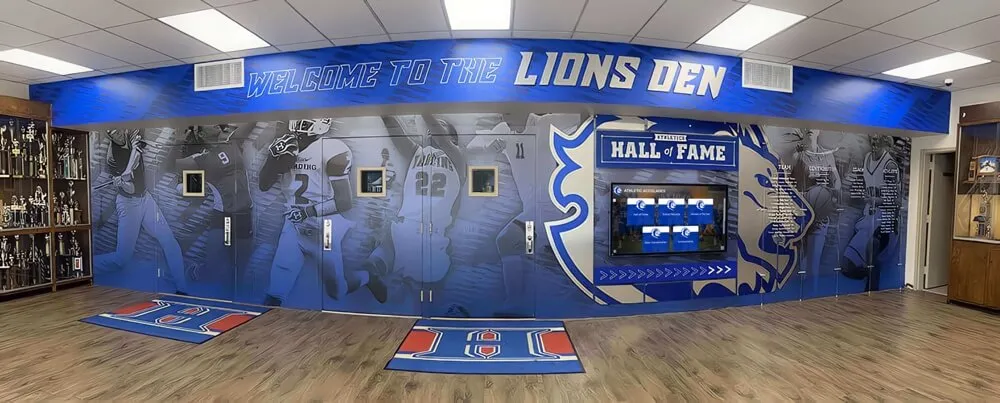
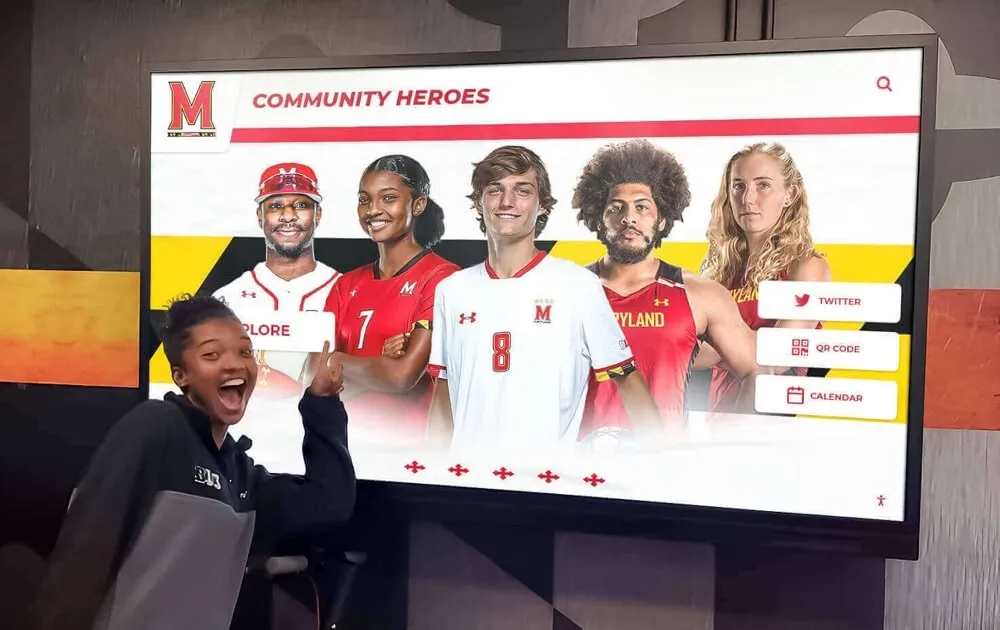
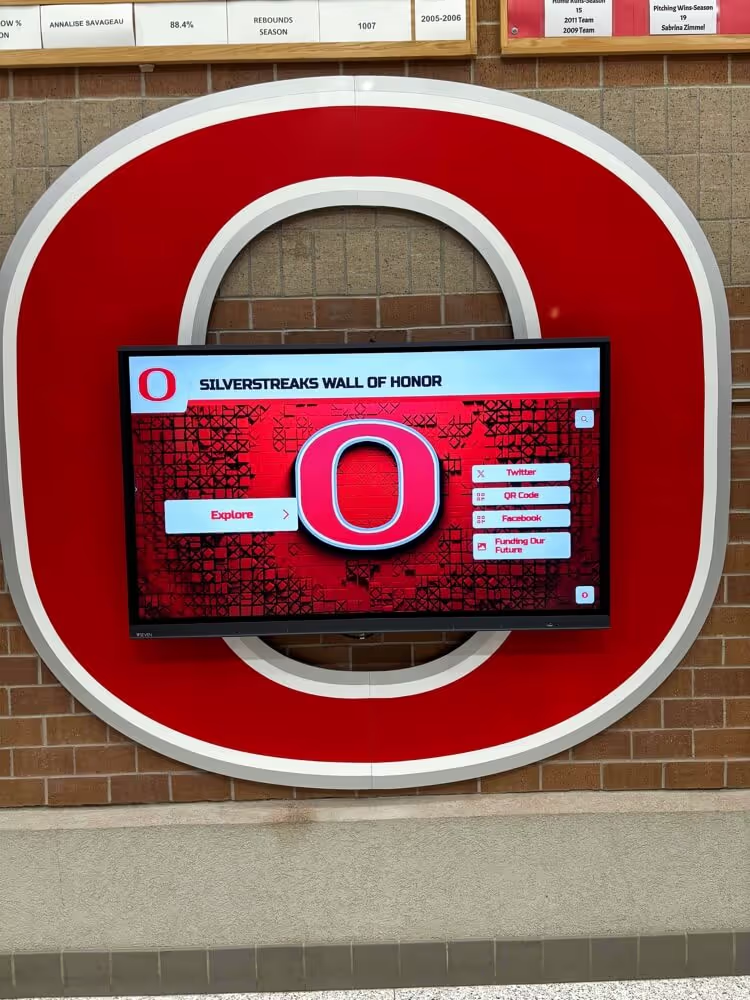
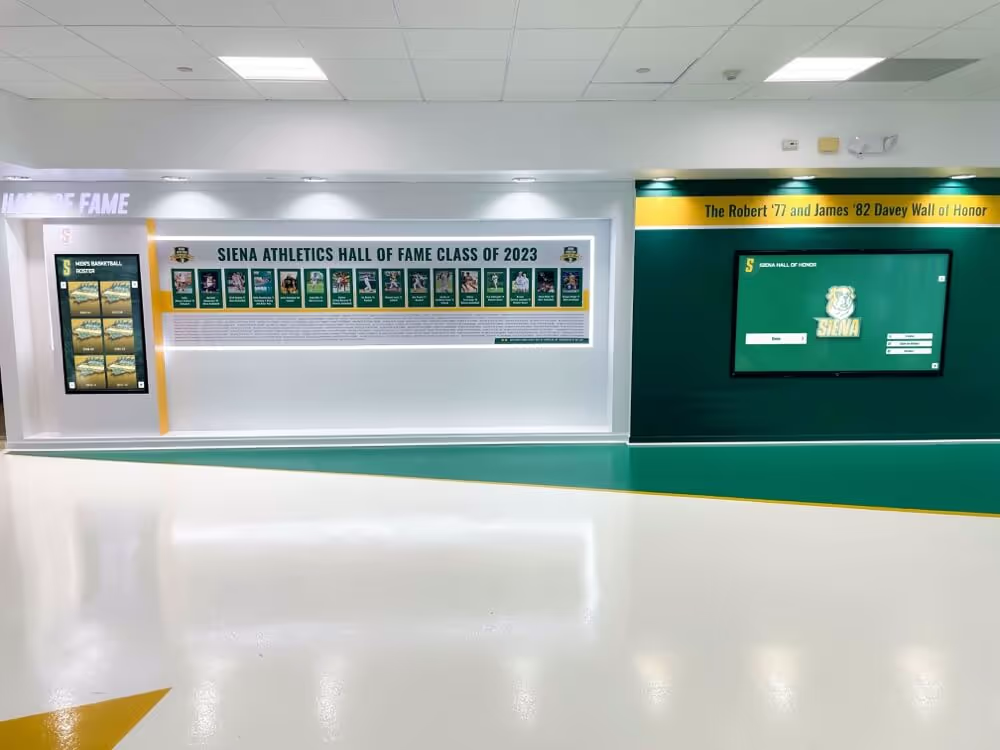
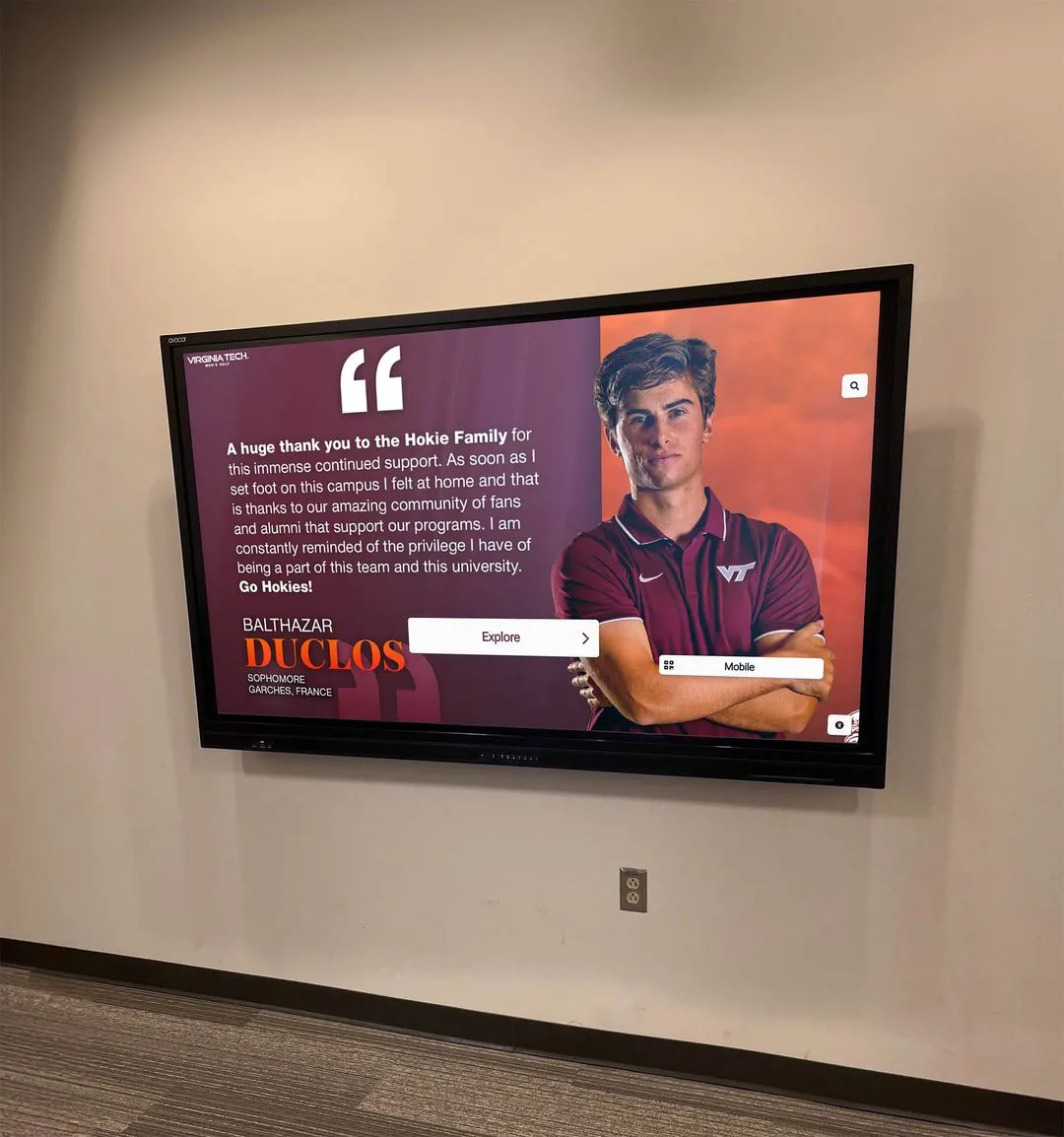
Well-documented athlete spotlight profiles give every visitor to a school's recognition display a complete and engaging story to explore
Roles and Responsibilities
Ambiguity about who is responsible for collecting profile information is the most common reason templates go unfilled. Assign specific responsibilities clearly:
Athletic Director — Owns the master template, sets collection deadlines, and is accountable for archive completeness across all sports.
Head Coaches — Responsible for coach quotes, career statistics verification, and any special recognition notes for their sport. Should submit within the collection window.
Yearbook or Communications Staff — Responsible for photo collection, layout, and publication contexts. Should coordinate with athletic department rather than duplicate data collection efforts.
Team Captains or Student Liaisons — Can facilitate athlete personal statements and help connect coaches with athletes who have moved on to college or careers.
Alumni Outreach for Historical Profiles
For schools building archives that reach back multiple decades, alumni outreach campaigns are often the most productive source of missing information. A well-designed outreach message—sent through alumni networks, social media, and booster club communications—can recover hundreds of profiles that administrative records alone could not reconstruct.
Alumni portal website content for schools provides additional guidance on how athletic achievement content fits within broader alumni engagement strategy.
Displaying Athlete Spotlights Across Your School
Collecting strong profiles is only half the equation. The other half is making them visible in contexts where they create impact—where current students see what their predecessors accomplished, where alumni return and find themselves recognized, and where families understand the full scope of the school’s athletic tradition.
Hallway and Lobby Displays
Physical hallway displays—whether printed photograph galleries, vinyl portrait walls, or framed showcase boards—create constant ambient recognition. Every student who walks past a wall of athlete spotlights is reminded that athletic achievement is valued and visible at this school.
Digital displays in lobbies and hallways take this further, allowing the same wall space to present rotating athlete spotlights, searchable archives, and interactive browsing that physical prints cannot support. A visitor who spent one season at the school twenty years ago can find their profile in seconds.
Digital Trophy Cases and Interactive Kiosks
Trophy cases are often the most underutilized recognition real estate in a school building. Traditional trophy cases display physical objects but rarely tell the stories behind them—who scored the winning goal, which team broke the school’s longest championship drought, which athlete’s record has stood for three decades.
Interactive kiosk systems integrated into or adjacent to trophy cases convert this passive display space into active recognition. Athlete spotlight profiles linked to specific trophies, championships, and records give every object in the case a narrative.
Schools using interactive digital trophy cases find that athlete spotlights become the most-browsed content category, consistently outpacing team records and school history in user interaction data. Student athlete high honors recognition profiles on touchscreen systems demonstrate the depth of engagement schools see when profiles are complete and well-organized.
School Websites and Digital Publications
Athlete spotlight profiles that live only in physical spaces miss the majority of the audience—alumni who live elsewhere, families who cannot visit campus, community members who follow the school’s athletic programs online. Publishing profiles to the school website or a dedicated athletic recognition portal makes the archive universally accessible.
A ten-year class reunion is one of the most powerful moments for alumni reconnection—and athletic achievement profiles are consistently among the most-discussed content when classes gather. Schools that have maintained strong digital archives create meaningful engagement opportunities that less systematic programs cannot replicate. For context on how athletic recognition content supports broader alumni events, 10-year reunion programming ideas with digital displays provides useful framing.
Connecting Athlete Spotlights to Broader Recognition Programs
The athlete spotlight template does not exist in isolation. It is one component of a broader recognition ecosystem, and schools that think about how these elements connect create programs that are greater than the sum of their parts.
Halls of Fame
The athlete spotlight archive is the farm system for the athletic hall of fame. Every athlete documented in the archive is a potential future inductee, and the completeness of their profile determines how meaningful their induction will be. Schools with strong archives produce hall of fame inductions that feel fully honored; schools with weak archives produce inductees who receive minimal documentation because the information was never collected.
Building the athlete spotlight archive systematically means that when a nomination committee reviews candidates ten or twenty years from now, they will have access to complete career records rather than fragments.
Record Boards
Digital and physical record boards are natural complements to athlete spotlight profiles. When a record board lists the all-time scoring leader, the athlete spotlight template should connect directly to a complete profile for that individual. This creates a recognition experience where achievement is documented at multiple levels of depth—the record board provides the quick reference, the spotlight profile provides the story.
All-state athlete recognition through digital displays shows how schools are connecting these recognition layers in practical implementations.
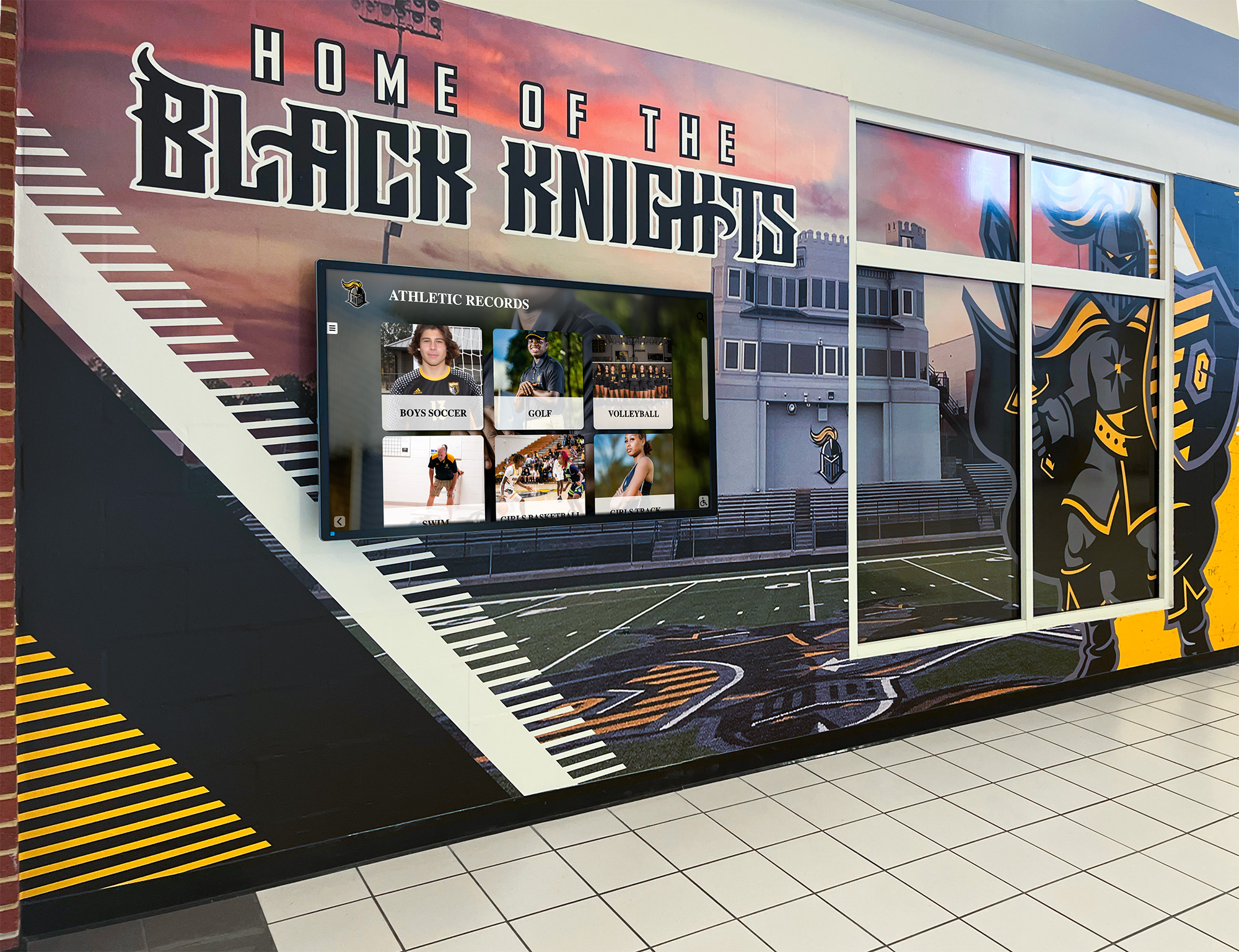
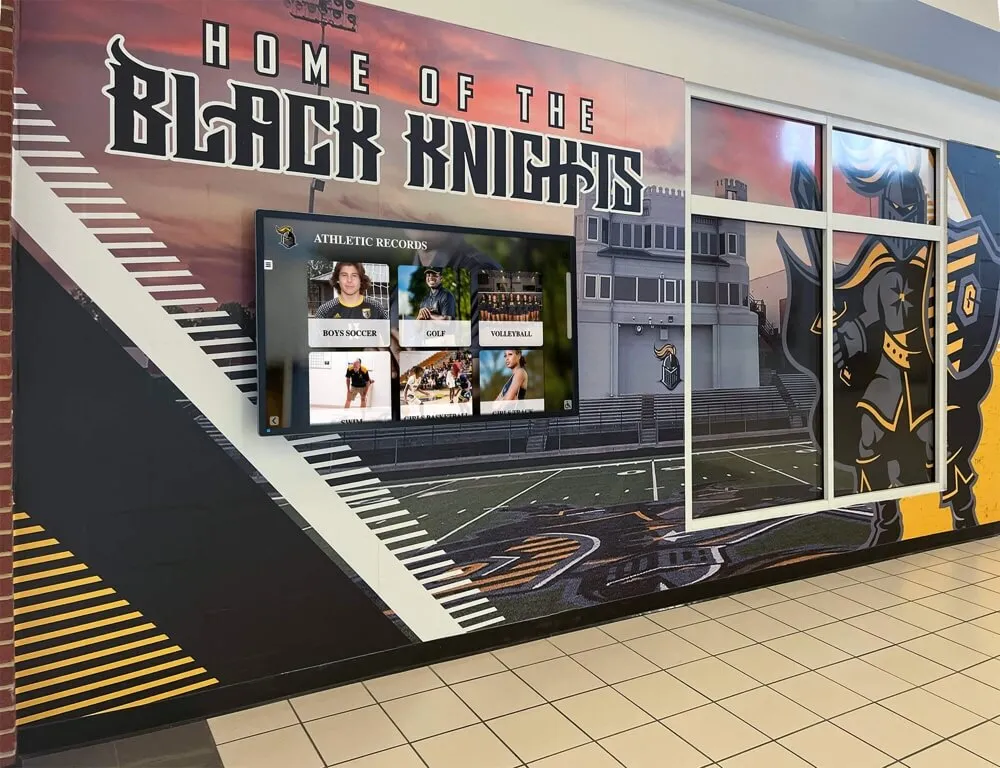
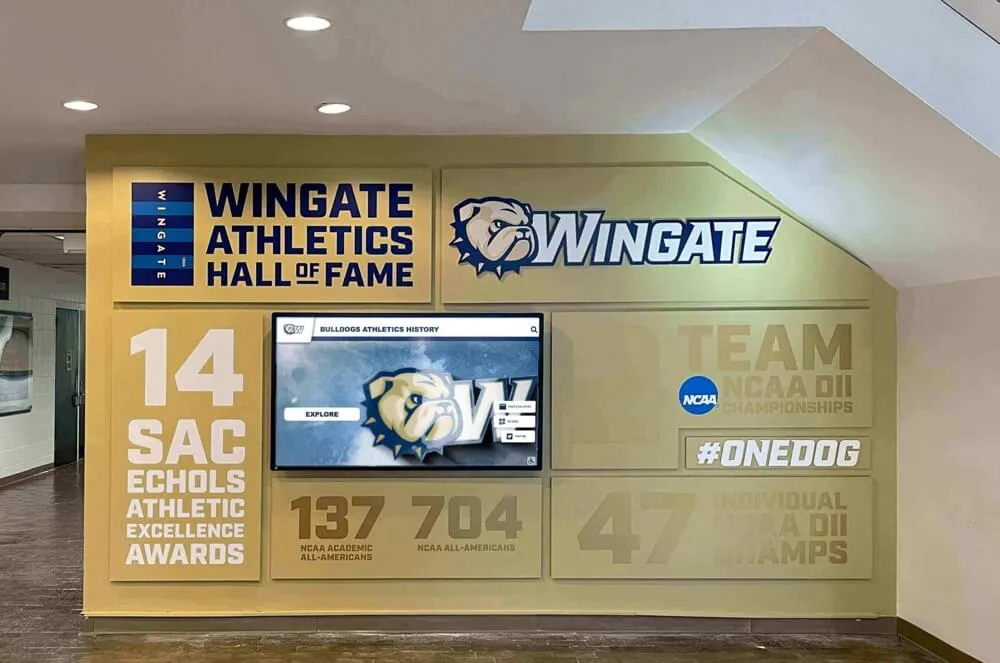
Digital athletic record displays connect naturally to the athlete spotlight archive, giving every record a complete human story behind the number
Academic Recognition Integration
Athletic achievement does not happen in isolation from academic life. Schools that integrate athlete spotlight documentation with academic recognition programs—honor roll, academic all-state, National Honor Society—create holistic profiles that represent the complete student rather than one dimension of their experience.
This integration also serves equity goals: a student-athlete who earns academic all-state in addition to athletic all-conference has a richer story to tell, and the recognition program that surfaces both achievements is the one that fully honors that person’s contributions.
Community Heroes and Donor Recognition
Many schools recognize coaches, boosters, and community supporters alongside athletes. The athlete spotlight template framework—consistent fields, professional photography standards, narrative sections—applies equally to coach profiles, booster recognition, and donor acknowledgment. Schools that use consistent recognition frameworks across categories produce more coherent, professional-looking recognition programs overall.
Student athlete high honors recognition profiles demonstrate how athletic recognition frameworks can be extended to serve broader community recognition goals.
Frequently Asked Questions About Athlete Spotlight Templates
How long should an athlete spotlight profile be?
Length depends on context. For yearbook and print publication, aim for 100–200 words of narrative alongside the statistical section—enough to tell the story without overwhelming the layout. For digital and touchscreen profiles, 300–500 words is appropriate because users self-select to read more. For hall of fame induction profiles, there is no meaningful upper limit—a complete and rich narrative serves the inductee better than artificial brevity.
Should every athlete get a spotlight profile, or only standout performers?
Every varsity athlete deserves a basic profile capturing their identity, sport, position, graduation year, and seasonal statistics. Reserve the extended narrative treatment—coach quotes, personal statements, significant moments—for recognition contexts where depth is appropriate: hall of fame profiles, annual all-sport award recipients, and senior recognition programs. The basic template should capture everyone; the extended template serves the highest-recognition contexts.
How do we handle privacy for student-athlete profiles?
For current students, include profile publication in your annual athletic participation consent forms. Obtain separate consent for any profile that will be published publicly (website, social media) versus internally (yearbook, school lobby display). For alumni profiles, direct outreach to request permission before publishing—especially for any profiles that include personal statements, extended biography, or content beyond basic competitive records. Store consent documentation with the profile record.
What should we do when records are missing or uncertain?
Mark uncertain fields clearly rather than guessing. Note the source for each statistical entry, and flag records that could not be verified against primary sources. A profile that is honest about its gaps is more trustworthy—and more useful for future researchers—than one that fills gaps with estimates. Schools often find that publishing a partial profile with a note inviting alumni to contribute corrections is the most effective way to recover missing information.
Can one athlete spotlight template really work for the yearbook, the touchscreen display, and the hall of fame?
Yes—with the understanding that the template defines the complete dataset, not the complete publication. Different contexts publish different subsets of the same profile. The yearbook might show 30% of the template fields; the touchscreen might show 70%; the hall of fame profile might show 100% plus additional sections specific to induction context. Designing the template for the most complete context ensures every other context has what it needs.
How Rocket Alumni Solutions Supports Athlete Spotlight Programs
Rocket Alumni Solutions builds interactive touchscreen walls of fame, digital trophy cases, athletic record boards, and school archive systems designed specifically to display the kind of rich athlete spotlight profiles described in this guide. Their systems are built to accept the full athlete spotlight template—career statistics, photography, coach commentary, personal statements, and post-graduation achievements—and present them in browseable, searchable formats accessible to students, families, and alumni.
For schools that have been collecting athletic records in spreadsheets, filing cabinets, or disconnected databases, Rocket’s implementation team helps convert that existing data into the structured profiles their display systems require. For schools starting fresh, the template framework described in this guide maps directly to how Rocket systems store and display athlete information.
Build an Athlete Spotlight Archive That Lasts
Your school’s athletes deserve profiles that honor the full scope of what they accomplished—not just a name on a roster. Rocket Alumni Solutions builds interactive display systems that bring athlete spotlight templates to life on touchscreen walls of fame, digital trophy cases, and lobby recognition displays.
Request a demo at Rocket Alumni Solutions to see how schools are building athlete spotlight archives that serve every recognition context—from the current season’s yearbook to hall of fame inductions decades from now.
A consistent athlete spotlight template is not a bureaucratic requirement. It is a commitment to honoring the students who chose your program, competed under your colors, and built your school’s athletic tradition. Every field collected, every photograph archived, every coach quote preserved is a brick in the foundation of an athletic legacy that inspires the next generation. The work of building that foundation belongs to everyone in the athletic community—and the template is where that work begins.